7 Pressure Pots That Clear Bubbles From Cast Resin
California Air Tools’ 365 tops this list for consistent clamping and a straightforward paint-to-resin conversion. TCP Global’s 2.5 gallon tank offers the cheapest reliable entry point for beginners. Astro Pneumatic’s 4550 suits casters who open their pot daily and need clamps that resist wear.
Clear resin needs steady pressure, not a fancier resin formula. California Air Tools’ 365 tank handles that job for most home casters, backed by TCP Global’s cheaper tank and Astro Pneumatic’s tougher clamp system. Projects taller than a coaster or pen blank usually call for a 5 gallon tank instead of the common 2.5 gallon body.
Nearly every tank sold under this search term started life as paint equipment, so listings describe fluid outlets and spray guns rather than curing resin. That mismatch between what sellers write and what casters search for makes comparison shopping harder than it should be. We compared tank capacity, working pressure rating, clamp design, gauge quality, usable internal height and how much conversion work each tank demands, then ranked seven pots on resin-casting fit.
What we recommend

California Air Tools 365 2.5 Gallon Paint Pressure Pot
Resin casters recommend this tank more than any rival, largely because its build quality beats generic imports. A 2.5 gallon body fits small to medium moulds without hogging bench space. Owners report the clamps seat evenly, which stops the slow overnight pressure loss that plagues cheaper tanks.
Pros
- Clamps hold pressure through a full overnight cure
- Conversion from paint feed to resin use is quick
- Compact enough for a standard workbench
Cons
- Paint fittings must be removed before first use
- 2.5 gallon capacity limits mould size

TCP Global 2-1/2 Gallon Pressure Paint Pot Tank
TCP Global’s tank is where many casters start their first pressure setup. It holds steady pressure through a cure once the paint fittings are removed and plugged. A regulator and gauge come included, though the stock gauge is basic enough that owners often swap it for a finer one.
Pros
- Lower cost entry into pressure casting
- Regulator and gauge included in the box
- Conversion steps are widely documented online
Cons
- Stock pressure gauge lacks fine resolution
- Seal sometimes needs replacing before it holds fully
Astro Pneumatic Tool 4550 2-1/2 Gallon Pressure Pot
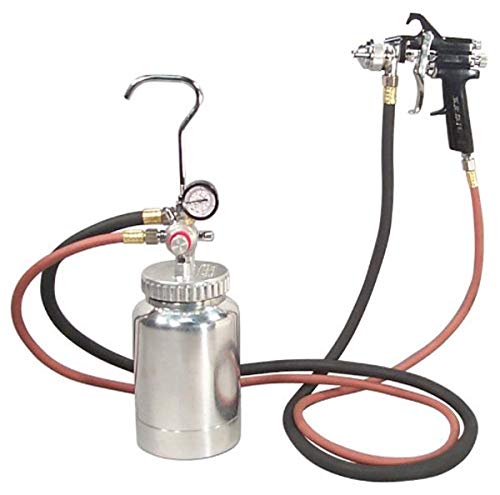
Astro Pneumatic builds this tank for professional paint shops, and that shows in the clamp arrangement. Daily opening wears out light clamps fast, which is where the heavier casting earns its keep. Capacity still matches most rivals at 2.5 gallons, according to the listing, just with a tougher closure.
Pros
- Clamp system withstands daily opening and closing
- Thick lid casting resists warping over time
- Comes from a brand trusted in trade shops
Cons
- Heavier to lift than budget-tier tanks
- Still needs paint hardware removed before casting use

California Air Tools 5 Gallon Paint Pressure Pot Tank
Stepping up from 2.5 to 5 gallons unlocks tall moulds and multi-piece batches, including river table offcuts. Fill time grows longer, and the tank draws more air per cycle. Owners report the extra internal height fixes the biggest complaint about smaller pots: not enough vertical room.
Pros
- Enough internal height for tall moulds
- Cures several small pieces in one cycle
- Matches the build quality of the smaller model
Cons
- Fills slowly without a larger compressor
- Takes up considerable bench or floor space

VEVOR 2.5 Gallon Pressure Paint Pot
VEVOR offers the cheapest route into pressure casting on this list. For occasional hobby projects it holds pressure well enough once set up correctly. Included seals and gauges are the weak point, and many buyers replace both within the first few sessions.
Pros
- Lowest cost way to try pressure casting
- Ships complete with hose fittings and gauge
- Adequate for occasional hobby projects
Cons
- Seal and gauge quality varies between units
- Clamps require careful, even tightening to seal

Titan 21993 2.5 Gallon Pressure Pot
Titan ships this tank with a clearer regulator and gauge than most budget options. Dialing in a precise pressure for a specific resin becomes easier as a result. Tank size follows the standard 2.5 gallon pattern, so the upgrade here is control, not capacity.
Pros
- Gauge makes setting exact pressure straightforward
- Safety relief valve fitted as standard
- Fewer upgrades needed right after purchase
Cons
- No capacity advantage over cheaper 2.5 gallon tanks
- Paint feed hardware still needs removing before use
Cal Hawk Tools 2-1/2 Gallon Paint Pressure Pot
Weight sets this tank apart from most steel rivals in its class. Moving it between a bench and a storage shelf between sessions is noticeably easier. Layout follows the familiar 2.5 gallon pattern with a clamped lid and included regulator, and owners report a light silicone grease on the seal helps it hold pressure.
Pros
- Easier to lift and store between sessions
- Familiar conversion process matches other 2.5 gallon tanks
- Lower entry cost than trade-grade options
Cons
- Lighter construction than heavier trade tanks
- Seal benefits from grease to hold pressure well
Compared at a glance
| # | Model | Tank capacity | Best for | Score | Price |
|---|---|---|---|---|---|
| 1 | California Air Tools 365 2.5 Gallon Paint Pressure Pot | 2.5 gallons | Best overall | 9.4 | Check price |
| 2 | TCP Global 2-1/2 Gallon Pressure Paint Pot Tank | 2.5 gallons | Best value | 9.2 | Check price |
| 3 | Astro Pneumatic Tool 4550 2-1/2 Gallon Pressure Pot | 2.5 gallons | Best clamp system | 9.0 | Check price |
| 4 | California Air Tools 5 Gallon Paint Pressure Pot Tank | 5 gallons | Best for large moulds | 8.8 | Check price |
| 5 | VEVOR 2.5 Gallon Pressure Paint Pot | 2.5 gallons | Best budget | 8.6 | Check price |
| 6 | Titan 21993 2.5 Gallon Pressure Pot | 2.5 gallons | Best regulator setup | 8.3 | Check price |
| 7 | Cal Hawk Tools 2-1/2 Gallon Paint Pressure Pot | 2.5 gallons | Best lightweight option | 8.0 | Check price |
How to choose
What actually clears bubbles from resin Trapped gas causes cloudy castings, not weak resin. Pressure squeezes that gas into a fraction of its original volume. Around 40 to 60 psi is usually enough for bubbles to shrink past the point where light scatters off them. Vacuum chambers solve a different problem: pulling air out of silicone before you pour, rather than compressing it after.
What size pressure pot fits your projects Coasters, pen blanks and small jewelry pieces rarely need more than 2.5 gallons. Taller pieces run out of usable height fast in that size, since the clamp ring eats into the interior. A 5 gallon tank clears that ceiling and lets you cure several small moulds per cycle. Check the stated internal height rather than trusting the gallon figure alone.
How to convert a paint pot for resin casting Every tank on this list started out as paint equipment, so conversion is standard practice, not a red flag. Removing the fluid outlet and paint feed tube comes first, followed by plugging both ports with thread tape and threaded plugs. Confirm the tank holds pressure overnight before trusting it with an actual mould. Leave the safety relief valve in place; it protects you if a regulator fails.
Running a pressurized tank safely at home Exceeding the tank’s rated psi is the fastest way to damage a seal, or worse. Release pressure completely before touching any clamp. Tightening clamps in a cross pattern, the way you would torque lug nuts, keeps the lid seated flat and stops slow leaks. Inspect the seal for cracks before each session and keep the tank away from direct heat.
Frequently asked questions
What psi should you run for resin casting?
Most casters work between 40 and 60 psi, well under the typical 80 psi tank rating. Pushing higher rarely improves clarity and adds unnecessary strain on seals and clamps.
Is a vacuum chamber better than a pressure pot for resin?
They solve different problems. A vacuum chamber pulls air out of silicone before you pour. A pressure pot compresses bubbles already trapped in curing resin, and many casters eventually use both.
Can a paint pressure pot be used for resin casting?
Yes, and nearly every tank sold under this search term is one. Remove the paint feed hardware, plug the ports with thread tape, and test for overnight pressure loss before a real pour.
How long should resin stay under pressure?
Until it holds its shape on its own, which varies by resin brand. Many casters leave pieces pressurized for the manufacturer’s full cure window to stop bubbles reappearing after release.
What compressor works with a resin pressure pot?
Any compressor reaching the tank’s rated psi will fill it, but tank size on the compressor affects cycle speed. A small pancake compressor suits a 2.5 gallon pot, while a 5 gallon pot fills faster with a larger one.
Why does a pressure pot lose pressure overnight?
Usual culprits are an unevenly seated lid, a worn seal, or a plugged paint port without thread tape. Tighten clamps in a cross pattern and recheck the seal for cracks.
What size pressure pot should you buy for resin?
2.5 gallons handles coasters, pen blanks and jewelry-scale moulds. Move to 5 gallons for taller pieces or to cure multiple moulds in one cycle.
Is pressure casting resin safe to do at home?
It is, within the tank’s rated pressure and with the safety relief valve fitted. Release pressure fully before opening clamps and treat the tank as pressure equipment, not a storage container.
Which pressure pot suits a first-time resin caster?
TCP Global’s 2.5 gallon tank and VEVOR’s version both keep upfront cost low. California Air Tools’ 365 costs a bit more but needs less troubleshooting out of the box.
The bottom line
California Air Tools’ 365 is worth the extra cost for anyone casting regularly, since even clamping keeps pressure steady through a long cure. TCP Global’s tank remains the cheaper entry point and performs well once the seal is sorted. Casters working with tall pieces should buy the 5 gallon tank directly rather than outgrowing a small one within months.
Jake Monroe
Jake worked as a residential contractor for over a decade before shifting to full-time writing. He evaluates power tools, hand tools and workshop gear through the lens of someone who has actually used them on job sites, not just read the box.