Rechargeable flashlights for the house, car and yard
Olight Baton 3 Pro Max works best day to day, pairing 2500 lumens with a magnetic base that keeps it topped up. Fenix PD36R Pro reaches close to 470 meters for yard and trail spotting. Maglite ML150LR belongs in a wall cradle, waiting for the next outage.
Olight Baton 3 Pro Max fits the buyer who wants one light for the house, the car and the yard. Turbo hits 2500 lumens, and a magnetic base recharges it without plugging anything in. One catch matters: the charging cable is proprietary, so a spare USB-C cord from a drawer will not rescue you.
Listings lead with lumens because lumens print well, yet runtime and beam shape decide which light you actually reach for. We compared maximum output, stated beam distance, cell format, charging method, low mode runtime and ingress ratings. Owner reports about how each light behaves after months in a drawer settled several placings.
The top picks, ranked

Olight Baton 3 Pro Max
A 5000 mAh 21700 cell drives 2500 lumens on turbo and stretches to days on the lowest setting. Charging happens by dropping the light onto a magnetic base, so it rarely sits flat when needed. Proximity sensing dims the beam when the head faces a hand, a wall or a pocket lining.
Pros
- Magnetic base removes the charging habit
- Output range runs from moonlight to turbo
- Tail magnet sticks to a car hood or toolbox
Cons
- Charging cable is proprietary
- Turbo steps down as the head heats
Fenix PD36R Pro
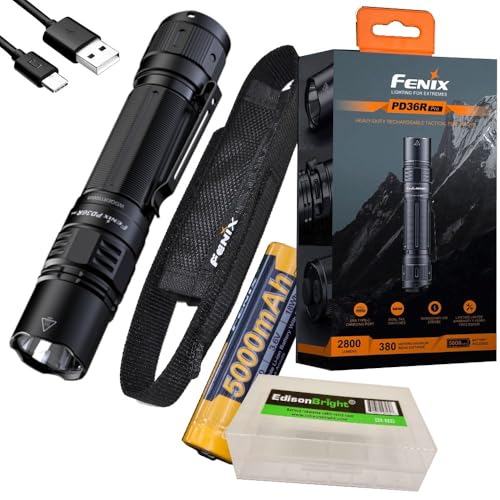
Beam distance near 470 meters beats every other light here for picking out a fence line or a trail junction. USB-C sits under a port cover on the body, so any standard cable charges it. Two switches split instant turbo from the mode cycle, which saves hunting through levels in the dark.
Pros
- Longest reach of the seven
- Charges from any USB-C cable you own
- Separate tactical and mode switches
Cons
- Tight hotspot glares during close work
- Longer body than pocket sized lights

Nitecore MH12 Pro
Peak output of 3300 lumens washes a whole backyard or a workshop bay in one sweep. An IP68 rated aluminum body shrugs off rain, dust and a brief drop into a puddle. Running that hard on a single cell keeps turbo to a short burst rather than a working mode.
Pros
- Highest peak output on this list
- Sealed for heavy rain and dust
- Wide spill suits area lighting
Cons
- Turbo runtime is measured in minutes
- Head heats quickly at full output

Streamlight ProTac HL-X USB
Power comes from the included SL-B26 pack or from two CR123A cells, so a dead battery never ends a shift. Ten-Tap programming picks a three mode cycle, high only, or high with strobe. Anti roll head and a deep pocket clip suit a truck cab or a tool bag.
Pros
- Backup lithium cells eliminate downtime
- Interface programs to how you use it
- Built for daily knocks in a work bag
Cons
- Lower peak output than enthusiast lights
- Spare SL-B26 packs are hard to find locally

Maglite ML150LR
Drop in cradle mounts on a wall or sits in a cabinet, giving the light one home every person in the house knows. Output tops out at 1082 lumens, and twisting the head shifts the beam from a tight spot to a wide flood. Length and weight rule it out as a pocket light, which is exactly why it stays put.
Pros
- Cradle keeps it charged and findable
- Focusing head covers close and distant work
- Long body gives real reach as a hand light
Cons
- Too big to carry daily
- Cradle occupies an outlet permanently

ThruNite TC15 V3
Output reaches 2760 lumens from a single 18650 cell, which is high for a light this compact. USB-C charging sits on the body, and a flat tail stands the light upright as a room lantern. Build reads solid rather than premium, with a simpler interface than the enthusiast brands.
Pros
- High peak output for a compact 18650 light
- Standard USB-C charging on the body
- Tail stand turns it into a room light
Cons
- Smaller cell shortens high mode runtime
- Switch feel is less refined

Coast HP7R
Sliding focus ring moves the beam from a broad work flood to a tight spot with one hand, no head twisting. Dual power accepts the rechargeable pack or a holder of alkaline cells once that pack runs down. Impact resistant aluminum and an included belt holster suit garage and utility work.
Pros
- Beam adjusts with one hand
- Alkaline backup keeps it usable anywhere
- Holster comes in the box
Cons
- Lower peak output than the enthusiast lights
- Focus mechanism adds a dust entry point
How to choose
What to look for in a rechargeable flashlight Cell format sets the ceiling on everything else. A 21700 holds around 5000 mAh and sustains high output far longer than an 18650 at roughly 3000 to 3500 mAh. Charging method comes next. USB-C on the body means any cable in the house works, while magnetic bases feel effortless but tie you to one accessory. Check the lowest mode as well, since a light running 20 hours on 15 lumens beats a turbo specialist during an outage. Ingress ratings such as IP68 describe what survives rain and dust. Finally, look at the clip, the tail magnet or the cradle, because carry hardware decides where the light lives.
Lumens, throw and runtime: which spec actually matters Lumens count total light leaving the head. Beam distance measures how far a usable amount of it travels. Fenix PD36R Pro pushes a tight hotspot out near 470 meters, which is excellent across a paddock and harsh when you are reading a fuse box label two feet away. Flood heavy beams handle indoor and close work better. Runtime is the spec buyers skip and then regret, because turbo on any single cell light steps down within minutes as the head warms. Judge a flashlight on its sustained 300 to 700 lumen mode instead, since that is where almost all of its working life happens.
Best picks for outages, work trucks and camping Outage lights fail for two reasons: nobody remembers where they are, or they sit flat. Maglite’s ML150LR solves both with a cradle that gives the light a fixed, always charging home. Olight’s magnetic base does the same job on a hall table with less hardware. Trucks and tool bags favour the Streamlight ProTac HL-X USB, because two CR123A cells cover the moment its rechargeable pack dies. Campers should either carry a power bank or pick that same dual fuel design. During a long outage, run 60 lumens rather than turbo, since a low mode lights a room all evening while full output drains the cell before bedtime.
How to charge and store lithium flashlights Lithium cells self discharge slowly and dislike sitting at zero, so top up any drawer light every three to six months. Heat does the other damage. A glovebox in summer shortens cell life noticeably, which is why a vehicle light with CR123A backup ages better than a pure rechargeable. Repeated deep discharges to shutdown shorten the pack’s usable life too. Cradle designs like the Maglite are built to sit on charge continuously, while USB-C lights prefer occasional top ups. One practical habit saves grief later: tape a spare cable inside the cupboard where a proprietary charger light lives.
How they stack up
| # | Model | Max output | Best for | Score | Price |
|---|---|---|---|---|---|
| 1 | Olight Baton 3 Pro Max | 2500 lumens | Best overall | 9.4 | Check price |
| 2 | Fenix PD36R Pro | 2800 lumens | Best for long throw | 9.2 | Check price |
| 3 | Nitecore MH12 Pro | 3300 lumens | Best for maximum output | 8.9 | Check price |
| 4 | Streamlight ProTac HL-X USB | 1000 lumens | Best for work and vehicles | 8.7 | Check price |
| 5 | Maglite ML150LR | 1082 lumens | Best for power outages | 8.4 | Check price |
| 6 | ThruNite TC15 V3 | 2760 lumens | Best budget | 8.2 | Check price |
| 7 | Coast HP7R | Slide focus, flood to spot | Best adjustable beam | 8.0 | Check price |
Questions worth asking
How many lumens do you need in a flashlight?
Roughly 300 to 500 lumens handles household and garage jobs. Higher peaks help outdoors, though most lights drop out of turbo within a few minutes.
Which rechargeable flashlight is best for power outages?
Maglite ML150LR, because the wall cradle keeps it charged and easy to find. Run a low mode during the outage to stretch one charge across the evening.
Is USB-C charging better than a magnetic charging base?
USB-C uses cables you already own, which matters when a charger goes missing. Magnetic bases such as Olight’s win on daily convenience but lock you to one accessory.
What is the difference between 18650 and 21700 batteries?
A 21700 is physically larger, holding around 5000 mAh against roughly 3000 to 3500 mAh for an 18650. That gap shows up directly as runtime at any given output.
Can you leave a rechargeable flashlight on the charger all the time?
Cradle designs like the Maglite are built for constant charging. USB-C lights do better with a top up every few months than with permanent connection.
Are rechargeable flashlights good for camping?
Yes, provided you pack a power bank or choose a dual fuel model. Streamlight’s ProTac HL-X USB takes CR123A cells, which removes the recharging problem entirely.
Olight Baton 3 Pro Max vs Fenix PD36R Pro: which should you buy?
Olight for pocket carry and automatic charging on a magnetic base. Fenix when you need distance outdoors and want to charge from an ordinary USB-C cable.
What does an IP68 rating mean on a flashlight?
Full dust sealing plus protection against continuous immersion under conditions the maker specifies. Nitecore’s MH12 Pro carries that rating, so rain and puddles are not a concern.
Why does turbo mode dim after a few minutes?
Thermal regulation. Driving 2500 lumens or more heats the head fast, so the light steps output down to protect the LED and the cell.
Do flashlight batteries lose charge in storage?
Lithium cells self discharge slowly, so a light left untouched for a year often sits well below full. Check and recharge every three to six months.
Our take
Buy the Olight Baton 3 Pro Max if one light must cover the house, the car and the yard, because a magnetic base means it is charged on the night you finally need it. Anyone lighting a driveway, a paddock or a trail should take the Fenix PD36R Pro instead for its far greater reach and standard USB-C port. Keep a Maglite ML150LR in its cradle alongside either one, since an outage light needs a fixed home rather than a pocket.
Dana Whitfield
Dana spent eight years buying and merchandising for a regional kitchenware retailer before moving into editorial work. She has handled thousands of SKUs across cookware, small appliances and kitchen organization, and focuses on the practical differences that matter once a product is actually in daily use.