Which rebounder gives the quietest, deepest bounce?
JumpSport Fitness Trampoline Model 350 leads on bounce quality, using 30 EnduroLast cords and six arched legs on a 39 inch frame. BCAN’s 40 inch folding model is the value pick, with a stated 450 pound limit and a five-position handle. Taller users get more travel from the 44 inch JumpSport 570 PRO.
JumpSport Fitness Trampoline Model 350 suits anyone bouncing several times a week. Thirty bungee cords stretch further than steel springs, so landings sink deeper and stay silent. Six arched legs hold the frame flat when you come down off centre. Storage is the tradeoff, because this frame does not fold.
Listings rarely mention that suspension type changes the entire feel underfoot. We compared cords against springs, frame diameters, stated weight limits, mat fabric, leg count and folding method. Owner reports about squeaking springs, cords relaxing after a year and handles working loose settled the order.
Our top picks

JumpSport Fitness Trampoline Model 350
Thirty EnduroLast cords do the job springs normally handle, which is why landings feel soft at the bottom and make almost no noise. Six arched legs push the load outward, keeping the frame planted on off-centre landings. A 39 inch mat leaves room for jogging in place, and cord tension adjusts as the set relaxes.
Pros
- Silent cords let you train near a sleeping household
- Arched legs resist tipping on off-centre landings
- Tension adjusts as the cords settle over months
Cons
- Legs unscrew but the frame itself will not fold
- Cords are a wear item and eventually need replacing

BCAN 40 Inch Foldable Mini Trampoline
Stated limit of 450 pounds tops this group by a wide margin, carried on a 40 inch steel spring frame. Handle adjusts through five heights and lifts off once balance stops being a concern. Folding in half puts it behind a sofa, and a padded cover keeps toes clear of the spring hooks.
Pros
- 450 pound limit covers heavier users plus hand weights
- Five-position handle helps with balance work
- Folds in half for upright storage against a wall
Cons
- Springs ring out louder than bungee cords
- Bounce lands firmer and shallower than cord frames

Pure Fitness 38 Inch Exercise Trampoline
Thirty steel springs on a 38 inch frame cover light cardio and warm-ups without extras. Rubber tips on six legs stop the frame creeping across tile during jogging drills. Finish sits below the premium models, so treat it as a way to find out whether rebounding suits you at all.
Pros
- Lowest barrier to trying rebounding without safety compromises
- Rubber leg tips grip tile and laminate
- Padded cover overlaps the springs fully
Cons
- Springs lose tension faster under daily sessions
- Frame stays rigid, so storage means standing it on edge

Leaps & ReBounds Bungee Rebounder
Thirty-two cords on a 40 inch frame produce the most absorbing bounce in this comparison. Owners with knee and hip complaints consistently report the least jarring landings here. Woven Permatron resists UV and stretch better than basic polypropylene, and single cords swap out individually as they wear.
Pros
- Deep cord travel lowers joint loading against spring frames
- Cords replace one at a time rather than as a full set
- Permatron mat holds up to sunlight and repeated stretch
Cons
- No handle offered for balance support
- Assembled frame claims permanent floor space

JumpSport 570 PRO
Frame width of 44 inches is the reason to pick this over the Model 350, since a longer stride needs a wider landing zone. Thirty-six cords carry a stated 300 pound limit and travel further under load. Expect it to own the room, because the width that fixes your form also blocks the corner.
Pros
- Wider mat suits users over six feet tall
- Higher stated limit than the Model 350 at 300 pounds
- Longer cord travel deepens the bounce under load
Cons
- Largest footprint of the seven at 44 inches
- Shifting it takes two hands and a clear path

Stamina 36 Inch Folding Trampoline
Thirty-six inches fits a bedroom corner where 40 inch frames simply do not. Folding in half slides it under a bed or behind a door, and a carry bag ships in the box. Narrow mat caps stride length, so gentle bouncing works better here than running drills.
Pros
- Smallest footprint here, suited to bedrooms and offices
- Folds flat for under-bed storage
- Carry bag makes it genuinely portable between homes
Cons
- Short stride room limits jogging in place
- Spring noise carries through wooden floors
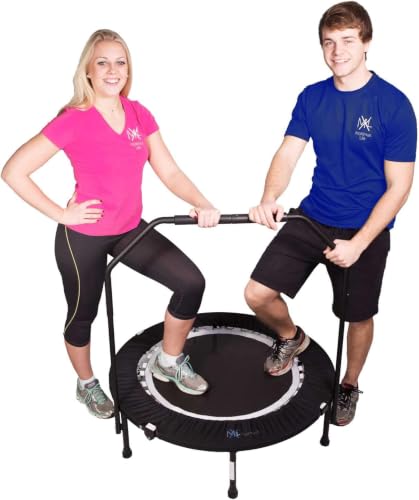
MaXimus PRO Folding Rebounder
Guided workout content plus a removable handle bar answers the beginner problem of not knowing what to do for 20 minutes. Frame folds twice, packing smaller than single-fold rivals and fitting a car boot. Steel springs supply the bounce, giving a firmer feel than the JumpSport cord models.
Pros
- Routines remove the guesswork during the first weeks
- Double fold stores on a wardrobe shelf
- Handle bar steadies balance in early sessions
Cons
- Firm spring bounce is less forgiving on knees
- Extra hinges add joints that can work loose
Side by side
| # | Model | Frame | Best for | Score | Price |
|---|---|---|---|---|---|
| 1 | JumpSport Fitness Trampoline Model 350 | 39 in diameter | Best overall | 9.4 | Check price |
| 2 | BCAN 40 Inch Foldable Mini Trampoline | 40 in diameter | Best value | 9.2 | Check price |
| 3 | Pure Fitness 38 Inch Exercise Trampoline | 38 in diameter | Best budget | 9.0 | Check price |
| 4 | Leaps & ReBounds Bungee Rebounder | 40 in diameter | Best for quiet low-impact bouncing | 8.8 | Check price |
| 5 | JumpSport 570 PRO | 44 in diameter | Best for taller and heavier users | 8.6 | Check price |
| 6 | Stamina 36 Inch Folding Trampoline | 36 in diameter | Best for small homes | 8.3 | Check price |
| 7 | MaXimus PRO Folding Rebounder | 40 in diameter | Best for guided workouts | 8.0 | Check price |
What matters most
What to look for in a rebounder Suspension sets the feel, frame diameter sets what you can actually do on it, and leg design decides whether it stays flat. Compare the stated weight limit against your own weight plus any dumbbells you plan to hold. Mat fabric matters across years: woven Permatron resists UV and stretch, while basic polypropylene sags sooner. Check that the cord or spring cover overlaps the frame completely, because that gap is where toes get caught.
Bungee cords vs steel springs Cords stretch progressively, so you sink further before the rebound and the landing feels cushioned. They also run close to silent, which matters in flats and shared houses. Springs deliver a firmer, shallower bounce that some people prefer for fast footwork, and they last longer before anything needs swapping. Cords do relax with use and want tension adjustment after a year or so. Springs squeak instead, usually well before they actually fail.
Frame size, stride length and ceiling height A 36 to 38 inch mat handles gentle bouncing and warm-ups. From 40 inches upward there is room for jogging in place and jumping jacks. Users over six feet should look at 44 inches, as on the JumpSport 570 PRO, to keep a natural stride. Measure upward too, since mat height plus a foot of bounce eats basement headroom faster than people expect. Leave roughly two feet clear around the frame for arm swing.
Folding, floor space and who each pick suits Folding outranks every other feature when the rebounder has to disappear between sessions. Stamina’s 36 inch model folds in half and ships with a carry bag, while MaXimus PRO folds twice and fits a wardrobe shelf. Both run springs, and that is the tradeoff, because no bungee model here folds at all. Beginners often do better with a handle, which BCAN and MaXimus PRO include and the JumpSport frames do not. If quiet, deep bouncing outweighs storage, keep a cord frame assembled and give up the floor space.
Questions worth asking
What is a rebounder good for?
Low-impact cardio, calf and ankle conditioning, balance work and general circulation through repeated bouncing. Owners commonly run 15 to 20 minute sessions as a joint-friendly alternative to road running. It does not replace strength training.
Are bungee rebounders better than spring ones?
For quiet operation and softer landings, yes, because cords stretch further and absorb more of the impact. Springs feel firmer and go longer between replacements. Cords make sense for daily use, springs for occasional sessions.
What size rebounder do I need for jogging in place?
Forty inches upward gives enough mat to jog without clipping the edge. Under six feet and bouncing gently, 36 to 38 inches is plenty. Over six feet, a 44 inch frame keeps your stride natural.
Do you need a handle bar on a rebounder?
Only if balance is shaky or you are easing back in after an injury. BCAN and MaXimus PRO both ship removable bars. Many owners take the handle off within a few weeks once they feel steady.
How much ceiling height does a rebounder need?
Add mat height to your standing height, then allow at least 12 inches of bounce above that. Eight foot basement ceilings work for most people bouncing gently. Proper jumping needs noticeably more clearance.
Can you use a rebounder on carpet?
Yes, though thick pile lets the legs sink unevenly and the frame can feel unsteady. A firm exercise mat underneath levels it and protects the carpet. Inspect the leg tips for wear either way.
How long do bungee cords last on a rebounder?
Lifespan tracks how often you bounce and how much you weigh. Owners typically report a year or more of regular sessions before tension drops noticeably. Better models let you swap cords one at a time.
Which rebounder is easiest on the knees?
Deeper cord travel absorbs more of the landing, which puts the Leaps & ReBounds bungee model and the JumpSport 570 PRO ahead of the spring frames. Spring bounce returns energy faster and feels harsher. Anyone with a diagnosed joint problem should clear it with a clinician first.
Which rebounders fold for storage?
BCAN folds in half, Stamina folds in half and includes a carry bag, and MaXimus PRO folds twice for wardrobe storage. All three use springs. JumpSport and Leaps & ReBounds frames come apart at the legs only.
JumpSport 350 vs BCAN 40 inch: which should you buy?
Take the JumpSport 350 for a quiet, deep cord bounce and the steadiest leg design. Go with the BCAN if you need the 450 pound limit, a handle bar or a frame that folds away. Expect the BCAN to be audibly louder.
Final word
Choose the JumpSport Fitness Trampoline Model 350 for regular training, since 30 cords and arched legs give a quiet, deep bounce no spring frame here matches. Users over six feet should step up to the 44 inch 570 PRO for stride room. Go with the BCAN 40 inch if the unit has to fold away or you need its 450 pound limit, and accept more noise in exchange.
Derek Holt
Derek has a background coaching recreational and amateur athletes and has worked the sales floor at specialty fitness retailers. He focuses on equipment durability, ergonomics and realistic use cases rather than marketing claims.
You might also need

Core Products Soft Foam Neck Brace: Gentle Support for $16.49?

Why Does a Punching Bag Need to Be the Right Weight for Your Size?

Why Does a Jump Rope’s Weight Change the Workout Difficulty?
