6 Beginner-Friendly RC Drones Kids Can Actually Fly
The Holy Stone HS210 is the best starter drone, since altitude hold and full prop guards make early crashes harmless. The Potensic A20 suits younger children best, and the Ryze Tello is the pick once a child wants to learn real flight control.
Altitude hold does the hardest part of flying, which is why the Holy Stone HS210 works well for most first time pilots. Younger children fly more confidently on the slower Potensic A20. A child ready to move past crashing usually graduates to the Ryze Tello.
Drone listings tend to lead with camera resolution, a spec that barely matters for a beginner. Prop guards, one key takeoff, and the number of batteries in the box decide whether a drone gets used again. We compared seven widely sold models on safety design, flight assistance, and what parents report after weeks of real crashes.
Before you buy
What actually makes a kids drone easy to fly Altitude hold matters more than any other spec. Without it, a beginner has to manage throttle and steering at the same time, and the drone shoots into the ceiling or drops within seconds. A barometric or vision sensor holds height automatically, so the child only steers. Every drone worth recommending for a beginner has this feature, and it separates a toy that gets used from one that ends up in a cupboard.
Best drones for young kids versus older beginners A five or six year old does better on a slow, forgiving model like the Potensic A20, where a low top speed limits how fast mistakes happen. Kids around ten who have moved past crashing benefit more from something like the Ryze Tello, which rewards genuine stick skill and adds vision positioning. Match the drone’s speed ceiling to the child’s patience, not just their age.
Why guards and battery count matter more than camera resolution First flights end in collisions, so full prop guards are not optional; they protect fingers, furniture, and the drone itself. Light weight also limits damage on impact. Most small drones fly for five to ten minutes and then need thirty to ninety minutes to recharge, so a single battery means a short flight followed by a long wait. Models with two or three packs, like the HS210 and SP350, roughly triple the useful session.
Flying outdoors: weight, weather, and local rules Registration requirements depend on weight and location. In the United States, recreational drones under 250 grams are generally exempt, which covers most models here, though rules change and restrictions still apply near airports and over crowds. Wind is the bigger practical problem: anything more than a gentle breeze carries a lightweight beginner drone away. An adult should supervise outdoor flights on a calm day.
What we recommend
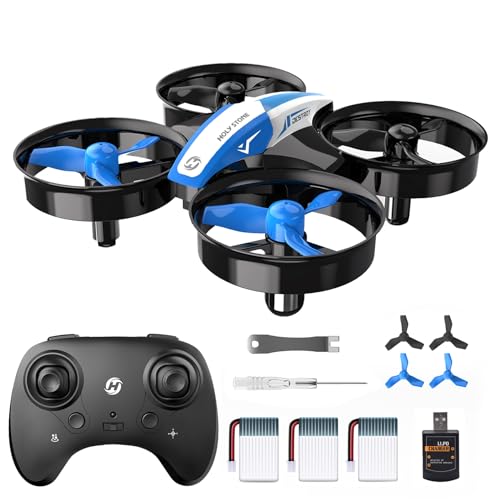
Holy Stone HS210 Mini Drone
Altitude hold keeps the HS210 at a steady height, so a child only needs to steer. Headless mode removes confusion over which way the drone is facing, and one key takeoff handles the two hardest moments of a flight. Three batteries turn a five minute novelty into a real session, and parents report the light frame and full prop guards survive repeated indoor crashes.
Pros
- Three batteries give a real session length
- Altitude hold makes it easy to control
- Full guards survive indoor crashes
Cons
- No camera on this model
- Too light for anything but calm outdoor air

Potensic A20 Mini Drone
Its lowest speed setting is deliberately gentle, which suits a five or six year old still learning that the sticks are proportional. Altitude hold, headless mode, and one key takeoff all feature on an airframe light enough that a collision does no damage. Parents call it the least intimidating drone in this group, and the higher speed settings keep it interesting as skills grow.
Pros
- Slowest speed setting suits very young pilots
- Grows with the child through three speeds
- Small and light enough for indoor use
Cons
- Short flight time per battery
- Very susceptible to any breeze outdoors

Ryze Tello (Powered by DJI)
DJI flight control gives the Tello vision positioning, so it holds its spot far more steadily than a toy grade drone. It streams video to a phone, supports simple Scratch programming, and rewards attention rather than just novelty. According to owners, it stays in use long after simpler drones get shelved, though flying it well takes more focus than a basic toy demands.
Pros
- Far more stable than toy grade drones
- Longest flight time in this group
- Programmable, so it teaches as well as entertains
Cons
- Requires a phone to use the camera features
- Prop guards are sold separately

DEERC D20 Mini Drone
A built in camera streams live to a phone, so a child can fly and film without needing two separate drones. Two batteries, gesture controlled photos, and trick flips keep younger pilots entertained between charges. Owners describe the footage as modest, which is normal at this size, and note the guards handle indoor bumps well.
Pros
- Camera and streaming at a low price
- Two batteries in the box
- Trick flips keep interest up
Cons
- Camera quality is basic
- Streaming range is short

SNAPTAIN SP350 Drone
Slightly larger and heavier than pocket sized minis, the SP350 stays composed in light outdoor air where tiny drones simply blow away. Three batteries, prop guards, and assist features like altitude hold and circle fly come standard. Parents call it a reasonable step between indoor toys and serious drones, though wind still grounds it like any drone this size.
Pros
- More stable outdoors than pocket minis
- Three batteries for longer sessions
- Good range of automatic flight modes
Cons
- Too large to fly comfortably indoors
- Still grounded by moderate wind

Syma X20 Pocket Drone
Syma has built entry level drones for years, and the X20 is one of the simplest: a truly pocket sized quadcopter with altitude hold, one key takeoff, and enclosed motors. Its size makes it best suited to a living room or hallway rather than a yard. Parents treat it as a cheap way to test whether a child enjoys flying, with the caveat that flight time is short and outdoor conditions are not its strength.
Pros
- Cheapest way to test the interest
- Truly pocket sized for travel
- Simple controls with few settings
Cons
- Very short flight time
- Indoor use only in practice
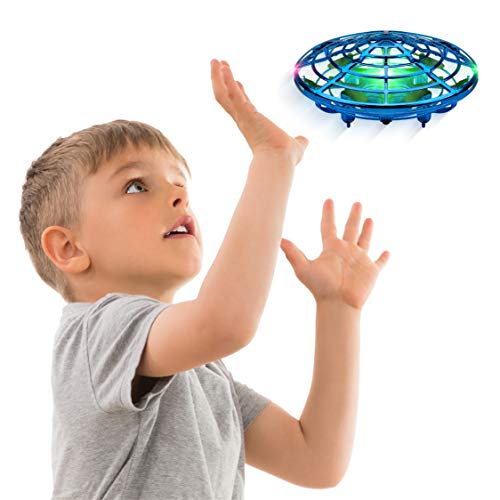
Force1 Scoot Hand Operated Drone
No controller is needed at all: infrared sensors read hand movement beneath and around the Scoot, so a very young child can fly it with zero stick skills. A full spherical cage protects both fingers and furniture. Parents rate it as the easiest option for preschoolers, while noting it is a toy for play rather than a drone that teaches piloting.
Pros
- No controller skills needed at all
- Full cage protects fingers and furniture
- Very quick to charge and restart
Cons
- Not a drone for learning to pilot
- Indoor only and easily confused by bright light
Side by side
| # | Model | Flight time | Best for | Score | Price |
|---|---|---|---|---|---|
| 1 | Holy Stone HS210 Mini Drone | Around 7 minutes per battery | Best overall | 9.4 | Check price |
| 2 | Potensic A20 Mini Drone | Around 5 to 6 minutes per battery | Best for young children | 9.2 | Check price |
| 3 | Ryze Tello (Powered by DJI) | Around 13 minutes per battery | Best for learning to fly | 9.0 | Check price |
| 4 | DEERC D20 Mini Drone | Around 10 minutes total across batteries | Best with a camera | 8.8 | Check price |
| 5 | SNAPTAIN SP350 Drone | Around 7 to 8 minutes per battery | Best for outdoor play | 8.6 | Check price |
| 6 | Syma X20 Pocket Drone | Around 5 minutes per battery | Best budget | 8.3 | Check price |
| 7 | Force1 Scoot Hand Operated Drone | Hand motion via infrared sensors | Best for the youngest kids | 8.0 | Check price |
Frequently asked questions
What age is right for a first drone?
Hand controlled toys like the Force1 Scoot suit children from around four with supervision. Simple altitude hold drones such as the Potensic A20 work well from about six. More capable models like the Ryze Tello suit children around ten and up who are ready to learn real flight control.
Do kids drones need to be registered?
In the United States, recreational drones under 250 grams generally do not require registration, and most beginner drones fall well below that weight. Rules differ by country and change over time, so check your national aviation authority before flying outdoors.
How long do these drones fly on a charge?
Small toy drones typically manage five to ten minutes, with the Ryze Tello reaching around thirteen. Recharging usually takes thirty to ninety minutes, which is why included battery count matters for keeping a child engaged.
Can these drones be flown outside?
Light drones are strongly affected by wind and work best indoors or in very calm outdoor conditions. Slightly larger models like the SNAPTAIN SP350 cope better in light air. Anything beyond a gentle breeze will carry a beginner drone away.
What is headless mode on a kids drone?
Normally a drone’s controls are relative to its own front, so once it turns around, steering feels reversed. Headless mode makes controls relative to the pilot instead, so pushing forward always moves the drone away from the child. It removes the most confusing part of early flying.
Are the cameras on kids drones any good?
They are modest. A 720p camera without a gimbal produces shaky footage that is fun but not sharp. Treat a camera as a bonus rather than a deciding factor, and prioritize flight assistance and battery count instead.
What happens when a propeller breaks?
Propellers are consumable parts, and most kids drones ship with spares since they break first in a crash. Replacements are inexpensive and clip or screw on quickly. Check that spare props are sold for a specific model before buying, since some budget brands offer limited parts support.
Is a controller based drone better than a hand controlled one?
For learning to fly, yes. Controller based drones teach stick skills that transfer to more capable aircraft later. Hand controlled toys like the Scoot suit very young children who just want something fun and safe, and work best as a stepping stone.
Which drone is best for a child who wants to learn real flying?
The Ryze Tello, powered by DJI flight control, holds position with vision sensors and supports simple programming through Scratch. It rewards practice more than the simpler altitude hold toys aimed at first time flyers.
The bottom line
Three batteries, altitude hold, and full prop guards make the Holy Stone HS210 the drone most children should get first. A younger child does better on the slower, less intimidating Potensic A20. Once a child flies confidently, the Ryze Tello is the natural next step and the only model here that keeps teaching new skills.
Rachel Simmons
Rachel previously worked in child-product retail and brings a practical, detail-first eye to gear reviews, focusing on safety standards, ease of use and the fine print that matters most for new caregivers.


