Rain Gauges That Give Gardeners a Number to Trust
AcuRite 00899 fits most households, since its tipping bucket empties itself and the indoor console holds daily through yearly totals. Stratus Precision reads to 0.01 inch by eye and is what CoCoRaHS volunteers report from. Ecowitt WH5360B graphs rainfall history without a full weather station.
AcuRite 00899 answers the question people actually wake up with, which is how much rain fell overnight. Its tipping bucket resets itself, and the indoor console stacks daily, weekly, monthly and yearly running totals. Debris is the weak point, because one leaf in the funnel stops the count completely.
Placement and a clear funnel decide accuracy more than the electronics do. Tilt a tipping bucket and it over reports; park a tube under a maple and it reads low all summer. We compared listed resolution, funnel diameter, wireless range and logging depth across current models. Owner feedback on acrylic cracking after a freeze and sensors drifting out of sync shaped the order.
The best picks, ranked

AcuRite 00899 Wireless Rain Gauge with Self-Emptying Collector
Walking out to dump a tube after every storm gets old quickly. A tipping bucket handles that step alone, and the indoor console stacks daily, weekly, monthly and yearly figures beside a rainfall alarm you set yourself. Pollen and leaf litter block the funnel, so plan a rinse every month or two.
Pros
- Resets itself after every storm
- Running totals readable from indoors
- Alarm triggers at a rainfall level you choose
Cons
- Funnel blocks with leaves and pollen
- Batteries needed in sensor and display
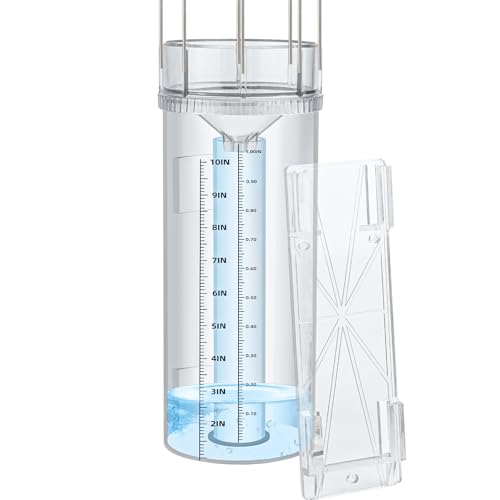
Stratus Precision Rain Gauge
CoCoRaHS volunteers submit their daily readings from this design. A 4 inch funnel feeds an inner tube marked to a hundredth of an inch, which makes light rain easy to read by eye. Snow melts in the outer cylinder for a water equivalent figure, though every reading and reset happens by hand.
Pros
- Reads 0.01 inch without any electronics
- Outer cylinder handles snow water equivalent
- Accepted by citizen science networks
Cons
- Hand reading and emptying after each storm
- No console, logging or alerts
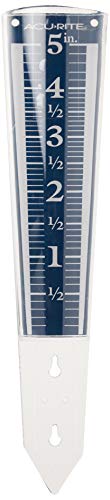
AcuRite 00850A2 Magnifying Rain Gauge
Magnified numerals keep the water column legible from a patio or garden path. Mounting works two ways, on the supplied ground stake or bracketed to a fence post. Acrylic splits when trapped water freezes, so drain it before the first hard freeze of the season.
Pros
- Column stays readable from several feet away
- Stake and bracket both supplied
- Nothing to pair, charge or replace
Cons
- Cracks if left full through a freeze
- Capacity stops at 5 inches

Ecowitt WH5360B Wireless Rain Gauge
Rainfall appears as a bar graph on the console, so a wet fortnight reads at a glance. Hourly totals separate a slow soaking from a downpour that ran straight off the beds. Pushing that data to the cloud requires a separate Ecowitt gateway.
Pros
- Bar graph shows the rainfall trend
- Hourly logging reveals storm intensity
- Sensor pairing holds steady over time
Cons
- Cloud upload needs an extra gateway
- 100 foot range trails the AcuRite sensor

Netatmo Rain Gauge Module
Rainfall lands in the same app as temperature, humidity and indoor air quality from the Netatmo base station. Automations can skip an irrigation cycle after a wet night, and a voice assistant will read the day’s total aloud. Without the Netatmo Weather Station the module does nothing at all.
Pros
- Feeds irrigation automations with real rainfall
- History by day and month inside one app
- Sealed housing built for year round mounting
Cons
- Netatmo Weather Station is mandatory
- No console for anyone who avoids apps

La Crosse Technology 724-1710 Wireless Rain Gauge
One screen carries rainfall totals alongside indoor and outdoor temperature. Frost alerts give warning to cover tender seedlings after a clear, wet night. Level the sensor carefully, because a tilted tipping bucket records more rain than actually fell.
Pros
- Rain and temperature share a single display
- Heavy rainfall alarm can be set
- 200 foot range covers a mid size yard
Cons
- Accuracy depends on careful leveling
- Backlight washes out in daylight
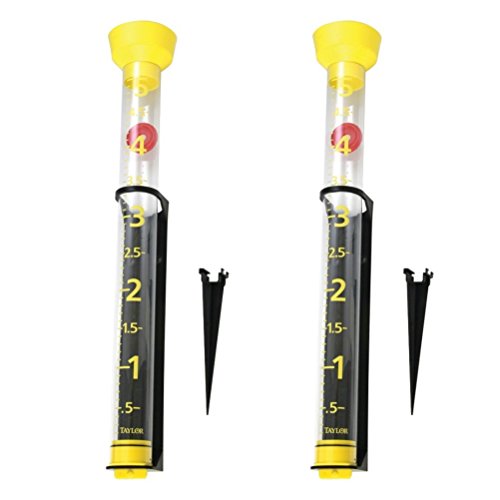
Taylor Precision Products Jumbo Rain Gauge
Raised jumbo digits read through a kitchen window from across the lawn. A wide funnel still catches a fair sample when rain arrives at an angle. Direct sun yellows the plastic over several summers, which slowly kills the contrast on those digits.
Pros
- Legible from indoors without stepping outside
- Bracket holds firm on a fence post
- No batteries, pairing or maintenance
Cons
- Plastic yellows under strong sun
- Increments are coarser than a precision tube
Compared at a glance
| # | Model | Resolution | Best for | Score | Price |
|---|---|---|---|---|---|
| 1 | AcuRite 00899 Wireless Rain Gauge with Self-Emptying Collector | 0.01 inch | Best overall | 9.4 | Check price |
| 2 | Stratus Precision Rain Gauge | 11 inches total | Best for accuracy | 9.2 | Check price |
| 3 | AcuRite 00850A2 Magnifying Rain Gauge | 5 inches | Best budget | 9.0 | Check price |
| 4 | Ecowitt WH5360B Wireless Rain Gauge | 0.01 inch | Best for rainfall history | 8.7 | Check price |
| 5 | Netatmo Rain Gauge Module | Add on module | Best for smart homes | 8.5 | Check price |
| 6 | La Crosse Technology 724-1710 Wireless Rain Gauge | 0.01 inch | Best with temperature | 8.3 | Check price |
| 7 | Taylor Precision Products Jumbo Rain Gauge | 5 inches | Best for reading from indoors | 8.0 | Check price |
What matters most
What to look for in a rain gauge Resolution and funnel width carry most of the accuracy. Readings to 0.01 inch separate a token drizzle from a soaking worth skipping a watering for. Wider funnels catch a more representative sample, which is why the 4 inch Stratus became the reference volunteer networks use. After that comes one fork in the road: read a tube by hand, or let a sensor report indoors. That single choice splits every gauge here into two families.
Manual tubes vs wireless tipping buckets Manual tubes have nothing to break, cost nothing to run and stay accurate as long as somebody empties them. Wireless models count each time a small seesaw fills and flips, then radio the tally to a console. Tipping buckets under report during very intense rain, because water arrives faster than the bucket can swing. They also stop dead when a leaf blocks the funnel, and no warning appears on the display. Plenty of gardeners run both and treat the tube as the reference.
Where to put a rain gauge for an accurate reading Open ground beats anywhere convenient. Keep the gauge at least twice the height of the nearest obstacle away from it, so a 20 foot tree means roughly 40 feet of clearance. Walls and fences create eddies that push rain past the funnel or drop extra into it. Three to five feet above ground clears splash coming off the lawn. Roof edges are the worst spot of all, since runoff and drips can double a total.
Measuring rain and snow through winter Freezing water expanding inside a sealed tube is what splits acrylic gauges, so drain models like the AcuRite 00850A2 before a hard freeze. Tipping buckets ice up and simply stop counting until they thaw, unless a heated collector is fitted. Stratus copes better because its outer cylinder carries indoors, where melted snow gives a direct water equivalent. Anyone tracking year round totals in a snow belt should plan for that manual step. Cold climates are exactly where a second, simple tube earns its place.
Questions worth asking
How accurate are home rain gauges?
A well sited manual tube reads to about 0.01 inch, matching the precision of many official stations. Wireless tipping buckets track closely in ordinary rain but fall short during very intense downpours.
What is the best rain gauge for gardeners?
AcuRite 00899, because its console shows running weekly totals, and that number decides whether beds need water. A single storm in isolation rarely tells a gardener much.
Where should a rain gauge be placed in a yard?
Out in the open, at least twice the height of nearby trees or buildings away from them, mounted level three to five feet up. Never under a roof edge or tight against a fence.
Do wireless rain gauges work in freezing weather?
They count normally until the collector ices over, then pause until it thaws. Only models with a heated collector keep measuring through a sustained freeze.
Can a rain gauge measure snow?
Indirectly. Pull the funnel and inner tube, let snow collect in the outer cylinder, then melt it indoors for the water equivalent. Stratus is built around that routine.
Stratus vs AcuRite: which rain gauge should you buy?
Stratus wins on precision and is what citizen science networks accept. AcuRite wins on convenience, reporting indoors and resetting itself. Owners who care about both often keep one of each.
Why does my rain gauge read zero after it rained?
A blocked funnel is the usual culprit, from leaves, pollen or a spider nest. On wireless models, check the sensor batteries and confirm the console still shows a signal icon.
How often should you clean a rain gauge?
Rinse the funnel every month or two, and more often through pollen season and leaf fall. Warm water and a soft brush are enough; skip detergents that leave a film.
Is a smart rain gauge worth it for irrigation?
Yes when a smart controller is already running. A Netatmo module can pause a watering cycle after rainfall, saving water and avoiding the waterlogging that kills shallow rooted plants.
What resolution do you need in a rain gauge?
0.01 inch covers garden decisions comfortably. Coarser markings on jumbo tubes are fine for a rough sense of a storm, but they blur the difference between 0.10 and 0.20 inch.
Final word
Buy the AcuRite 00899 for an ordinary garden. Self emptying plus indoor totals is what keeps a gauge in use past the first month, and the occasional funnel rinse takes two minutes. Reporting to a weather network, or simply want the most defensible number? Stratus Precision justifies the manual reading. Netatmo’s module makes sense only for households already running its Weather Station alongside a smart irrigation controller.
Dana Whitfield
Dana spent eight years buying and merchandising for a regional kitchenware retailer before moving into editorial work. She has handled thousands of SKUs across cookware, small appliances and kitchen organization, and focuses on the practical differences that matter once a product is actually in daily use.
You might also need

Vollum 8 Liter Insulated Beverage Dispenser Review: Does the Spigot Design Deliver?

JH JIEMEI HOME Ramen Bowl Set Review: Real Donburi Bowls or Just Pretty Glaze?

Breaking Bad Los Pollos Hermanos Apron Review: Fun Fan Gear, But How Functional?