Projectors That Fit Your Room, Budget and Use
The Epson Home Cinema 2350 is the strongest all-around pick, balancing 2800 lumens of brightness with accurate 3LCD color and built-in streaming. Buyers who want true native 4K detail should consider the XGIMI Horizon Ultra instead, while gamers get more value from the low input lag on the Optoma UHD35.
The Epson Home Cinema 2350 stands out for pairing 2800 lumens of brightness with 3LCD color accuracy and built-in Android TV, a combination that suits most living rooms without extra hardware. Its main limitation is a native 1080p panel, which trails true 4K resolution on pricier models.
We compared published lumens ratings, resolution specifications, light source type and smart platform support across each listing rather than measuring brightness ourselves.
The best picks, ranked

Epson Home Cinema 2350
Three-chip 3LCD technology avoids the rainbow artifact some single-chip DLP projectors show, a detail dedicated home theater buyers notice quickly. Native 1080p resolution upscales 4K content reasonably well, backed by 2800 lumens bright enough for rooms with some ambient light. Built-in Android TV support means no separate streaming box is required for most content.
Pros
- 3LCD design avoids rainbow artifacts common on single-chip projectors
- 2800 lumens stays watchable with some ambient light
- Built-in Android TV skips the need for a separate streaming device
Cons
- Native 1080p resolution trails true 4K panels on the Horizon Ultra
- Replacement lamp adds a recurring cost laser models avoid

BenQ HT2060
A short-throw lens projects a large image from a short distance, useful in rooms too small for a standard throw projector. BenQ’s CinematicColor covers 100 percent of the DCI-P3 color gamut, aimed at buyers who care about accurate color over raw brightness. At 2200 lumens it performs best with controlled lighting rather than a bright living room.
Pros
- Short throw lens fits rooms too tight for standard projectors
- Accurate DCI-P3 color suits movie and sports viewing
- Simpler setup than lens-shift heavy alternatives
Cons
- 2200 lumens struggles in rooms with notable ambient light
- 1080p resolution is lower than the 4K options on this list

XGIMI Horizon Ultra
A dual-light laser engine combines with a true native 4K panel, producing sharper detail than the upscaled 1080p models on this list. Harman Kardon tuned speakers add real audio output, reducing the need for a separate sound system in smaller rooms. Automatic keystone correction and focus make setup faster than lamp-based projectors with manual adjustment.
Pros
- True native 4K panel delivers sharper detail than upscaled rivals
- Automatic focus and keystone correction speed up setup
- Built-in Harman Kardon audio reduces need for external speakers
Cons
- Costs more than every other projector in this list
- Laser light engine is heavier and larger than portable options

Anker Nebula Capsule 3 Laser
About the size of a soda can, the Capsule 3 Laser trades raw brightness for true portability, running on Google TV with built-in streaming apps. A laser light source lasts far longer than traditional projector lamps, useful since this model is meant to travel often. It skips a built-in battery, so it still needs a wall outlet rather than running cordlessly.
Pros
- Compact can-sized body is easy to pack and travel with
- Laser light source avoids replacing bulbs over the projector’s life
- Built-in Google TV skips the need for a separate streaming stick
Cons
- 300 ANSI lumens only works well in a dark room
- No dedicated battery, so it needs a nearby power outlet

Optoma UHD35
A 240Hz refresh rate at 1080p and low input lag make the UHD35 one of the few projectors built with gaming in mind rather than movies alone. DLP technology upscales to 4K resolution, trading the finer detail of native 4K panels for a lower price. At 3600 lumens it handles moderately lit rooms better than most laser alternatives on this list.
Pros
- Low input lag suits fast-paced console and PC gaming
- 3600 lumens handles brighter rooms better than most rivals here
- Priced well below true native 4K laser projectors
Cons
- Upscaled 4K trails the detail of the Horizon Ultra’s native panel
- DLP rainbow artifact can appear for some viewers in bright scenes

Samsung The Freestyle 2nd Gen
A built-in tilting stand lets the Freestyle project onto a wall, ceiling or floor without a separate mount, flexibility none of the fixed-stand projectors here offer. Samsung Smart Hub brings the same streaming interface found on its televisions, which helps buyers already in that ecosystem. Select bundles add an IP55 rating that allows limited outdoor use away from dust and splashes.
Pros
- Built-in rotating stand projects onto walls, ceilings or floors easily
- Samsung Smart Hub matches the interface of Samsung smart TVs
- Compact size travels more easily than box-shaped projectors
Cons
- 230 lumens limits it to dim rooms or nighttime viewing
- 1080p resolution trails the 4K options on this list
ViewSonic PX701-4K
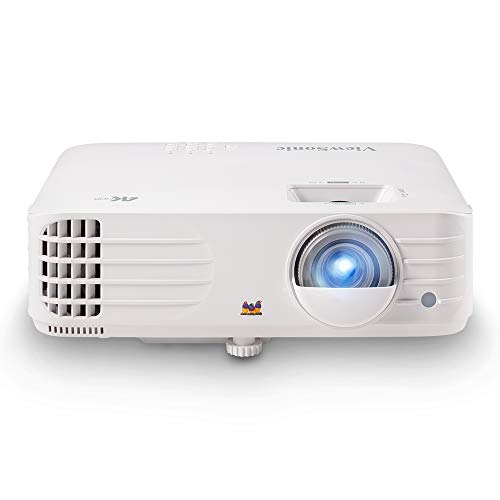
At 3200 lumens with 4K UHD support, the PX701-4K handles bright conference rooms better than most home theater projectors on this list. Dual HDMI inputs and a 1.3x zoom lens simplify switching between a laptop and a secondary source without moving the unit. ViewSonic rates the lamp for up to 15000 hours in its lowest power mode, well beyond typical home theater usage.
Pros
- 3200 lumens stays visible in brightly lit conference rooms
- Dual HDMI inputs simplify switching between laptop sources
- Long-rated lamp life suits daily office or classroom use
Cons
- Built-in speaker is weak compared with dedicated home theater audio
- Styling and ports lean toward office use over living room decor
How to choose
What to look for in a projector Brightness, measured in lumens, decides how watchable a projector stays with lights on, ranging from 230 lumens on the Samsung Freestyle up to 3600 on the Optoma UHD35. Resolution splits between native 4K panels like the XGIMI Horizon Ultra and upscaled 1080p or 4K found on cheaper models. Light source matters for long-term cost, since lamp-based units like the Epson Home Cinema 2350 eventually need a replacement bulb while laser models do not.
Picking the right projector for your room Small or oddly shaped rooms benefit from a short-throw lens like the one on the BenQ HT2060, which projects a large image from close range. Dedicated dark home theater rooms get the most from higher-resolution, higher-contrast models like the XGIMI Horizon Ultra. Rooms with some ambient light need higher lumens, which rules out ultra-portable options like the Anker Nebula Capsule 3 Laser unless the lights go off.
Gaming, streaming and smart features Gamers should prioritize input lag over resolution, which is why the Optoma UHD35’s sub-5 millisecond response time matters more than its upscaled 4K image. Built-in smart platforms, such as Android TV on the Epson or Google TV on the Anker Capsule 3 Laser, remove the need for a separate streaming stick. The Samsung Freestyle’s rotating stand suits casual movement between rooms more than fixed gaming setups.
Office and presentation use Conference rooms and classrooms need higher sustained brightness, which is where the ViewSonic PX701-4K’s 3200 lumens and dual HDMI inputs earn their place. Long lamp life matters more in daily office use than in a home theater that runs a few hours a week. Buyers choosing between home and office use should weigh audio quality separately, since office-focused projectors often pair with external speakers anyway.
Side by side
| # | Model | Resolution | Best for | Score | Price |
|---|---|---|---|---|---|
| 1 | Epson Home Cinema 2350 | 1080p with 4K enhancement | Best Overall | 9.2 | Check price |
| 2 | BenQ HT2060 | 1080p | Best for Small Rooms | 8.8 | Check price |
| 3 | XGIMI Horizon Ultra | Native 4K UHD | Best 4K Laser Picture Quality | 9.0 | Check price |
| 4 | Anker Nebula Capsule 3 Laser | 1080p | Best Ultra-Portable | 8.5 | Check price |
| 5 | Optoma UHD35 | 4K UHD, upscaled | Best Budget 4K Gaming | 8.6 | Check price |
| 6 | Samsung The Freestyle 2nd Gen | 1080p | Best for Flexible Placement | 8.3 | Check price |
| 7 | ViewSonic PX701-4K | 4K UHD, upscaled | Best for Presentations and Office Use | 8.4 | Check price |
Questions worth asking
How many lumens does a projector need for a bright room?
At least 3000 lumens, like the ViewSonic PX701-4K or Optoma UHD35, holds up reasonably well with some ambient light. Models under 500 lumens, such as the Anker Nebula Capsule 3 Laser, need a dark room to look their best.
Is native 4K worth paying more for over upscaled 4K?
For buyers focused on image detail, yes. The XGIMI Horizon Ultra’s native 4K panel shows finer detail than the upscaled 4K on the Optoma UHD35, though the gap matters less at smaller screen sizes.
What is the difference between a lamp-based and a laser projector?
Lamp-based models like the Epson Home Cinema 2350 cost less upfront but need periodic bulb replacement. Laser models like the XGIMI Horizon Ultra cost more initially but rarely need a light source replacement.
Can a projector replace a TV for everyday viewing?
Brighter models like the Epson Home Cinema 2350 work reasonably well with daytime light, but most projectors still look best with some light control, unlike a standard television.
Is a short-throw projector better for small rooms?
Yes, when ceiling height or room depth is limited. The BenQ HT2060’s short throw lens produces a large image from close range, where standard projectors would need far more distance.
Do portable projectors work well in daylight?
Not usually. Compact models like the Anker Nebula Capsule 3 Laser and Samsung Freestyle run under 350 lumens, which only looks sharp once the room gets dark.
What input lag is low enough for gaming on a projector?
Under 10 milliseconds feels responsive to most gamers. The Optoma UHD35 reaches as low as 4.2 milliseconds at 1080p and 240Hz, well within that range.
Do office projectors need 4K resolution?
Not strictly. Text and slides read clearly at 1080p, though the ViewSonic PX701-4K’s upscaled 4K adds sharpness for detailed charts or video content.
How long do projector lamps and laser light sources last?
Traditional lamps, like the Epson Home Cinema 2350’s, typically last several thousand hours before replacement. Laser light sources, like the one in the XGIMI Horizon Ultra, are rated for tens of thousands of hours.
Final word
The Epson Home Cinema 2350 earns the top recommendation for most living rooms, since its brightness, accurate color and built-in streaming cover the widest range of everyday use. Buyers chasing the sharpest possible image should choose the XGIMI Horizon Ultra instead, as its native 4K panel and laser light source outperform every upscaled model here. Anyone shopping specifically for gaming should skip both and pick the Optoma UHD35 for its low input lag and 240Hz refresh rate.
Marcus Chen
Marcus covered consumer electronics for enthusiast tech publications for six years before joining ChoiceCrest. He specializes in translating manufacturer spec sheets into plain-language buying advice, with a focus on audio, computing accessories and smart-home gear.


