Which Professional Water Ski Matches Your Skiing Level?
Connelly’s Carbon V leads for skiers who already run a slalom course, built around a carbon wrap and adjustable Sidewinder fin. HO Sports’ Omni delivers strong value with a hybrid hull, and Radar’s Vapor Lithium suits advanced skiers chasing tournament speeds near 36 mph.
Connelly’s Carbon V suits skiers who already run a slalom course, combining a 70 percent carbon wrap with an adjustable Sidewinder fin. It sacrifices some flex forgiveness next to a wide-body ski, which can challenge newer skiers. Anyone still on combo skis or carrying extra weight will find a better match further down this list.
Length, core material, and fin type all shift with skier weight and skill level, which makes this harder to shop than it looks. We compared manufacturer specifications, including core construction, surface area, rated speed, and binding compatibility, to match each ski to a real use case.
What we recommend

Connelly Carbon V Slalom Water Ski
A polyurethane core wrapped in 70% carbon keeps the Carbon V light through hard cuts. Six V-shaped steps on the bottom help the tail release cleanly at speed. Connelly offers 65, 67, and 69 inch lengths with Sidewinder bindings and an adjustable RTP fin.
Pros
- Carbon wrap keeps swing weight low through direction changes
- V-shaped step bottom channels water for a clean tail release
- Adjustable Sidewinder fin lets skiers fine-tune turn engagement
Cons
- Narrow tail rewards technique more than raw stability
- Best suited to skiers who already run a slalom course

HO Sports Omni Slalom Water Ski
HO Sports splits the difference between traditional and wide skis with the Omni’s hybrid waist width. Flex-frame construction adds torsional give for a maneuverable feel at speed. It ships in 65 and 67 inch lengths with Free-Max double bindings covering boot sizes 4 through 15.
Pros
- Hybrid width bridges traditional and wide-body feel in one ski
- Clean Edge hull reduces drag on the release off each turn
- Free-Max bindings fit a broad range of boot sizes
Cons
- Less specialized than a pure competition tournament ski
- Torsional flex feels softer than stiffer carbon models

Radar Vapor Lithium Slalom Water Ski
Radar scales the Vapor Lithium across five lengths, from 63.5 to 68 inches, to match skier weight. The 67 inch version fits skiers between 160 and 200 lbs with 364.5 square inches of surface area. A suggested top speed of 36 mph supports full course running.
Pros
- Lithium core construction holds its shape at tournament speeds
- Five length options match skiers from 85 to 220 lbs
- Consistent surface area scaling keeps handling predictable across sizes
Cons
- Demands a confident, aggressive stance to load the ski correctly
- Pro Build bindings sell separately on most listings

Radar Senate Alloy Slalom Water Ski
Starting from the Vapor shape, the Senate Alloy adds extra width between the tunnel and edge bevel. Paulownia wood stringers inside a polyurethane core, wrapped in carbon, give a softer, more predictable turn. Radar rates it for 26 to 34 mph, wider than most pure tournament skis.
Pros
- Paulownia stringers add a softer, more forgiving ride through turns
- Wider tunnel-to-edge bevel than the Vapor improves grip in chop
- 26 to 34 mph range suits club and recreational course speeds
Cons
- Softer flex trades some top-end response for comfort
- Not the fastest option for tournament speeds above 34 mph

HO Sports Freeride Slalom Water Ski
A snow-ski inspired flex pattern lets the Freeride’s tail bend smoothly into turns. Its NACA airfoil-style 3D fin adds lift while cutting drag compared with a flat fin. HO Sports offers 63, 65, and 67 inch lengths, with the 67 fitting skiers up to 190 lbs.
Pros
- Snow-ski inspired flex pattern makes carving turns feel effortless
- 3D airfoil fin adds lift with less drag than a flat fin
- Free-Max boots give a relaxed fit for long open-water sessions
Cons
- Relaxed binding fit gives less lock-in feel than tournament boots
- Not built for the tightest buoy-course turns at high speed
Connelly Big Easy Slalom Water Ski
Connelly widens the Big Easy to 11.56 inches for effortless deep-water starts. A closed-cell polyurethane core and 635 square inch surface area support skiers 220 lbs and up. It runs best between 24 and 28 mph with a Shadow binding and RTP rear toe plate.
Pros
- Wide 11.56 inch profile makes deep-water starts nearly effortless
- 635 square inch surface area adds stability for larger riders
- Aluminum drop-through fin holds up to repeated dock landings
Cons
- 24 to 28 mph range sits far below tournament slalom speeds
- Wide body sacrifices the sharp turning of a narrow slalom ski
O’Brien Celebrity Combo Water Skis
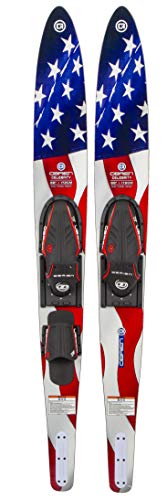
This Celebrity pair uses a dual tunnel hull for stable tracking on two skis. X-7 adjustable bindings fit a wide range of boot sizes without a separate boot purchase. Skiers can later drop the rear ski and progress to a single slalom model as skills improve.
Pros
- Dual tunnel hull keeps tracking predictable for new skiers
- X-7 adjustable bindings fit a wide range of boot sizes
- Removable rear ski lets skiers progress to single-ski slalom later
Cons
- Combo shape turns less sharply than a dedicated slalom ski
- Not rated for full tournament course speeds
How they stack up
| # | Model | Length options | Best for | Score | Price |
|---|---|---|---|---|---|
| 1 | Connelly Carbon V Slalom Water Ski | 65, 67, 69 inches | Best overall for competitive slalom skiers | 9.4 | Check price |
| 2 | HO Sports Omni Slalom Water Ski | 65 and 67 inches | Best value for versatile course skiing | 9.1 | Check price |
| 3 | Radar Vapor Lithium Slalom Water Ski | 63.5 to 68 inches | Best for advanced and tournament skiers | 9.0 | Check price |
| 4 | Radar Senate Alloy Slalom Water Ski | 65 and 67 inches | Best for a smoother, more forgiving turn | 8.7 | Check price |
| 5 | HO Sports Freeride Slalom Water Ski | 63, 65 and 67 inches | Best for all-around open-water freeriding | 8.5 | Check price |
| 6 | Connelly Big Easy Slalom Water Ski | 69 inches | Best for heavier or bigger-bodied skiers | 8.3 | Check price |
| 7 | O’Brien Celebrity Combo Water Skis | 58, 64 and 68 inches | Best for beginners progressing from combo skis | 8.0 | Check price |
How to pick the right one
What Makes a Water Ski Built for Competition Competition-grade slalom skis use lighter, stiffer cores than recreational combo skis. Polyurethane resin wrapped in carbon, as seen on the Carbon V, cuts swing weight during fast direction changes. Fin type matters too, since adjustable rear fins let skiers fine-tune how sharply the ski turns into a buoy. Bindings range from relaxed Free-Max boots to snug Sidewinder systems, and the right choice depends on how locked-in a skier wants to feel.
How Skier Weight Determines Slalom Ski Length Ski length works as a weight calculation, not a style choice. Radar’s Vapor Lithium spans five lengths, from 63.5 inches for skiers around 85 to 120 lbs up to 68 inches near 220 lbs. Shorter skis turn quicker but float less, so an undersized ski for a given weight sits low and drags. Checking the manufacturer’s weight range before buying prevents a mismatch no amount of technique can fix.
Combo Skis vs Single Slalom Skis for Skill Progression Combo pairs like the O’Brien Celebrity let new skiers stand up on two skis before moving to one. A dual tunnel hull keeps tracking stable while a skier learns edge control. Dropping the rear ski for a dedicated slalom model, such as the HO Sports Omni or Radar Senate Alloy, sharpens turning ability once a skier is ready. Jumping straight to a narrow tournament ski without that step often leads to frustrating falls.
Is a Wide-Body Ski Worth It for Bigger or Heavier Skiers? Wide-body skis, such as the Connelly Big Easy at 11.56 inches across, trade sharp turning for flotation. Skiers over 220 lbs get easier deep-water starts and more stability at lower speeds between 24 and 28 mph. That width comes at a cost, since wide skis do not carve as tightly as a narrow slalom shape. Heavier skiers chasing a slalom course later may outgrow a wide-body ski as technique improves.
Frequently asked questions
What length water ski do I need for my weight?
Match a ski’s published weight range to your body weight. Radar’s 67 inch Vapor Lithium fits skiers between 160 and 200 lbs, while the 63.5 inch version suits 85 to 120 lbs.
How is a slalom ski different from a combo ski?
A slalom ski is a single ski used after a skier drops the rear ski, while a combo pair like the O’Brien Celebrity keeps both feet on separate skis for easier starts.
Can beginners use a competition slalom ski?
Beginners usually struggle on a narrow tournament ski like the Carbon V. A wide-body or combo option builds balance and edge control first.
What core material works best for a professional water ski?
Polyurethane resin wrapped in carbon, used in the Carbon V and Senate Alloy, balances light swing weight with the stiffness needed for hard course turns.
Is carbon fiber better than fiberglass for slalom skis?
Carbon wraps add stiffness and cut weight compared with fiberglass, which is why most tournament-focused skis, including the Carbon V, use a carbon layup over the core.
Which water ski suits advanced or tournament skiers best?
The Radar Vapor Lithium targets full course speeds up to 36 mph and comes in five lengths to match experienced skiers by weight.
Do professional water skis come with bindings included?
Most listings, including the Carbon V and Omni, bundle bindings such as Sidewinder or Free-Max systems, though some Pro Build models sell the ski and bindings separately.
Are wide-body skis slower than narrow slalom skis?
Yes. Wide-body skis like the Big Easy are rated for 24 to 28 mph, well under the 36 mph range of a narrow tournament ski like the Vapor Lithium.
Water ski vs wakeboard: which is better for course skiing?
A water ski tracks through a set slalom course using a fin and edge control, while a wakeboard rides flat for wake tricks and jumps. Course skiing requires a dedicated slalom ski like those compared here, not a wakeboard.
The bottom line
The Connelly Carbon V remains the strongest pick for skiers who already run a slalom course and want a light, responsive ski without stepping up to a full Pro Build model. Skiers over 220 lbs or still building confidence should choose the Connelly Big Easy or O’Brien Celebrity Combo instead, since both prioritize stability over sharp turning. Skiers chasing speeds above 34 mph will get more from the Radar Vapor Lithium’s wider length range.
Derek Holt
Derek has a background coaching recreational and amateur athletes and has worked the sales floor at specialty fitness retailers. He focuses on equipment durability, ergonomics and realistic use cases rather than marketing claims.