Top Thermal Cameras for Pros Who Need Accuracy
The Fluke Ti480 PRO is our top pick for professionals who need the highest resolution and accuracy, but it comes with a premium price. For those who need a more budget-friendly option without sacrificing key features, the FLIR C5 is a compact yet capable choice.
Professional thermal cameras are essential for diagnosing electrical faults, finding moisture in buildings, and spotting HVAC issues. They turn heat into a visual image, allowing you to see problems that are invisible to the naked eye.
Choosing the right one depends on your specific trade, budget, and the detail you need. This guide breaks down the best models available, highlighting their strengths and limitations to help you make an informed decision.
How to pick the right one
The best picks, ranked
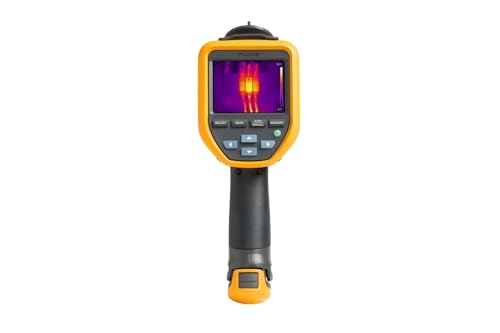
Fluke Ti480 PRO
The Fluke Ti480 PRO offers a 640×480 resolution and a 180-degree rotating screen, making it ideal for detailed inspections. Its laser sharp autofocus and advanced image processing deliver crisp thermal images. Professionals report it is reliable and built to last, though it is heavy and expensive.
Pros
- Exceptional image clarity with high resolution
- Durable and reliable for demanding job sites
- Rotating screen improves ergonomics
Cons
- Very expensive investment
- Bulky and heavy for one handed use

FLIR C5 Compact Thermal Camera
The FLIR C5 is a pocket sized camera that offers 160×120 resolution, which is sufficient for basic inspections. It features FLIR’s IGM technology and a 3.5 inch touchscreen. Users note it is handy and easy to carry, but it lacks the detail of higher end models.
Pros
- Compact and portable
- Affordable entry level professional tool
- Simple to operate
Cons
- Lower resolution limits diagnostic capability
- Small screen may be hard to view in bright light

FLIR E8 Pro
The FLIR E8 Pro provides 320×240 resolution and FLIR’s patented MSX technology for enhanced detail. It is designed with building inspectors in mind, offering features like one touch level span and flexible Wi-Fi. It is praised for its usability and image quality, though it is not as high res as the top model.
Pros
- Excellent image quality for the price
- User friendly interface
- Built to withstand tough conditions
Cons
- Price may be high for small businesses
- Battery life could be longer

FLUKE TiS55+
The Fluke TiS55+ is a mid range camera that offers 256×192 resolution and a wide temperature range. It is equipped with Fluke’s IR Fusion technology that overlays thermal and visual images for easy problem identification. Its field replaceable battery is a plus, but the resolution is lower than some competitors.
Pros
- Good balance of performance and cost
- Accurate temperature measurement
- Durable design
Cons
- Resolution may not capture very small details
- Touchscreen can be unresponsive at times

Hikmicro B20
The Hikmicro B20 offers a 256×192 resolution and a temperature range up to 650 degrees C, making it suitable for industrial environments. It has a 90 degree rotating screen and a 25Hz refresh rate for smooth imaging. Users appreciate its value, but some report occasional software glitches.
Pros
- High maximum temperature for industrial tasks
- Rotating screen for convenience
- Priced competitively
Cons
- Software can be buggy
- Build quality feels less premium

FLIR K65
The FLIR K65 is a rugged thermal camera specifically for firefighters. It can withstand extreme heat and provides clear images through smoke. Its design is simple with large buttons for use with gloves. The price is high, but its specialized features justify the cost for professional fire departments.
Pros
- Designed to endure harsh conditions
- Excellent image quality in smoke
- Simple one hand operation
Cons
- Very expensive
- Not suitable for general inspection tasks

Seek Thermal CompactPRO
The Seek Thermal CompactPRO is a small thermal camera that plugs into a smartphone’s USB C port. It offers 320×240 resolution and a wide field of view. It is a convenient and low cost option for quick checks, but it lacks the standalone capabilities of dedicated devices.
Pros
- Portable and easy to carry
- Turns your phone into a thermal camera
- Good value for money
Cons
- Requires a compatible smartphone
- Phone battery drains faster
Compared at a glance
| # | Model | Resolution | Best for | Score | Price |
|---|---|---|---|---|---|
| 1 | Fluke Ti480 PRO | 640 x 480 | High resolution and maximum accuracy | 9.4 | Check price |
| 2 | FLIR C5 Compact Thermal Camera | 160 x 120 | Everyday professional use on a budget | 8.0 | Check price |
| 3 | FLIR E8 Pro | 320 x 240 | Building inspections and moisture detection | 9.0 | Check price |
| 4 | FLUKE TiS55+ | 256 x 192 | Electrical and mechanical applications | 8.8 | Check price |
| 5 | Hikmicro B20 | 256 x 192 | Industrial maintenance with high temperature range | 8.6 | Check price |
| 6 | FLIR K65 | 320 x 240 | Firefighting and high heat environments | 9.2 | Check price |
| 7 | Seek Thermal CompactPRO | 320 x 240 | Smartphone based thermal imaging | 8.2 | Check price |
Frequently asked questions
What resolution do I need in a thermal camera?
For general professional use, a resolution of 160×120 is the minimum, but 320×240 is recommended for detailed inspections. Higher resolution cameras, like 640×480, are better for detecting small temperature differences from a distance.
Can thermal cameras see through walls?
No, thermal cameras cannot see through walls. They detect surface temperatures. However, they can detect temperature differences on a wall’s surface, which may indicate issues like moisture or missing insulation behind the wall.
What is thermal sensitivity and why is it important?
Thermal sensitivity, measured in milliKelvin (mK), is the smallest temperature difference the camera can detect. A lower mK value means the camera can detect smaller temperature differences, which is crucial for identifying subtle anomalies in electrical systems or building envelopes.
Do professional thermal cameras require certification?
In some industries, such as building inspection, certification may be required to interpret thermal images correctly. The camera itself does not require certification, but the user should have training to accurately diagnose issues.
Can I use a thermal camera for electrical inspections?
Yes, thermal cameras are commonly used for electrical inspections to detect overheating components, loose connections, and overloaded circuits. A camera with high thermal sensitivity and a suitable temperature range is recommended.
How accurate are thermal cameras?
Most professional thermal cameras have an accuracy of plus or minus 2 degrees C or 2% of the reading, whichever is greater. For critical measurements, it is important to consider the camera’s emissivity settings and adjust for the surface being measured.
What is MSX technology?
MSX (Multi Spectral Dynamic Imaging) is a FLIR technology that overlays visible light details on the thermal image. This helps users identify objects and orientation, making it easier to pinpoint problem areas.
Are there thermal cameras that connect to smartphones?
Yes, there are smartphone attachments like the Seek Thermal CompactPRO that plug into your phone’s port. They are portable and cost effective but may lack some advanced features and have lower resolution compared to standalone devices.
How long do thermal camera batteries last?
Battery life varies by model, typically ranging from 2 to 6 hours of continuous use. Some cameras have replaceable batteries, allowing you to carry spares for extended work sessions.
Can thermal cameras measure humidity or moisture?
Thermal cameras cannot measure humidity directly, but they can detect moisture by showing temperature differences caused by evaporative cooling. For precise moisture readings, you would need a moisture meter.
The bottom line
For most professionals, the FLIR E8 Pro offers the best balance of resolution, features, and price, making it our top recommendation for building inspectors and HVAC technicians. If you require the highest possible accuracy and are willing to invest, the Fluke Ti480 PRO is the premium choice. For those on a tight budget, the FLIR C5 is a reliable entry level tool, but it is not suitable for detailed diagnostics. Choose based on your specific needs, but always prioritize resolution and thermal sensitivity for serious work.
Jake Monroe
Jake worked as a residential contractor for over a decade before shifting to full-time writing. He evaluates power tools, hand tools and workshop gear through the lens of someone who has actually used them on job sites, not just read the box.


