Which Ski Boots Handle Aggressive All-Mountain Skiing?
Nordica’s Speedmachine 3 130 leads this comparison for advanced and expert skiers, pairing a 100mm last with a fully heat-moldable liner. The Tecnica Mach1 130 MV delivers similar performance at better value, while the Head Nexo LYT 130 suits skiers stepping up from mid-flex boots on a tighter budget.
Nordica’s Speedmachine 3 130 stands out for advanced and expert skiers who want a stiff, responsive boot with a shop-moldable fit. Its 100mm last suits average foot volume, though narrow or wide-footed skiers need a different width to start comfortably.
Boot fit depends more on foot shape than on the flex number printed on the cuff, so a 130 flex boot that suits one skier can pinch another badly. We compared last width, shell material, liner fit systems, and stated flex ratings across current 130 flex boots, balancing race, freeride, and comfort-focused picks.
The best picks, ranked

Nordica Speedmachine 3 130
Grilamid plastic in the lower shell keeps the Speedmachine 3 130 lighter, while a stiffer polyurethane cuff drives power into the ski. Its 100mm last targets advanced and expert skiers with average foot volume who want a responsive, all-mountain boot. A heat-moldable Terry Palissencer liner lets a boot shop custom-fit the shell.
Pros
- Stiff 130 flex suits aggressive skiing styles
- Heat-moldable liner allows custom shop fitting
- 100mm last balances precision with comfort
Cons
- Too stiff for intermediate or casual skiers
- 100mm last can feel narrow on wider feet

Tecnica Mach1 130 MV
A 100mm medium volume last widens the Mach1 130 MV’s appeal beyond narrow race lasts, while still holding a 130 flex for precision. Tecnica’s Custom Adaptive Shape system heat-molds specific pressure zones rather than baking the entire shell. One power strap across the cuff adds lateral support during hard turns.
Pros
- Medium volume last suits a broader range of foot shapes
- Zone-specific molding targets pressure points
- Power strap adds lateral cuff support
Cons
- Zone molding covers less area than full shell heat molding
- Still too stiff for beginner or intermediate skiers
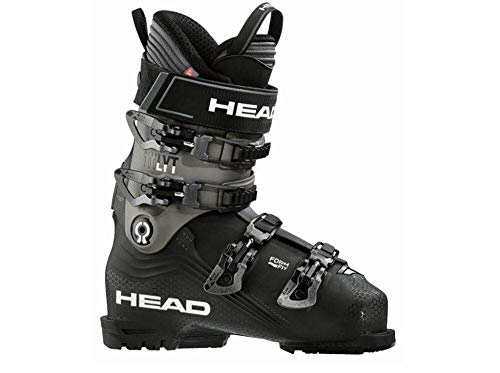
Head Nexo LYT 130
Head’s Liquid Fit system injects low-pressure foam around the foot at a shop, shaping the shell without a full heat mold. A 100mm last and 130 flex suit skiers moving up from mid-flex boots. Lighter shell construction trims swing weight compared with race-focused 130 flex boots.
Pros
- Liquid Fit offers a custom shell without full heat molding
- Lighter shell reduces leg fatigue on long days
- 100mm last suits average foot volume
Cons
- Liquid Fit process requires a specialty shop visit
- Less lateral stiffness than dedicated race boots

Salomon S/Pro 130
Twinframe construction separates the lower shell from the cuff pivot on the S/Pro 130, widening the range of ankle motion versus a one-piece shell. Heat-moldable Custom Shell material adjusts width for wider or higher-volume feet. A rear-entry-inspired cuff design eases entry despite the stiff 130 flex.
Pros
- Twinframe design widens range of ankle motion
- Heat-moldable shell accommodates wider feet
- Easier entry than typical stiff overlap boots
Cons
- Twinframe construction adds some shell bulk
- Best wide-foot fit still requires shop molding

Rossignol Hero World Cup 130 SC
FIS-legal race specifications shape the Hero World Cup 130 SC, pairing a narrow 98mm last with a direct, stiff shell for slalom and giant slalom. Three-piece cuff construction, typical of race boots, improves edge-to-edge power transfer over recreational shells. Race-oriented liners favor precision over everyday comfort padding.
Pros
- Narrow 98mm last suits low-volume race feet
- Three-piece cuff maximizes power transfer
- Direct shell feel benefits slalom and GS training
Cons
- Narrow last is uncomfortable for average or wide feet
- Race liner offers less all-day comfort padding
Lange RX 130
A 97mm last makes the RX 130 among the narrowest options in the 130 flex category, built for low-volume feet that want a snug, precise fit. Dual-core shell construction stiffens the lower boot for better power transfer. A Concept Comfort liner adds heat-moldable padding to fine-tune fit further.
Pros
- 97mm last suits narrow, low-volume feet precisely
- Dual-core shell adds lower boot stiffness
- Heat-moldable liner fine-tunes fit further
Cons
- Too narrow for average or wide foot shapes
- Snug fit needs careful shop sizing to avoid pressure points

Atomic Hawx Prime 130 S
Atomic’s Memory Fit system heat-molds both shell and liner on the Hawx Prime 130 S, going further than liner-only adjustment. A 3D lightweight shell trims weight compared with standard race-oriented 130 flex boots, useful across varied all-mountain terrain. A wide cuff design adds stability on off-piste and variable snow.
Pros
- Memory Fit molds both shell and liner for precise fit
- Lightweight shell reduces fatigue on long all-mountain days
- Wide cuff design adds off-piste stability
Cons
- 98mm last still runs narrow for high-volume feet
- Full Memory Fit molding requires a specialty shop
How they stack up
| # | Model | Flex rating | Best for | Score | Price |
|---|---|---|---|---|---|
| 1 | Nordica Speedmachine 3 130 | 130 | Best overall | 9.4 | Check price |
| 2 | Tecnica Mach1 130 MV | 130 | Best value | 9.1 | Check price |
| 3 | Head Nexo LYT 130 | 130 | Best budget | 8.8 | Check price |
| 4 | Salomon S/Pro 130 | 130 | Best for wide feet and comfort fit | 8.6 | Check price |
| 5 | Rossignol Hero World Cup 130 SC | 130 | Best for racing and World Cup flex | 8.4 | Check price |
| 6 | Lange RX 130 | 130 | Best for narrow low-volume feet | 8.2 | Check price |
| 7 | Atomic Hawx Prime 130 S | 130 | Best for all-mountain freeride | 8.0 | Check price |
What to look for
What Defines a Professional-Level Ski Boot A flex rating of 130 or higher marks the professional and expert category, resisting forward flex under aggressive skiing forces. Shell materials range from Grilamid, lighter and more flexible in cold temperatures, to polyurethane, which adds stiffness and weight. Heat-moldable liners are standard here, letting a boot fitter shape fit around the foot instead of relying on stock padding.
Flex Rating and Forward Lean Explained Resisting forward flex more than a 90 or 100 flex recreational boot, a 130 flex rewards a strong, forward-driving stance but punishes a passive one with harsh feedback. Forward lean angle, adjustable within a few degrees on boots like the Salomon S/Pro 130, changes how far forward the shin sits at rest. Race boots such as the Rossignol Hero World Cup 130 SC often ship with less adjustment since race stances are more standardized.
Choosing Boot Width and Last for Your Foot Shape Measured in millimeters at the widest part of the forefoot, last width is the single biggest factor in comfortable fit. Narrow lasts around 97 to 98mm, found on the Lange RX 130 and Rossignol Hero World Cup 130 SC, suit low-volume feet but create pressure points on wider ones. A 100mm last, used on the Nordica Speedmachine 3 130 and Salomon S/Pro 130, fits average to slightly wider feet without heavy shop punching.
Best Boots for Racing, Freeride, and All-Mountain Days Gate training rewards the narrow, direct feel of the FIS-legal Rossignol Hero World Cup 130 SC. Variable terrain favors the Atomic Hawx Prime 130 S instead, whose wider cuff and lighter shell suit long days off-piste. Skiers upgrading from intermediate gear for the first time often do better starting with a medium volume option like the Tecnica Mach1 130 MV before moving to a narrower race last.
Questions worth asking
What flex rating is best for advanced skiers?
A 130 flex rating, found on boots like the Nordica Speedmachine 3 130, generally suits advanced and expert skiers who drive the boot forward aggressively and consistently.
How do I know my ski boot last width?
A boot fitter measures forefoot width in millimeters. Boots in this category typically range from about 97mm for narrow feet to 100mm for average width, according to manufacturer specifications.
Are 130 flex ski boots too stiff for intermediate skiers?
Owners and fitters generally report that a 130 flex demands a strong, forward stance, so intermediate skiers who ski more passively often find a 110 or 120 flex more comfortable.
Race boots vs all-mountain boots, what’s the difference?
Race boots like the Rossignol Hero World Cup 130 SC use a narrower last and a three-piece cuff for direct power transfer. All-mountain boots like the Atomic Hawx Prime 130 S use a wider cuff and lighter shell for varied terrain.
What is the best ski boot for narrow feet?
The Lange RX 130 uses a 97mm last, among the narrower options in the 130 flex category, suited to low-volume feet that want a snug fit without extra shop punching.
Can professional ski boots be heat molded?
Most 130 flex boots in this category, including the Nordica Speedmachine 3 130 and Atomic Hawx Prime 130 S, use heat-moldable liners or shells that a boot fitter shapes at a shop.
How much forward lean should a ski boot have?
Forward lean is typically adjustable within a few degrees on boots like the Salomon S/Pro 130. The right setting depends on the skier’s stance and shin angle rather than one fixed number.
Which ski boots work best for wide feet and high volume?
The Salomon S/Pro 130 uses a Twinframe shell construction and a heat-moldable Custom Shell liner that accommodate wider or higher-volume feet better than narrower race-last boots.
Is a medium volume boot a good first step into 130 flex?
Skiers moving up from softer flexes often find a medium volume last, like the one on the Tecnica Mach1 130 MV, more forgiving than a narrow race last while still holding a stiff 130 flex.
The bottom line
Nordica’s Speedmachine 3 130 remains the top pick for advanced and expert skiers with average foot volume, pairing a 100mm last with a fully heat-moldable liner for shop customization. Skiers with wider or higher-volume feet should choose the Salomon S/Pro 130 instead, since its Twinframe shell handles width adjustments more easily. Racers training gates get more direct feedback from the Rossignol Hero World Cup 130 SC.
Derek Holt
Derek has a background coaching recreational and amateur athletes and has worked the sales floor at specialty fitness retailers. He focuses on equipment durability, ergonomics and realistic use cases rather than marketing claims.