Commercial-grade sandboxes for daily group play
KidKraft Backyard Sandbox with Canopy leads for settings that run every day, pairing a cedar frame with bench seats and adjustable shade. Step2 Naturally Playful Sandbox skips all upkeep and locks its lid down properly. ECR4Kids Sand and Water Activity Table brings sand play indoors at waist height.
KidKraft Backyard Sandbox with Canopy fits a nursery garden or a backyard used every day, since cedar, two bench seats and an adjustable canopy arrive in one purchase. Cedar does need a seal coat each spring, which moulded plastic never asks for. Settings with nobody to do that upkeep should jump to the Step2 Naturally Playful Sandbox instead.
Sandboxes fail in three predictable ways: lids that never seal, corners that rot from the ground up, and sand that sours because water cannot escape. Capacity gets underestimated too, because a box sized for two toddlers collapses into elbowing with six. We compared sand capacity, frame material and joinery, cover design, seating, drainage and footprint. Owner reports after a full season outdoors decided the durability calls that product pages leave out.
What matters most
What separates a commercial-grade sandbox from a toy Frame material decides most of it. Cedar and double-wall moulded polyethylene survive years of weather, while thin pine and single-wall shells crack or rot inside two seasons. Cover design comes next, because an open box fills with rain and becomes a hygiene problem within days. Capacity ranks third and gets ignored most often. Crowding is what snaps rims and warps lids, not the sand itself. On wooden models, check the joinery: screwed and bracketed corners outlast stapled ones by years.
Covers, drainage and keeping the sand clean Animals are the usual reason a sandbox gets condemned, and a loose tarp stops none of them. Locking lids on the Step2 Naturally Playful and Badger Basket models seal the box completely. Mesh covers like the KidKraft one pass rain through while blocking leaves and cats, which suits drier climates. Drainage carries equal weight. Set a ground box on level soil over permeable landscape fabric, never on a plastic sheet or slab that traps water below the sand.
Sizing for daycares, childminders and family gardens Count the children first, then work back to a footprint. Roughly six to eight square feet of sand area per child keeps digging from turning into elbowing. KidKraft and Outsunny boxes with seating on two or more sides cover a small group. Turtle-shell boxes serve one or two at a time. Where several age groups share one garden, two smaller boxes usually beat a single large one, since toddlers and older diggers can then be separated without a rota.
Indoor sand play and tight spaces Classrooms rule out ground boxes entirely, and that is the gap the ECR4Kids activity table fills. Waist-height bins contain the mess, drain plugs empty them in seconds, and a locking lid converts the unit to a work surface for the next activity. Volume drops sharply, so expect pouring and scooping rather than tunnelling. Fill it with non-toxic play or kinetic sand, which clumps together instead of scattering across the floor.
The best picks, ranked
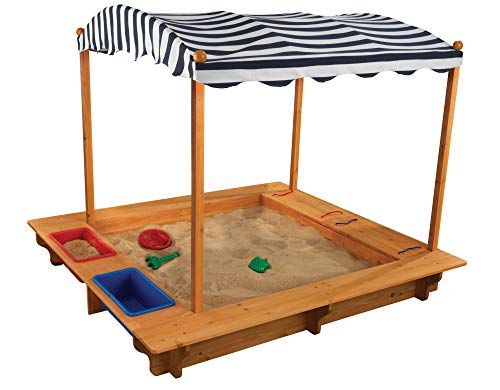
KidKraft Backyard Sandbox with Canopy
Cedar carries natural oils that resist rot and insects, which is why it outlives pine frames on damp ground. Two corner benches with backrests give children a dry place to sit, and the canopy tilts to track the sun through the middle of the day. Overnight, a fitted mesh cover keeps leaves, cats and debris out while rain drains straight through.
Pros
- Cedar resists rot with no chemical treatment
- Canopy angle adjusts as the sun moves
- Bench seats cut the sand tracked indoors
Cons
- Annual seal coat keeps the wood from greying
- Assembly runs well past an hour

Step2 Naturally Playful Sandbox
Double-wall moulded polyethylene shrugs off frost, rain and sun with zero annual upkeep. Its two-piece lid locks down rather than resting loose, so rain and animals stay out between sessions. Moulded seat areas run along the rim, and the shell swallows roughly 200 pounds of play sand.
Pros
- No sanding, sealing or rot to manage
- Lid latches instead of sitting on top
- Seating is moulded into the shell
Cons
- Colour fades under strong sun over several seasons
- Fixed footprint cannot be extended later

Little Tikes Turtle Round Sandbox
This turtle shell stays light enough for one adult to tip, empty and rinse at the end of a season. Its shell lid clips down to block cats, then flips over to hold a few inches of water on a hot afternoon. Two or three toddlers fit, so treat it as a second station rather than the main sand area.
Pros
- One adult can lift and empty it alone
- Inverted lid becomes a shallow water tray
- Cheapest route to a properly lidded box
Cons
- Too small to serve a full group
- Shallow shell limits real digging

Badger Basket Covered Convertible Cedar Sandbox with Two Bench Seats
Both lid panels fold open into bench seats with backrests, so the cover earns a second job instead of leaning against a fence. Cedar handles damp ground better than treated pine and needs no paint. Footprint stays tight, which suits a patio, a balcony corner or a childminder garden.
Pros
- Lid converts to seating with no extra hardware
- Solid panels block rain and animals completely
- Fits where full-size boxes will not
Cons
- Interior gets tight beyond two children
- Panels are heavy for a child to lift alone

Little Tikes Big Digger Sandbox
A crane arm and digger bucket are moulded straight into the rim, so nothing walks off the way loose spades do. Clip-on lid seals the sand between sessions. Play features rather than floor area define it, which makes it a companion to a larger box in a daycare rather than a replacement.
Pros
- Fixed digger cannot be lost or taken home
- Holds attention longer than a plain shell
- Rinses out quickly at the end of a season
Cons
- Digger mount eats into usable sand area
- Crane mechanism traps sand and needs rinsing

Outsunny Kids Wooden Sandbox with Canopy
Its canopy slides along the frame, so one box can be shaded at noon and open by late afternoon. Fir timber comes treated for outdoor use, with bench seating fitted along two sides. Underneath, a fabric liner separates sand from bare soil and slows weeds pushing up through the base.
Pros
- Canopy retracts instead of being unclipped
- Liner keeps soil and weeds out of the sand
- Two sides of seating hold more children
Cons
- Fir needs resealing more often than cedar
- Canopy fabric fades after a couple of summers

ECR4Kids Sand and Water Adjustable Activity Play Table
Raising sand to waist height keeps it off a classroom floor, which is why nurseries and preschools use this format indoors. Legs adjust, so one table serves toddlers and older preschoolers through the year. Twin removable tubs let sand sit on one side and water on the other, and the locking lid turns the frame into a work surface between activities.
Pros
- Works indoors where a ground box cannot
- Drain plugs empty and clean the tubs fast
- Height changes as a group of children grows
Cons
- Sand volume is far below any ground-level box
- Standing play only, with no room to sit inside
The lineup, side by side
| # | Model | Frame | Best for | Score | Price |
|---|---|---|---|---|---|
| 1 | KidKraft Backyard Sandbox with Canopy | Cedar wood with corner bench seats | Best overall | 9.4 | Check price |
| 2 | Step2 Naturally Playful Sandbox | Double-wall moulded polyethylene | Best value | 9.2 | Check price |
| 3 | Little Tikes Turtle Round Sandbox | Moulded plastic shell | Best budget | 9.0 | Check price |
| 4 | Badger Basket Covered Convertible Cedar Sandbox with Two Bench Seats | Cedar wood | Best for small yards | 8.8 | Check price |
| 5 | Little Tikes Big Digger Sandbox | Moulded crane arm and digger bucket | Best for digging play | 8.6 | Check price |
| 6 | Outsunny Kids Wooden Sandbox with Canopy | Treated fir wood | Best for sun protection | 8.3 | Check price |
| 7 | ECR4Kids Sand and Water Adjustable Activity Play Table | Raised twin-bin activity table | Best for classrooms | 8.0 | Check price |
Questions worth asking
What kind of sand should go in a sandbox?
Use washed and screened play sand labelled for children, with the fine silica dust removed. Builders sand and beach sand carry stones, shell and debris. Most family-sized boxes take somewhere between 150 and 300 pounds of fill.
How do you keep cats out of a sandbox?
A lid that latches is the only dependable answer, which is why the Step2 and Badger Basket models suit daycare settings. Mesh covers block animals while letting rain through. Most contamination traces back to a box left open overnight.
Which sandbox is best for a daycare or preschool?
KidKraft Backyard Sandbox with Canopy outdoors, for its seating, shade and cedar frame. ECR4Kids Sand and Water Activity Table indoors, since it keeps sand off the floor and adjusts to different ages. Plenty of settings run both together.
Is a wooden or plastic sandbox more durable?
Cedar lasts many years outside but wants sealing roughly once a year. Double-wall moulded plastic asks for nothing at all, though colours fade under strong sun. Pick plastic whenever nobody on site will handle the upkeep.
What size sandbox do I need for a group of children?
Allow six to eight square feet of sand area per child to avoid crowding. Turtle-shell boxes handle two or three toddlers. Boxes with bench seating on multiple sides, such as the KidKraft or Outsunny, cover a small group comfortably.
How often should sandbox sand be replaced?
Rake it weekly and lift out debris as you spot it. In a busy setting, plan on fresh sand once a year. A sealed lid stretches that interval, while sand rained on repeatedly and left uncovered should be swapped sooner.
Do sandboxes need drainage underneath?
Yes. Level the ground, lay permeable landscape fabric, then set the box on top so water drains away and the sand dries. Solid plastic sheeting or a concrete slab traps moisture and the sand turns sour.
Can a sandbox be used indoors?
Ground boxes cannot, but raised tables such as the ECR4Kids model are built for it. Waist-height bins keep sand contained and the lid closes the unit between activities. Non-toxic play or kinetic sand clumps rather than scattering across a floor.
Can a sandbox stay outside over winter?
Cedar and moulded plastic both overwinter well once the lid is secured. Empty or seal the sand, because repeated freezing and thawing packs it into a solid block. Take fabric canopies off and store them dry to prevent mildew.
The verdict
For a nursery garden or a backyard used every single day, the KidKraft Backyard Sandbox with Canopy repays its assembly time, because cedar, bench seating and adjustable shade all arrive together. Any setting without someone to seal wood each spring should take the Step2 Naturally Playful Sandbox and its locking lid. Indoors, no ground box competes with the ECR4Kids activity table, and a preschool running both outdoor and indoor sessions will end up owning two of these.
Rachel Simmons
Rachel previously worked in child-product retail and brings a practical, detail-first eye to gear reviews, focusing on safety standards, ease of use and the fine print that matters most for new caregivers.


