Mountain Bikes That Handle Real Singletrack, Not Bike Paths
Diamondback’s Overdrive Comp 29 suits most riders stepping up from casual paths onto real singletrack, thanks to its aluminum hardtail frame and hydraulic disc brakes. Diamondback’s Line 29 adds full suspension for rougher descents a hardtail cannot smooth out. Mongoose’s Switchback Comp delivers similar hardtail capability for less.
Riders moving beyond casual paths onto real singletrack get the most from Diamondback’s Overdrive Comp 29, since its aluminum hardtail frame and hydraulic disc brakes handle climbs and technical descents. Rougher, faster descents call for the Diamondback Line 29 instead, because full suspension controls terrain a hardtail struggles with. A tighter budget still buys similar hardtail performance through the Mongoose Switchback Comp.
Suspension travel and frame material shape handling more than most riders expect before comparing specs side by side. A hardtail with 100 millimeters of travel rides nothing like a full-suspension bike with 120 millimeters front and rear. We compared frame material, suspension, wheel size, and gearing across seven current listings to match each bike to real trail conditions.
Before you buy
What separates a trail-capable mountain bike from a hybrid A suspension fork, disc brakes, and knobby tires built for loose terrain set a trail-capable mountain bike apart from a basic hybrid. Frame material matters too: aluminum keeps weight down while resisting the dents steel picks up on rocky trails. Gearing range affects how well a bike climbs steep grades without excessive pedaling effort. Wheel size, typically 27.5 or 29 inches, changes how the bike rolls over obstacles.
Hardtail vs full suspension Front suspension only, as on the Diamondback Overdrive Comp, keeps a hardtail’s weight lower and pedaling efficient on climbs. Rear shock absorption, added on the Diamondback Line 29, smooths out rocky or root-heavy descents that a hardtail cannot control as well. Full suspension bikes weigh more and need more frequent maintenance on their extra pivot points. Riders who mostly climb should lean hardtail; those chasing descents benefit from full suspension.
Best mountain bikes for climbing vs descending A lighter bike with a wide gear range wins on climbs, which is where hardtails like the Vilano Blackjack or Mongoose Switchback Comp perform well. Suspension travel and wider tire clearance matter more on technical descents, both present on the Diamondback Line 29. Fat bikes like the Framed Marquette trade climbing efficiency for traction on sand, snow, and loose surfaces most bikes cannot handle.
Wheel size and frame fit for different riders Handling changes more with wheel size than most riders expect. Twenty-nine inch wheels, used on most bikes here, roll over roots and rocks smoothly and suit taller riders. Maneuvering at low speed comes easier on the 27.5-inch wheels found on the Hiland model, which also fit smaller riders better. Frame size still matters separately from wheel size, so checking a manufacturer’s height chart avoids an awkward fit.
What we recommend
Diamondback Overdrive Comp 29
A 6061 aluminum hardtail frame pairs with a RockShox suspension fork offering around 100 millimeters of travel. Hydraulic disc brakes and a wide-range drivetrain handle climbs and technical descents alike. Twenty-nine inch wheels roll over roots and rocks more smoothly than smaller sizes.
Pros
- RockShox fork outperforms basic suspension found on cheaper bikes
- Hydraulic disc brakes give consistent stopping power on descents
- 29-inch wheels roll over trail obstacles more easily
Cons
- Hardtail frame transmits more impact on rough descents
- Heavier than carbon-frame competitors at a higher cost

Diamondback Line 29
Full front and rear suspension on an aluminum frame gives more control on rocky or root-covered descents than a hardtail offers. Wider tire clearance improves traction on loose terrain. Those extra suspension components add weight compared to hardtail models.
Pros
- Full suspension absorbs impact better on technical descents
- Wider tire clearance improves grip on loose or rocky trails
- Consistent hydraulic disc braking in wet conditions
Cons
- Heavier overall than hardtail options like the Overdrive Comp
- Suspension components need more frequent maintenance

Mongoose Switchback Comp
An aluminum hardtail frame carries a suspension fork and mechanical disc brakes at a lower price point. Its drivetrain covers a wide gear range suited to climbing moderate grades. Most of the trail capability of pricier hardtails shows up here for less.
Pros
- Wide gear range handles moderate climbs comfortably
- Aluminum frame keeps weight reasonable for the price
- Disc brakes outperform rim brakes in wet trail conditions
Cons
- Mechanical disc brakes need more adjustment than hydraulic
- Suspension fork offers less travel than premium hardtails

Schwinn High Timber Mountain Bike
Steel or aluminum framing, depending on trim, pairs with a basic front suspension fork on this entry-level model. Paved trails, gravel paths, and light off-road riding suit it better than technical singletrack. Linear-pull brakes keep cost down compared to disc brake systems.
Pros
- Lowest cost entry point into mountain bike styling and gearing
- Simple rim brakes are easy to adjust without special tools
- Lighter riders find the frame stiff enough for smoother trails
Cons
- Rim brakes lose stopping power faster in mud or rain
- Basic fork struggles on technical or rocky terrain
Vilano Blackjack 29er
A lightweight aluminum frame carries 29-inch wheels and a suspension fork built for moderate trail grades. Shimano-based drivetrains shift through a range suited to that kind of riding. Stepping up from a department-store bike costs less here than buying a premium hardtail.
Pros
- Shimano drivetrain shifts more reliably than unbranded components
- Lightweight aluminum frame suits longer rides comfortably
- Solid step-up option from entry-level department-store bikes
Cons
- Suspension fork has limited adjustment compared to RockShox forks
- Not built for aggressive technical descents

Framed Marquette Fat Bike
Oversized fat tires, roughly 4 inches wide, grip sand, snow, and loose gravel where standard mountain bike tires struggle. An aluminum frame keeps overall weight manageable despite the larger wheels. Gearing favors slower, torque-heavy riding over technical speed.
Pros
- Wide tires provide traction on sand and snow other bikes cannot handle
- Extends riding season into winter or wet conditions
- Stable, confidence-inspiring ride on loose surfaces
Cons
- Heavier rolling resistance than standard mountain bike tires
- Less efficient for fast singletrack compared to standard 29ers
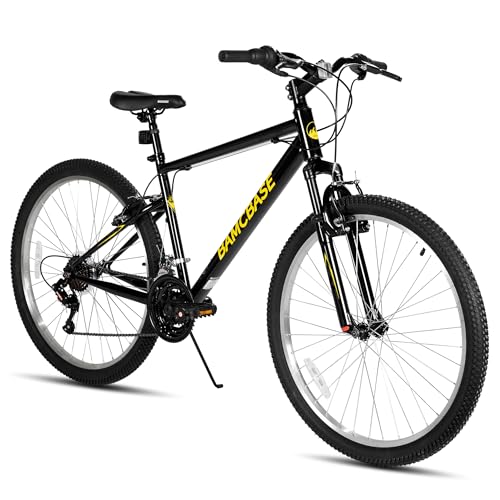
Hiland 27.5 Mountain Bike
A lighter aluminum frame pairs with 27.5-inch wheels, sized to suit smaller riders better than larger 29-inch options. Front suspension and disc brakes cover moderate trail use. Maneuvering at low speed comes easier with the smaller wheel size.
Pros
- 27.5-inch wheels suit smaller riders better than 29-inch bikes
- Lighter overall frame weight than most hardtails on this list
- Easier low-speed maneuverability on tight singletrack
Cons
- Smaller wheels roll over large obstacles less smoothly
- Component quality trails behind Shimano-equipped competitors
Compared at a glance
| # | Model | Frame material | Best for | Score | Price |
|---|---|---|---|---|---|
| 1 | Diamondback Overdrive Comp 29 | 6061 aluminum | Best overall | 9.3 | Check price |
| 2 | Diamondback Line 29 | Aluminum, full suspension | Best for technical trails | 9.1 | Check price |
| 3 | Mongoose Switchback Comp | Aluminum | Best value | 8.8 | Check price |
| 4 | Schwinn High Timber Mountain Bike | Steel or aluminum (trim dependent) | Best budget | 8.6 | Check price |
| 5 | Vilano Blackjack 29er | Aluminum | Best for riders moving up from beginner bikes | 8.4 | Check price |
| 6 | Framed Marquette Fat Bike | Aluminum | Best for all-terrain riding | 8.2 | Check price |
| 7 | Hiland 27.5 Mountain Bike | Lightweight aluminum | Best for smaller riders | 8.0 | Check price |
Good to know
What is the difference between a hardtail and full-suspension mountain bike?
A hardtail has front suspension only, while full suspension adds a rear shock. Hardtails climb more efficiently; full suspension handles rough descents more smoothly.
Is 29-inch or 27.5-inch better for mountain biking?
29-inch wheels roll over obstacles more easily and suit taller riders. 27.5-inch wheels maneuver faster at low speed and fit smaller riders better.
Are aluminum mountain bike frames good enough for real trails?
Yes. Aluminum frames, used on most bikes in this comparison, balance weight and durability well for singletrack and moderate technical trails.
Hydraulic vs mechanical disc brakes: which stops better on a mountain bike?
Hydraulic disc brakes, found on the Diamondback models, provide more consistent stopping power with less hand fatigue than mechanical disc brakes.
What suspension travel is enough for beginner trail riding?
Around 100 millimeters of front suspension travel, like the Diamondback Overdrive Comp offers, handles moderate trail riding without adding unnecessary weight.
Can a fat bike be used as a regular mountain bike?
Yes, but the wider tires add rolling resistance on hard-packed trails. Fat bikes like the Framed Marquette perform best on sand, snow, or loose gravel.
How much gearing range does a mountain bike need for climbing?
A wide-range drivetrain, common on the Overdrive Comp and Switchback Comp, helps riders climb steep grades without excessive strain on the knees.
Do I need full suspension for casual trail riding?
Casual trail riders often do fine on a hardtail, which climbs more efficiently. Full suspension matters more for aggressive or technical descents.
What is the best mountain bike for a beginner stepping up from a hybrid?
The Diamondback Overdrive Comp or Vilano Blackjack both offer a manageable step up, with suspension forks and disc brakes a hybrid typically lacks.
Mechanical vs hydraulic disc brakes: is the upgrade worth it?
Hydraulic brakes need less hand force and hold consistent power over long descents, which makes the upgrade worth it for riders tackling steeper trails often.
The verdict
Riders stepping into real trail riding should start with the Diamondback Overdrive Comp for its balance of suspension, brakes, and wheel size. Anyone tackling rockier, technical descents regularly should upgrade to the Diamondback Line 29’s full suspension instead. Budget-focused riders can still get comparable hardtail performance from the Mongoose Switchback Comp without paying for extra suspension they may not need.
Derek Holt
Derek has a background coaching recreational and amateur athletes and has worked the sales floor at specialty fitness retailers. He focuses on equipment durability, ergonomics and realistic use cases rather than marketing claims.