High-Capacity RV Water Filters for Serious Campers
For most RV owners seeking professional-grade filtration, the Clearg2 Systems CG2-B10A is the top pick because it delivers dual-stage filtration with a 0.5 micron rating and a high flow rate. Its main advantage is the ability to remove sediment, chlorine, and many chemicals while maintaining strong water pressure, but its main limitation is that replacement filters are relatively pricey.
Clean water is a must for any RV trip, whether you are boondocking or staying at a full-hookup campground. Standard inline filters often struggle with flow rate and capacity, leaving you with a trickle or frequent replacements.
High-capacity filters solve this by offering larger filter media and higher flow rates. We compared seven of the best professional-grade options to help you choose the right one for your rig.
How to pick the right one
The shortlist, ranked
Clearg2 Systems CG2-B10A
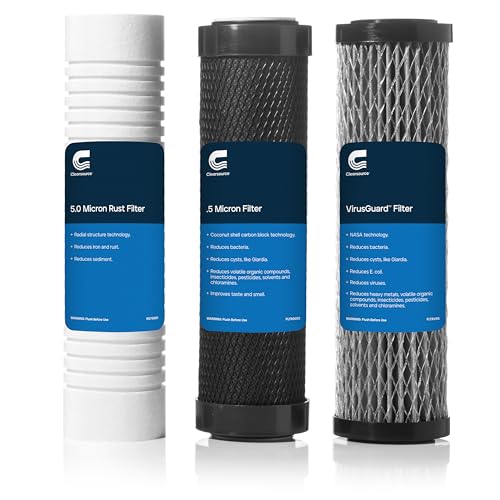
The Clearg2 CG2-B10A is a dual-stage filtration system that combines a 5-micron sediment filter with a 0.5-micron carbon block. Owners report excellent taste and odor reduction, and it handles high flow rates without pressure drop. It is designed for permanent or semi-permanent installation, making it a favorite for full-time RVers.
Pros
- Excellent contaminant reduction including cysts and lead
- High flow rate supports multiple fixtures
- Transparent housings allow easy monitoring
Cons
- Replacement filters are expensive
- Installation requires some plumbing skills

iSpring RCC7
The iSpring RCC7 is a 6-stage reverse osmosis system that removes up to 99% of over 1,000 contaminants, including lead, arsenic, and fluoride. While it is typically used in homes, many RVers install it for the highest quality water. It includes a storage tank and delivers a slow but steady flow, ideal for drinking and cooking.
Pros
- Removes almost all contaminants
- Adds beneficial minerals in final stage
- Long membrane life
Cons
- Requires 50 psi water pressure to operate
- Waste water ratio is 1:1, not ideal for boondocking

Camco TastePURE Plus 40043
The Camco TastePURE Plus is a disposable inline filter that offers a higher capacity than standard models, filtering up to 6 months or 1,500 gallons. It reduces bad taste, odor, sediment, and chlorine. It is easy to install with no tools, making it a great choice for weekend campers who want better water without complex systems.
Pros
- Easy installation, no tools needed
- Compact and lightweight
- Improves taste and odor noticeably
Cons
- Does not remove heavy metals or chemicals
- Must be replaced frequently compared to larger systems
AquaCrest RV Water Filter
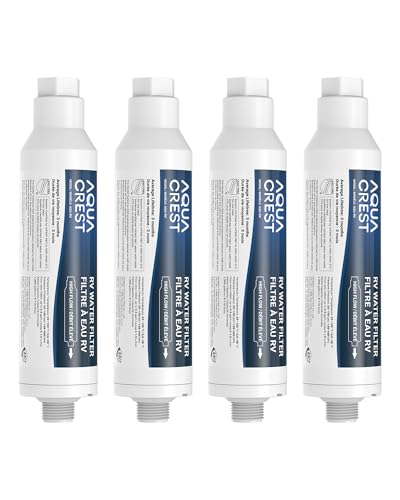
The AquaCrest RV Water Filter is a dual-stage system with a 20-micron sediment filter followed by a 5-micron carbon block. It is designed for RVers who encounter sandy or dirty water sources. The clear housings allow you to see when filters need changing. It offers a flow rate of up to 8 GPM, suitable for most RVs.
Pros
- Excellent sediment removal
- Transparent housings for monitoring
- High flow rate
Cons
- Carbon block does not reduce heavy metals
- Requires regular cleaning of sediment filter
RVs Water Filter System by Culligan
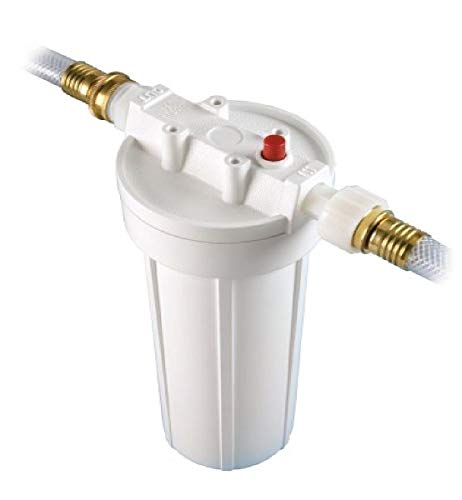
Culligan’s RV Water Filter System is a compact inline filter certified to NSF/ANSI Standard 42 for chlorine and taste/odor reduction. It also reduces sediment and rust. It is known for its reliability and easy twist-on connection. While not as high capacity as others, it offers consistent quality for up to 3 months or 750 gallons.
Pros
- NSF/ANSI 42 certified
- Simple twist-on installation
- Trusted brand
Cons
- Lower flow rate
- Shorter filter life

Watts Premier 531130
The Watts Premier 531130 is a whole-house filter that can be adapted for RV use. It features a 5-micron carbon block cartridge that reduces sediment, chlorine, and other contaminants. It is compact enough to fit under a sink or in a cabinet. Its high capacity of up to 10,000 gallons makes it a long-lasting option for RVers who stay in one place for extended periods.
Pros
- Very long filter life
- Compact design
- Can be used for whole RV if plumbed correctly
Cons
- Not designed specifically for RV vibration
- Requires mounting and plumbing

APEC Water Systems ROES-50
The APEC ROES-50 is a 5-stage reverse osmosis system that is popular for RVs because it can be installed under a counter and provides a dedicated faucet. It removes up to 99% of contaminants including lead, fluoride, and arsenic. It comes with a 3.2-gallon storage tank and includes all necessary fittings. It is ideal for RVers who want bottled-quality water without buying bottled water.
Pros
- High contaminant removal
- Includes storage tank
- DIY installation with instructions
Cons
- Produces waste water
- Slow flow from tank, requires pump for high flow
Compared at a glance
| # | Model | Filtration | Best for | Score | Price |
|---|---|---|---|---|---|
| 1 | Clearg2 Systems CG2-B10A | Dual-stage, 0.5 micron | Best overall for most RVs | 9.4 | Check price |
| 2 | iSpring RCC7 | 6-stage RO | Best for full-time RVers needing reverse osmosis | 9.1 | Check price |
| 3 | Camco TastePURE Plus 40043 | Single-stage, 5 micron | Best budget-friendly high-capacity inline filter | 8.8 | Check price |
| 4 | AquaCrest RV Water Filter | Dual-stage, 20/5 micron | Best for high sediment and well water | 8.7 | Check price |
| 5 | RVs Water Filter System by Culligan | Single-stage carbon | Best for certified contaminant reduction | 8.6 | Check price |
| 6 | Watts Premier 531130 | Single-stage, 5 micron | Best for under-sink installation with RV water heater | 8.4 | Check price |
| 7 | APEC Water Systems ROES-50 | 5-stage RO | Best for contaminant-free drinking water with high TDS | 8.2 | Check price |
Good to know
How often should I replace my high-capacity RV water filter?
Replacement frequency depends on usage and water quality. Most manufacturers suggest replacing filters every 3 to 6 months or after a certain number of gallons (e.g., 1,500 to 10,000 gallons). If you notice a drop in flow rate or a change in taste, it is time to replace the filter. For full-time RVers, checking monthly is wise.
Can I use a whole-house water filter in my RV?
Yes, many whole-house filters can be adapted for RV use, but consider the size and mounting. Whole-house filters are often too large to fit in tight RV spaces. Look for compact models like the Watts Premier 531130 that can fit under a sink. Ensure the connections are compatible with your RV’s plumbing.
Do RV water filters remove bacteria and viruses?
Most carbon and sediment filters do not remove bacteria or viruses. To remove microbiological contaminants, you need a filter with a pore size of 0.1 micron or less or a UV purifier. Reverse osmosis systems can remove some bacteria, but not all. If you are concerned about pathogens, consider a filter certified to NSF/ANSI 53 or 55 for cyst reduction.
What is the difference between a 5-micron and a 0.5-micron filter?
Micron rating refers to the filter’s ability to remove particles of a certain size. A 5-micron filter removes particles as small as 5 micrometers, including sediment and some cysts. A 0.5-micron filter removes much smaller particles, including many bacteria and cysts. Finer filters may have a lower flow rate but offer better protection.
Can I install a high-capacity RV water filter myself?
Many inline filters are easy to install with no tools, simply connecting to your hose. More complex systems, like reverse osmosis or dual-stage filters, require basic plumbing skills. If you are comfortable working with PVC or braided hoses, you can do it yourself. Otherwise, a professional installation is recommended.
Will a high-capacity filter reduce water pressure in my RV?
High-quality filters are designed to minimize pressure drop. However, any filter will cause some reduction. Look for filters with a high flow rate rating (e.g., 5 GPM or higher) to ensure adequate pressure. Reverse osmosis systems naturally have low flow and are intended for drinking water only, not for the whole RV.
Are there any filters that remove lead and other heavy metals?
Yes, filters with activated carbon that are certified to NSF/ANSI 53 for lead reduction can remove lead. Reverse osmosis systems are also effective at removing heavy metals. Check the product specifications for certifications to ensure the filter meets your needs.
What does NSF/ANSI 42 certification mean?
NSF/ANSI 42 covers aesthetic effects, such as chlorine taste and odor, and some particulates. A filter with this certification has been tested to reduce chlorine and improve taste. It does not guarantee removal of health contaminants. For health-related claims, look for NSF/ANSI 53 or 58 (for RO systems).
Can I use a high-capacity filter while boondocking?
Yes, but consider the water source. If you are drawing from a lake or river, you may need a sediment filter first. For reverse osmosis, you need adequate pressure and produce waste water, which is not ideal for boondocking. A simple carbon filter is more practical for occasional use.
How do I know if my filter is working properly?
Many filters come with clear housings so you can see the condition of the filter. Some have a pressure gauge. If you notice a decrease in flow rate, it may be clogged. Taste and odor changes are also indicators. For health-related filters, regular replacement is the only way to ensure effectiveness.
Final word
For most RVers, the Clearg2 Systems CG2-B10A strikes the best balance of high capacity, excellent filtration, and flow rate, making it our top recommendation. If you need the absolute purest water for drinking and cooking, consider a reverse osmosis system like the iSpring RCC7, but be prepared for installation complexity and waste water. Budget-conscious campers can rely on the Camco TastePURE Plus for a significant improvement over unfiltered water without breaking the bank.
Tony Russo
Tony trained as an automotive technician and spent years in service and parts retail before moving into writing. He focuses on garage tools, car care products and accessories from a hands-on maintenance perspective.