Heavy-Duty Car Polishers That Pros Actually Rely On
For most professional detailers, the Rupes BigFoot LHR21 Mark III is the top pick, offering the best balance of power, low vibration, and correction capability. It excels on large panels and delivers a swirl-free finish, but its premium price and need for a separate backing plate for smaller areas are drawbacks. If you need extreme cutting power for severe defects, consider the Flex XC3401 VRG, a forced rotation dual action that won’t bog down, though it has a learning curve. For budget-conscious pros, the Griot’s Garage G9 is a solid choice, providing smooth operation and a 10-year warranty, but it lacks the raw power of the premium models.
Professional heavy-duty polishing machines are built for daily use, demanding reliability, power, and precision. Unlike consumer-grade polishers, these tools are designed to handle severe oxidation, deep scratches, and large surfaces without overheating or stalling.
Whether you run a detailing business or tackle serious restoration projects, the right machine can make the difference between a flawless finish and hours of frustration. We compared the leading models from Rupes, Flex, Griot’s, and more to help you choose.
The shortlist, ranked

Rupes BigFoot LHR21 Mark III
The Rupes BigFoot LHR21 Mark III is the industry standard for professional paint correction. Its 21mm orbit stroke provides fast cutting while maintaining a smooth, low-vibration feel. Owners report that it easily handles heavy compounding and finishes down to a high gloss without holograms.
Pros
- Excellent cutting power for large panels
- Low vibration reduces operator fatigue
- Durable construction built for daily professional use
Cons
- Expensive, especially with necessary accessories
- Large head may be too big for tight areas

Flex XC3401 VRG
The Flex XC3401 VRG is a forced rotation dual action polisher that combines the safety of a DA with the cutting power of a rotary. It maintains rotation under load, so it won’t stall on curved surfaces. Professional detailers love its ability to remove deep scratches and sanding marks quickly.
Pros
- Forced rotation prevents stalling on any panel
- High torque for fast correction
- Built to last with a rugged design
Cons
- Heavier and more vibration than standard DA
- Steeper learning curve for beginners

Griot’s Garage G9
The Griot’s Garage G9 is a powerful 900-watt dual action polisher that offers smooth operation and a 10-year warranty. It features a 9mm orbit that provides good correction while remaining easy to control. Many users compare its performance to machines costing twice as much.
Pros
- Excellent value for the price
- Smooth and quiet operation
- 10-year warranty backing
Cons
- Not as powerful as premium models for severe compounding
- Smaller orbit means slower on large areas

Makita PO5000C
The Makita PO5000C is a variable speed rotary polisher that offers precise control for professional detailers. Its 5-position speed dial allows fine tuning, and the soft start prevents sling. It is known for its reliability and smooth power delivery.
Pros
- High power for aggressive cutting
- Soft start prevents paint damage
- Durable build with comfortable grip
Cons
- Rotary action requires skill to avoid burning paint
- No dust extraction feature

DeWalt DWP849X
The DeWalt DWP849X is a 12-amp variable speed rotary polisher that delivers high torque for heavy compounding. It features a 7-inch hook and loop backing pad and a low-profile design for better visibility. Detailers appreciate its rugged motor and comfortable rubber grip.
Pros
- High torque for fast material removal
- Variable speed control with locking switch
- Durable construction for job site use
Cons
- Heavier than some competitors
- Can be intimidating for beginners

ShineMate EB312
The ShineMate EB312 is a compact and lightweight dual action polisher that weighs only 4.2 pounds. It features a 12mm orbit for good correction and a brushless motor for extended life. Ideal for polishing roofs and vertical panels without fatigue.
Pros
- Ultra-lightweight design
- Brushless motor for efficiency
- Low vibration
Cons
- Less power for heavy compounding
- Smaller backing pad covers less area
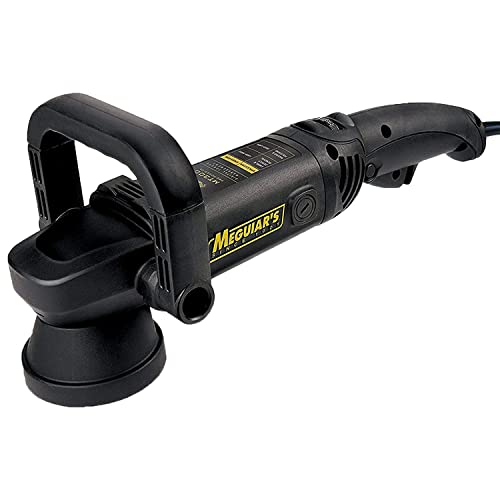
Meguiar’s MT300
The Meguiar’s MT300 is a dual action polisher that is user-friendly and effective. It has a 12mm orbit and a powerful motor, yet it is surprisingly easy to control. Meguiar’s includes a 5-inch backing plate and a 6-inch plate, offering versatility.
Pros
- Easy to use for novices
- Comes with two backing plates
- Good balance of power and control
Cons
- Not as durable as industrial-grade machines
- Some users find it slightly top-heavy
How to choose
Side by side
| # | Model | Orbit Size | Best for | Score | Price |
|---|---|---|---|---|---|
| 1 | Rupes BigFoot LHR21 Mark III | 21mm | Best overall for professional correction | 9.4 | Check price |
| 2 | Flex XC3401 VRG | 8mm (but actual is 8mm) | Best forced rotation for heavy defects | 9.2 | Check price |
| 3 | Griot’s Garage G9 | 9mm | Best value for serious enthusiasts | 9.0 | Check price |
| 4 | Makita PO5000C | 1400W (but in watts) | Best for precision and variable speed | 8.8 | Check price |
| 5 | DeWalt DWP849X | 12 Amps (but in amps) | Best heavy-duty rotary for volume work | 8.6 | Check price |
| 6 | ShineMate EB312 | 12mm | Best lightweight for overhead work | 8.4 | Check price |
| 7 | Meguiar’s MT300 | 12mm | Best for beginners and pros on a budget | 8.2 | Check price |
Frequently asked questions
What is the difference between a dual action polisher and a rotary polisher?
A dual action polisher has a random orbit motion that is safer for paint, reducing the risk of burning through clear coat. A rotary polisher spins in a fixed circle, offering more cutting power but requiring more skill. For heavy-duty professional work, many detailers use both types.
Why is a larger orbit size better for professional polishing?
A larger orbit (e.g., 21mm) covers more surface area per rotation, allowing you to work faster and achieve better correction. It also leaves a more uniform finish. However, larger orbits can be harder to control on tight curves.
Can I use a professional polisher on cars with ceramic coating?
Yes, but you must use the correct pad and polish. For ceramic coatings, you often need to remove the coating first. Using a heavy-cut compound can damage the coating. Always check the manufacturer’s recommendations.
How long does it take to learn to use a rotary polisher safely?
It can take several practice sessions to become comfortable. Start on scrap panels or old car parts. Learn proper technique, including speed control and pad angle, to avoid burning paint. Many detailers recommend taking a class or watching tutorials.
What is the ideal power (amps or watts) for a heavy-duty polisher?
For professional use, look for at least 900 watts or 12 amps. Higher power provides more torque, preventing the machine from stalling on curves or when using aggressive pads. Models like the Rupes and Flex have ample power for continuous work.
Should I buy a polisher with a brushless motor?
Brushless motors are more efficient, generate less heat, and have a longer lifespan. They also tend to be lighter and quieter. The ShineMate EB312 features a brushless motor, making it a good choice for extended use.
What backing plate size should I use for professional polishing?
Common sizes are 5-inch, 6-inch, and 7-inch. Smaller plates are better for tight areas, while larger plates cover more surface. Many machines come with one size, but you can purchase additional plates. For example, the Meguiar’s MT300 includes both 5 and 6 inch plates.
Can I use a car polisher on motorcycles or other vehicles?
Yes, but you may need a smaller backing plate and lower speeds. Motorcycles have intricate curves and smaller panels. A lightweight polisher like the ShineMate is easier to handle for such tasks.
Our take
For most professional detailers, the Rupes BigFoot LHR21 Mark III is the machine to buy because it offers the best combination of power, smoothness, and correction capability. If your budget is tighter, the Griot’s Garage G9 delivers remarkable performance for the price. But if you frequently tackle severe oxidation or sanding marks, the Flex XC3401 VRG is the ultimate tool for heavy defect removal.
Tony Russo
Tony trained as an automotive technician and spent years in service and parts retail before moving into writing. He focuses on garage tools, car care products and accessories from a hands-on maintenance perspective.


