Pro Battery Testers Worth Packing for a Road Trip
TOPDON BT200 leads for road trips, covering 100 to 2000 CCA plus cranking and charging tests from one set of clamps. ANCEL BA101 returns the same core answers in a door-pocket body. Shops documenting a replacement should pick FOXWELL BT705, which prints each result.
TOPDON BT200 is the tester to pack for a long drive, because one connection reports battery health, cranking voltage drop and alternator output. Coverage runs 100 to 2000 CCA and includes AGM and EFB chemistry. Bulk is the tradeoff: the handheld body and lead eat more glovebox room than a Bluetooth dongle. Drivers who want a permanent monitor on one car should look at the TOPDON BT100 instead.
Most roadside no-starts trace to a battery that was already failing weeks earlier. Resting voltage hides that decline, since a dying cell can read 12.4 volts and still collapse under cranking load. We compared CCA spans, supported chemistries, cranking and charging functions and clamp construction across current listings. Owners report conductance testers give steadier readings, and they do it without pulling current from an already weak battery.
The best picks, ranked

TOPDON BT200 Battery Tester
Three answers arrive from one pair of clamps: state of health, cranking voltage drop and charging system output. Coverage spans 100 to 2000 CCA across flooded, AGM, EFB and gel batteries, which matters on stop-start vehicles. Results land on a colour screen as a pass or replace verdict rather than raw conductance figures.
Pros
- Checks the starter and alternator alongside the battery itself
- Recognises AGM and EFB batteries fitted to stop-start engines
- Plain verdict removes the need to interpret conductance numbers
Cons
- Handheld body and lead take up real glovebox space
- No printer, so a shop record means photographing the screen

ANCEL BA101 12V Battery Load Tester
Everything a single-car owner needs sits here: 12 volt batteries from 100 to 2000 CCA with cranking and charging checks alongside. Conductance measurement draws almost no current, so a nearly flat battery still returns a usable number. Menus run two levels deep, which suits a tool used twice a year rather than twice an hour.
Pros
- Short menu tree suits occasional users who forget the sequence
- Reads discharged batteries that resistive load testers struggle with
- Slim enough to live in a door pocket beside a tyre gauge
Cons
- No 24 volt support for trucks or RV chassis systems
- Monochrome screen washes out in direct sunlight
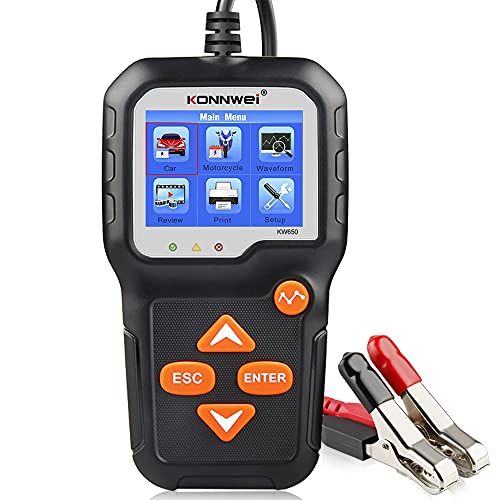
KONNWEI KW650 Battery Tester
Battery testing covers 12 volt systems, while cranking and charging tests reach 24 volt vehicles, pulling light trucks into range. The 100 to 2000 CCA span handles a city car and a diesel pickup from the same menu. Housing and clamps are basic, so handle the jaws with care and it survives several seasons.
Pros
- Adds 24 volt cranking and charging tests at the entry level
- Nothing inside to go flat during months in a boot
- Compact enough for a motorcycle tail pack
Cons
- Lighter-duty clamps than the workshop units here
- Dim backlight makes daylight readings awkward
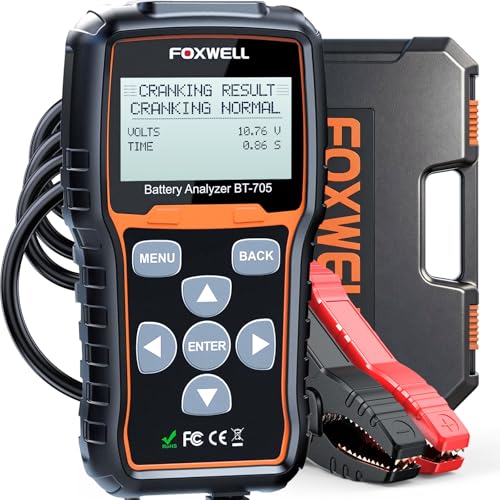
FOXWELL BT705 Battery Analyzer
A built-in thermal printer turns every test into a customer-facing slip, which is the feature independent garages actually want. Coverage reaches 12 and 24 volt systems, 100 to 2000 CCA, and flooded, AGM, EFB and gel chemistry. Thicker leads and heavier jaws reflect a tool designed to be picked up dozens of times a day.
Pros
- Printed slip supports a replacement recommendation in writing
- Heavy jaws and thick leads hold up to repeated daily use
- Handles 24 volt commercial vehicles without a second tool
Cons
- Too bulky for a passenger-car glovebox on a road trip
- Printer rolls are a consumable you have to restock

Autel MaxiBAT BT506 Battery and Electrical System Tester
Autel designed this to run alone or tethered to one of its diagnostic tablets, so battery data sits beside stored fault codes. Adaptive conductance covers 100 to 2000 CCA and separates state of health from state of charge. An internal cell charges over USB, which means it works on a bench with no vehicle attached.
Pros
- Splits state of health from state of charge instead of blending them
- Feeds readings into an existing Autel diagnostic workflow
- Runs on its own charge, so a dead test battery does not blank the screen
Cons
- Much of its value assumes an Autel tablet already in the toolbox
- Internal cell becomes one more thing to keep topped up

TOPDON BT100 Bluetooth Battery Tester
Terminals hold the unit permanently and a phone app receives readings over Bluetooth. Every start gets logged, so a slow decline in cranking voltage shows as a trend well before it strands anyone. No screen exists on the device, which makes a flat phone a genuine blind spot.
Pros
- Trend data answers the replace-or-risk-it question before a long drive
- Nothing to clamp on at the roadside or in the rain
- App keeps a start-by-start record rather than a single snapshot
Cons
- Readings depend entirely on a charged phone
- Tied to one vehicle once the clamps are bolted down

Schumacher BT-100 Battery Load Tester
An analogue needle and a resistive element make this the simplest tool in the group, covering 6 and 12 volt batteries. Applying a genuine 100 amp load shows how a battery behaves under strain, which some technicians trust over an estimate. Heat builds fast during a test, and nothing here reports on the starter or alternator.
Pros
- Applies real load instead of inferring capacity from resistance
- Nothing to pair, update or recharge before use
- Settles a borderline conductance reading with a second method
Cons
- Body heats up and needs a cooling pause between tests
- Battery only, with no charging system or starter data
Before you buy
What matters in a battery tester CCA range is the first filter. The tester must cover the cold cranking amps printed on your battery label, and most cars fall between 400 and 800. Diesel pickups climb higher, so a 100 to 2000 CCA span leaves headroom for anything you might borrow or tow. Chemistry support ranks second. Stop-start vehicles use AGM or EFB batteries, and a flooded-only algorithm misjudges their internal resistance. Cranking and charging tests finish the list, because a fresh battery killed by a failing alternator is a common repeat fault.
Reading the numbers without guessing Resting voltage reports state of charge, not health. 12.6 volts is full, 12.4 is roughly three quarters, and 12.0 sits close to empty. State of health is a separate figure: measured conductance against rated CCA, and under roughly 60 percent means failure is near. Cranking voltage decides trip planning. Below about 9.6 volts while the engine turns over, replace the battery rather than hoping. Charging output should read near 13.8 to 14.4 volts at idle once the engine is warm.
Testing before a long drive Timing changes the answer more than the tool does. Test after the car has sat overnight, since surface charge from driving inflates the reading and flatters a failing battery. Compact conductance units like the ANCEL BA101 or KONNWEI KW650 slide into a door pocket alongside jumper cables. Cold cuts available cranking power sharply, so a marginal battery in October becomes a no-start in January. Pair the tester with a lithium jump starter. Knowing the battery is weak solves nothing in a dark car park at midnight.
Shop, fleet and multi-vehicle work Daily use shifts priorities toward documentation and durability. FOXWELL BT705 prints a slip that backs a replacement recommendation, which no phone photo matches when a customer pushes back. Fleets running light trucks need 24 volt cranking and charging tests, a requirement that eliminates several consumer models outright. Bays already using Autel tablets gain from the MaxiBAT BT506, since battery data lands next to stored codes. One-car owners should skip all of this. A handheld conductance tester answers the same question in under a minute.
The lineup, side by side
| # | Model | CCA range | Best for | Score | Price |
|---|---|---|---|---|---|
| 1 | TOPDON BT200 Battery Tester | 100 to 2000 CCA | Best overall | 9.4 | Check price |
| 2 | ANCEL BA101 12V Battery Load Tester | 12V systems | Best value | 9.2 | Check price |
| 3 | KONNWEI KW650 Battery Tester | 12V, 100 to 2000 CCA | Best budget | 9.0 | Check price |
| 4 | FOXWELL BT705 Battery Analyzer | 12V and 24V | Best for workshop use | 8.8 | Check price |
| 5 | Autel MaxiBAT BT506 Battery and Electrical System Tester | 100 to 2000 CCA | Best for diagnostic integration | 8.6 | Check price |
| 6 | TOPDON BT100 Bluetooth Battery Tester | Bluetooth to phone app | Best for monitoring one car over time | 8.3 | Check price |
| 7 | Schumacher BT-100 Battery Load Tester | 6V and 12V batteries | Best for confirming a borderline result | 8.0 | Check price |
Questions worth asking
How do I know if my battery will survive a long road trip?
Check state of health and cranking voltage after the car has rested overnight. A state of health under roughly 60 percent of rated CCA, or cranking voltage below about 9.6 volts, means replace it before you set off.
What is the difference between a load tester and a conductance tester?
Load testers pull real current and watch the voltage sag, which punishes a weak battery. Conductance testers such as the TOPDON BT200 read internal resistance with negligible draw, so they work on partly discharged batteries.
Can a battery tester check the alternator too?
Most current units can. TOPDON BT200, FOXWELL BT705 and KONNWEI KW650 all run a charging test that reads output voltage and ripple with the engine running, which exposes a failing diode pack.
Which battery tester works best on AGM batteries?
Pick one that names AGM and EFB explicitly, since the algorithm differs from flooded chemistry. TOPDON BT200 and FOXWELL BT705 both list flooded, AGM, EFB and gel support.
Is a Bluetooth battery monitor better than a handheld tester?
They answer different questions. TOPDON BT100 stays bolted to one battery and logs decline across every start. A handheld unit moves between vehicles, which suits a household with two or three cars.
Do I need a 24V battery tester?
Only for commercial trucks, buses and some RV chassis systems. Cars and light pickups run 12 volt, though several testers here add 24 volt cranking and charging coverage anyway.
What resting voltage means a car battery is flat?
Around 12.0 volts at rest is close to discharged, and under 11.8 volts most batteries will not crank reliably. Sitting that low repeatedly causes sulphation, which permanently cuts usable capacity.
Should I test the battery before or after driving?
Several hours after, ideally the next morning. Driving leaves a surface charge that lifts the voltage reading, and that false high is how a failing battery passes a quick check.
Can I use a multimeter instead of a battery tester?
A multimeter reports state of charge and nothing more. It cannot measure conductance against rated CCA, so a battery that reads 12.6 volts at rest can still fail the moment the starter engages.
The verdict
Pack the TOPDON BT200 for a long drive, because one connection covers battery, starter and alternator, and it reads AGM and EFB correctly. Choose the ANCEL BA101 if you want the same core answers in something that fits a door pocket. Garages writing up replacements should step to the FOXWELL BT705 for the printed record and 24 volt coverage.
Tony Russo
Tony trained as an automotive technician and spent years in service and parts retail before moving into writing. He focuses on garage tools, car care products and accessories from a hands-on maintenance perspective.