Camping Stoves That Handle Wind, Groups, and Altitude
Camp Chef Everest 2X leads with 40,000 combined BTU across two burners, built for basecamp group cooking. Coleman Cascade 3-in-1 adds a griddle plate for less money. MSR WindBurner Stove System resists gusts above treeline and boils water fast.
Camp Chef Everest 2X tops this roundup for basecamp cooking, pairing two 20,000 BTU burners with a three-sided wind guard, though its steel body adds bulk backpackers will not want to carry.
Backpacking canister stoves, two-burner propane rigs, and integrated boil systems solve different problems, so we compared published BTU ratings, fuel type, and weight, then cross-checked owner reports on wind performance and simmer control.
The top picks, ranked

Camp Chef Everest 2X
Two 20,000 BTU burners combine for 40,000 BTU, well above most car-camping stoves. Stainless burner heads resist warping under high heat, and a three-sided wind guard keeps flames stable in open sites. A 1 lb propane canister runs it, or a bulk tank with the optional hose adapter.
Pros
- Highest combined BTU output in this lineup
- Stainless burner heads resist warping under high heat
- Wind guard blocks flame-out on three sides
Cons
- Steel body is too heavy for backpacking
- Needs a hard-sided case for vehicle transport

Coleman Cascade 3-in-1 Propane Camping Stove
Open grates swap for a nonstick griddle plate, so pancakes and bacon join the two 22,000 combined BTU burners without extra gear. PerfectFlow pressure control holds output steady in cold weather. Folding wind panels shield both burners on the sides and back.
Pros
- Griddle plate adds cooking versatility without extra gear
- PerfectFlow regulator holds output in cold temps
- Lower combined weight than the Everest 2X
Cons
- Combined BTU output trails dedicated high output stoves
- Griddle plate needs hand washing, not dishwasher safe
Coleman Classic Propane Camping Stove
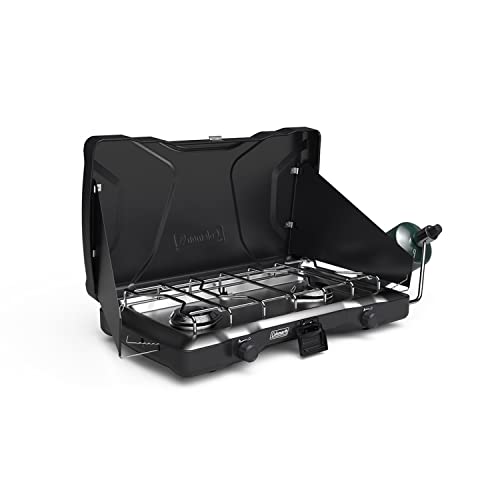
Wind-blocking panels cover three sides of this straightforward 20,000 combined BTU two-burner design. PerfectFlow technology holds a consistent flame even as canister pressure drops. No griddle or accessory attachments ship with it, just open burners for pots and pans.
Pros
- Lowest cost two-burner stove in this comparison
- Consistent flame at low canister pressure
- Compact folding design for easy storage
Cons
- No griddle or accessory options
- Lower BTU output than the Everest 2X or Cascade 3-in-1

MSR WindBurner Stove System
A radiant burner sits inside a heat exchanger pot, shielding the flame from gusts that blow out an open canister stove. The listing rates it to boil a liter of water in roughly 4.5 minutes. Its 1 liter personal system weighs about 15.5 ounces.
Pros
- Enclosed design resists wind that defeats open burners
- Integrated pot and burner reduce packed items
- Fast boil times even at altitude
Cons
- Not designed for simmering sauces or slow cooking
- Isobutane canisters lose pressure in freezing temperatures
Jetboil Genesis Basecamp Cooking System
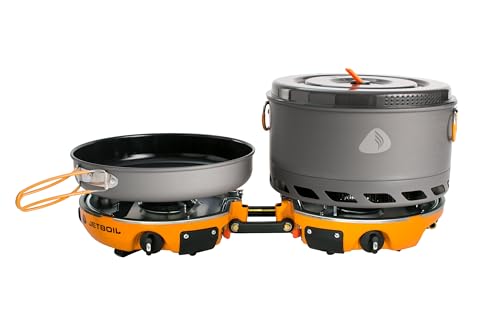
One canister runs a main pot and a simmer pot together through a shared fuel line connecting two burners. The main burner outputs roughly 10,000 BTU, and a secondary burner adds around 4,000 BTU for slower cooking. Legs fold flat for pack storage.
Pros
- Runs two pots off a single fuel canister
- Folding legs pack down for backcountry travel
- Secondary burner allows real simmer control
Cons
- Heavier than single burner backpacking stoves
- Combined BTU output trails propane car-camping stoves

GSI Outdoors Pinnacle Camp Stove
A wide burner head spreads flame more evenly than typical ultralight stoves, rated near 8,000 BTU. Folding arms support pots up to 8 inches wide. The listing notes it packs down small enough to fit inside a 1 liter pot.
Pros
- Lightest stove in this roundup by a wide margin
- Wide burner head spreads flame more evenly than narrow jets
- Packs inside cookware for minimal pack space
Cons
- No wind guard included, exposed flame in gusty sites
- Lowest BTU output limits large pot cooking
Soto Rivo Stove
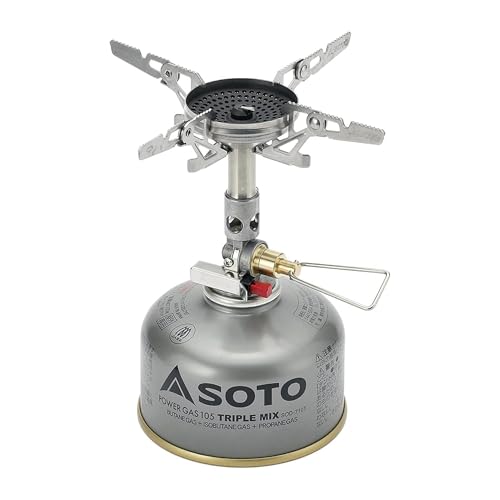
Four flex arms steady wider pots on this 10,200 BTU canister stove. A regulator valve, unlike standard needle valves, holds a steady low flame according to owner reports, staying stable in cold weather thanks to pressure regulation. It weighs about 3.7 ounces on its own.
Pros
- Regulator valve gives finer low-flame control than most canister stoves
- Four-arm base steadies wider pots
- Performs more consistently in cold weather
Cons
- No integrated wind protection
- Higher BTU siblings in this lineup boil faster for large groups
What to look for
What BTU output actually means for camp cooking BTU ratings measure heat output, not cooking speed on their own. A 20,000 BTU burner boils water faster than an 8,000 BTU canister stove, but wind, altitude, and pot size all change real results. Groups cooking full meals suit two-burner propane stoves in the 20,000 to 40,000 combined BTU range. Single burner backpacking stoves at 7,000 to 10,000 BTU boil faster than they look, since they pair with lightweight pots.
Choosing between propane and isobutane canisters Propane pushes more BTU output and stays stable in cold weather, which is why car-camping stoves like the Everest 2X and Cascade 3-in-1 use it. Isobutane weighs less and screws directly onto backpacking stoves, but pressure drops below freezing. Keeping the canister warm inside a jacket before use improves isobutane performance, according to owner reports.
Cooking for a group at a fixed campsite Two-burner stoves that run a main pot and a simmer pot together, like the Jetboil Genesis Basecamp or Camp Chef Everest 2X, suit group basecamp cooking best. Once wind shows up, a three-sided wind guard matters more than raw BTU rating, since open flames lose efficiency in a breeze. Griddle attachments, like the one on the Cascade 3-in-1, add breakfast versatility without separate cookware.
What changes above treeline or in strong wind Enclosed burner systems like the MSR WindBurner resist flame-out where open canister stoves fail, since the burner sits shielded inside the heat exchanger pot. Weight becomes the deciding factor for solo backpackers, where a few ounces on the GSI Pinnacle or Soto Rivo add up over a multi-day trip. Simmering also takes longer at altitude regardless of stove, since lower air pressure slows heat transfer to the pot.
The lineup, side by side
| # | Model | Burners | Best for | Score | Price |
|---|---|---|---|---|---|
| 1 | Camp Chef Everest 2X | 2 | Best overall | 9.4 | Check price |
| 2 | Coleman Cascade 3-in-1 Propane Camping Stove | 2 | Best value | 9.1 | Check price |
| 3 | Coleman Classic Propane Camping Stove | 2 | Best budget | 8.7 | Check price |
| 4 | MSR WindBurner Stove System | Enclosed radiant, single burner | Best for wind resistant backpacking | 8.9 | Check price |
| 5 | Jetboil Genesis Basecamp Cooking System | 2 connected | Best for group backpacking basecamp | 8.5 | Check price |
| 6 | GSI Outdoors Pinnacle Camp Stove | Canister-top, single burner | Best for ultralight solo backpacking | 8.2 | Check price |
| 7 | Soto Rivo Stove | Canister-top, single burner | Best for precision simmer control | 8.0 | Check price |
Frequently asked questions
How many BTU do I need for a two-burner camping stove?
Most two-burner propane stoves fall between 20,000 and 40,000 combined BTU. The Coleman Classic sits at 20,000, the Cascade 3-in-1 at 22,000, and the Camp Chef Everest 2X reaches 40,000 for faster cooking of large group meals.
What is the best camping stove for windy conditions?
The MSR WindBurner Stove System encloses a radiant burner inside a heat exchanger pot, resisting wind that would blow out an open flame canister stove. Owners report it stays lit in gusts that stop standard backpacking stoves.
Is propane or isobutane better for cold weather camping?
Propane holds pressure better in freezing temperatures, which is why car-camping stoves like the Everest 2X and Coleman Classic rely on it. Isobutane canisters, used by the Soto Rivo and GSI Pinnacle, lose pressure below freezing unless kept warm.
What is the lightest camping stove for backpacking?
The GSI Outdoors Pinnacle Camp Stove weighs about 5.5 ounces, the lightest in this comparison. The Soto Rivo follows close behind at roughly 3.7 ounces without its case.
Can a camping stove run two pots at once?
The Jetboil Genesis Basecamp Cooking System connects two burners to one fuel line, running a main pot and a simmer pot together. Standard single burner backpacking stoves only run one pot at a time.
Camp Chef Everest 2X vs Coleman Cascade 3-in-1, which is better for families?
The Cascade 3-in-1 costs less and adds a griddle plate for pancakes and bacon, practical for family breakfasts. The Everest 2X outputs nearly double the combined BTU, better suited to larger meals cooked faster for bigger groups.
What camping stove has the best simmer control?
The Soto Rivo uses a regulator valve that owners report holds a steady low flame better than typical needle valve canister stoves, useful for sauces or delicate dishes that scorch easily.
Do professional style camping stoves need a wind guard?
A wind guard matters once cooking moves outside a sheltered site. Open burner stoves like the Everest 2X and Coleman Classic include folding wind panels, while enclosed systems like the MSR WindBurner build wind resistance into the burner design itself.
Is a two-burner stove worth carrying to a basecamp over a single burner?
For groups cooking full meals, yes, a two-burner stove runs a main dish and a side dish at once. Solo hikers moving camp daily are usually better served by a single burner stove under a pound.
How long does a propane canister last on a two-burner stove?
Run time varies with burner setting and outside temperature, but a standard 1 lb canister typically covers several meals at moderate heat before needing a swap.
Our take
Camp Chef Everest 2X is the strongest pick for cooking full meals for a group at a fixed campsite, since its 40,000 combined BTU output and three-sided wind guard outperform every other stove here. Backpackers should skip it entirely and choose the GSI Outdoors Pinnacle or Soto Rivo instead, since both weigh under 6 ounces and pack inside cookware. Families on a tighter budget who still want griddle versatility get the best balance from the Coleman Cascade 3-in-1.
Derek Holt
Derek has a background coaching recreational and amateur athletes and has worked the sales floor at specialty fitness retailers. He focuses on equipment durability, ergonomics and realistic use cases rather than marketing claims.