Kids’ Microscopes With Glass Optics, Ranked by Age
AmScope M150C leads for students around ten and up, combining glass optics with coaxial coarse and fine focus. My First Lab Duo-Scope MFL-06 fits younger kids by lighting slides and solid finds. Celestron LABS S20 is the stereo pick for rocks, coins and insects instead of prepared slides.
AmScope M150C is the all-round choice for a child of roughly ten or older. Glass optics, a metal frame and coaxial coarse plus fine focus produce an image sharp enough to come back to. Its 1000x setting needs immersion oil to mean anything, so real viewing happens near 400x. Under ten, the dual-light My First Lab Duo-Scope teaches more.
Children quit a microscope because the picture stays blurry, not because cells are boring. Moulded plastic lenses, a single bottom lamp and missing fine focus cause most of that. Our ranking weighs lens material, magnification steps, lighting from above and below, frame construction and whether slides ship in the box. Owner feedback on durability and first-session success settled the order.
The best picks, ranked

AmScope M150C Compound Monocular Microscope
Optical glass elements and a metal frame put this nearer a school lab instrument than a toy. Coarse and fine knobs share one axis, which is what lets a child creep up on focus instead of overshooting it. LED brightness adjusts down, so a thin slide does not wash out under full power.
Pros
- Coaxial coarse and fine focus lands a sharp image
- Metal frame survives years of handling
- Rotatable head lets two children share one view
Cons
- 1000x needs immersion oil technique to be usable
- No slide kit in the base package
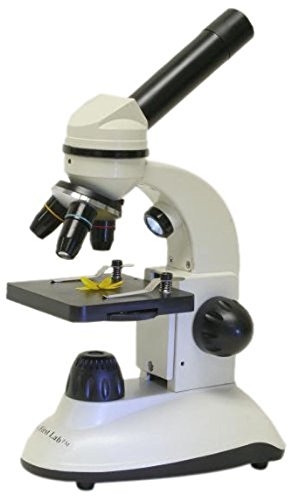
My First Lab Duo-Scope MFL-06
Two LEDs light from below for prepared slides and from above for coins, leaves and beetles, so a child can study whatever comes back from the garden. An all-metal body absorbs the knocks of a kitchen table setup. Three magnification steps keep the controls short enough for a primary-age user to run alone.
Pros
- Top light opens up solid objects, not just slides
- Metal body tolerates knocks and frequent moves
- Short magnification list is quick for kids to learn
Cons
- Stops at 400x, below lab-grade compound scopes
- Stage clips need adult help at first

Celestron LABS S20 Stereo Microscope
Two eyepieces build a genuine three dimensional image, which makes a pebble or wasp wing far more gripping than the flat view of a compound scope. Fixed 20x magnification removes objective swapping entirely, so there is almost nothing for a child to get wrong. Prepared slides are the wrong subject here, since the design targets opaque specimens.
Pros
- Depth perception suits rocks, coins and insects
- Fixed power means nothing to adjust mid-session
- Two-eye viewing stays comfortable for long looks
Cons
- Cannot resolve cells or prepared slides usefully
- 20x only, with no step up in power
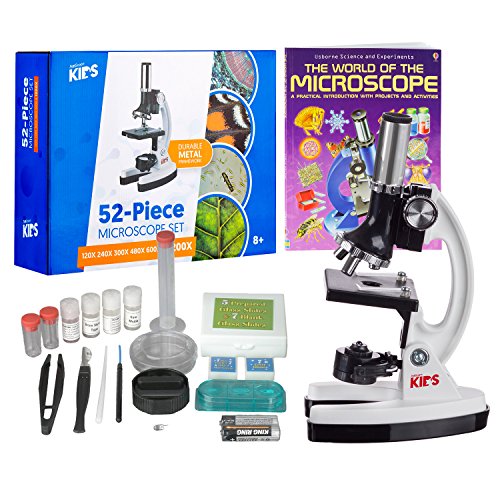
AmScope M30-ABS-KT2-W Beginner Microscope Kit
Six magnification settings from 120x to 1200x ship alongside prepared slides, blanks, tweezers and a collecting vial. Everything a first session needs sits in one box, which matters when the alternative is a scope and nothing to put under it. ABS plastic forms the body, making it lighter but less rigid than the metal-framed M150C.
Pros
- Complete kit needs no extra purchase to start
- Six steps span a wide magnification range
- Light enough for a child to carry between rooms
Cons
- ABS body flexes more than a metal frame
- Top settings deliver a dim, soft image

Swift SW200DL Compound Monocular Microscope
Build quality tracks school lab equipment, from the 360 degree rotatable monocular head to the standard objective thread. Dual illumination covers slides from below and surfaces from above, so it doubles as a specimen scope. Teenagers starting biology coursework get something they will not outgrow within a year.
Pros
- Dual lighting handles slides and solid samples
- Standard objectives match school lab gear
- Rigid frame stays still while focusing
Cons
- Controls are too involved for young children
- Heavier than kid-focused plastic models

National Geographic Dual LED Student Microscope
Bundled specimens and dual LED lighting get a child onto something real within minutes of opening the box. Three magnification steps keep operation simple from about age eight. Optical quality sits a rung below the AmScope M150C, so fine cell structure stays out of reach.
Pros
- Specimen kit answers the what do we look at problem
- Dual lighting covers slides and solid objects
- Three-step magnification is easy to teach
Cons
- Resolves less detail than a lab-style scope
- Plastic construction shortens its working life

Educational Insights GeoSafari Jr. Talking Microscope
Narration names each image and follows up with quiz questions, so a preschooler takes away content rather than a blurry blob. Power stays low by design, at roughly 8x, using sturdy image discs in place of breakable glass slides. Anything past age seven outgrows it quickly, which is exactly why it sits at the youngest end of this list.
Pros
- Narration explains what the child is looking at
- Image discs replace fragile glass slides
- Quiz mode holds preschool attention
Cons
- Cannot view specimens the child collects
- Outgrown within months once reading starts
Side by side
| # | Model | Magnification | Best for | Score | Price |
|---|---|---|---|---|---|
| 1 | AmScope M150C Compound Monocular Microscope | 40x to 1000x | Best overall | 9.4 | Check price |
| 2 | My First Lab Duo-Scope MFL-06 | 40x, 100x and 400x | Best for younger children | 9.2 | Check price |
| 3 | Celestron LABS S20 Stereo Microscope | Fixed 20x | Best for rocks and insects | 9.0 | Check price |
| 4 | AmScope M30-ABS-KT2-W Beginner Microscope Kit | 120x to 1200x in six steps | Best starter kit | 8.8 | Check price |
| 5 | Swift SW200DL Compound Monocular Microscope | 40x to 1000x | Best for teens | 8.6 | Check price |
| 6 | National Geographic Dual LED Student Microscope | 40x, 100x and 400x | Best value with accessories | 8.3 | Check price |
| 7 | Educational Insights GeoSafari Jr. Talking Microscope | Low power, roughly 8x | Best for ages 4 to 7 | 8.0 | Check price |
How to pick the right one
What to look for in a kids’ microscope Three features decide whether a microscope lasts past the first month. Optical glass beats moulded plastic, because plastic lenses soften contrast at every power. A metal frame holds rigid, so turning a knob does not shake the whole image. Fine focus matters most, since that final quarter turn is what converts a vague grey shape into visible cell walls. Advertised maximum magnification is the least useful figure printed on the box.
Compound vs stereo: which one matches your child’s specimens Compound scopes light thin, translucent things from below: onion skin, pond water, prepared slides. Stereo models such as the Celestron LABS S20 light from above and render solid objects in three dimensions, which suits rocks, coins, feathers and insects. A child who empties their pockets onto the table will use a stereo scope far more than a 1000x compound one. Dual-light designs like the Duo-Scope MFL-06 cover both jobs at a lower magnification ceiling.
Best microscope by age, from preschool to teens Ages four to seven do best with narrated low-power tools like the GeoSafari Jr., where audio carries the teaching. From about eight, dual LED models such as the National Geographic student scope or the Duo-Scope let a child examine their own finds between 40x and 400x. Ten and up can run a true compound instrument like the AmScope M150C. Teens aiming at biology coursework are better matched to the Swift SW200DL and its standard objectives.
How to make the first session actually work Most disappointment arrives inside the first hour. Start at the lowest power and focus there, because hunting for a specimen at 400x rarely succeeds. Keep prepared slides ready, since an empty stage loses a child fast; kits like the AmScope M30-ABS-KT2-W include them. Skip the 1000x setting early on, as it needs immersion oil and a steady hand to produce anything better than a dim blur.
Good to know
What is the best microscope for a child serious about science?
AmScope M150C pairs glass optics and a metal frame with 40x to 1000x and coaxial focusing, which suits children around ten and up. Teens heading into biology coursework should look at the Swift SW200DL.
What magnification does a kid’s microscope actually need?
Nearly all real viewing sits between 40x and 400x. That range covers onion cells, pond water and insect wings. Settings advertised as 1000x or 1200x need immersion technique and usually look dimmer rather than better.
Compound vs stereo microscope: which suits kids better?
Compound scopes view thin specimens lit from below, such as prepared slides. Stereo models like the Celestron LABS S20 show solid objects in three dimensions. Children who collect rocks and bugs reach for the stereo design far more often.
Which microscope works for a four year old?
Educational Insights GeoSafari Jr. Talking Microscope fits that age using narrated image discs and quiz modes instead of glass slides. Treat it as a first introduction, since it is outgrown quickly.
Is a microscope with top and bottom lights worth it?
Dual lighting doubles what a child can view. Bottom light serves prepared slides; top light handles coins, leaves and insects. My First Lab Duo-Scope MFL-06 and the National Geographic student scope both include it.
Are plastic microscopes worth buying for kids?
Plastic frames are fine for lighter use and easier for small children to carry. Plastic lenses are the real problem, cutting contrast at every power. Look for optical glass even when the body is ABS.
What should a child look at first under a microscope?
Begin with prepared slides from a kit, then onion skin, a single hair and a drop of pond water. All three show clear structure between 40x and 400x and need no special preparation.
Is 1000x magnification useful for kids?
Rarely. Getting a clean image at 1000x demands immersion oil and careful technique. A sharp 400x view teaches far more than a dim, wobbling one at maximum power.
Do kids’ microscopes come with slides included?
Some do. AmScope M30-ABS-KT2-W, My First Lab Duo-Scope and the National Geographic student scope ship with prepared slides and tools. AmScope M150C does not, so budget for a slide set alongside it.
Can a kids’ microscope connect to a phone or screen?
Only with a separate eyepiece adapter, which none of these seven include. Photography also needs a steady stand and patience with focus, so treat phone capture as a later upgrade rather than a buying reason.
The bottom line
Choose the AmScope M150C for a child who is genuinely curious, because glass optics, a metal frame and coaxial fine focus are what deliver an image worth revisiting. Under about ten, My First Lab Duo-Scope MFL-06 does more with its dual lighting and three simple steps. Pick the Celestron LABS S20 instead when your child hunts rocks and beetles rather than studying prepared slides.
Rachel Simmons
Rachel previously worked in child-product retail and brings a practical, detail-first eye to gear reviews, focusing on safety standards, ease of use and the fine print that matters most for new caregivers.


