Which Power Tools Belong in Every Home Toolbox?
DEWALT’s DCD791D2 drill driver is the tool to buy first, since a brushless 20V drill covers more household jobs than anything else. Milwaukee’s 2853-20 impact driver is the natural second purchase, and CRAFTSMAN’s CMCD700C1 offers the budget way in.
Starting from zero, DEWALT’s DCD791D2 brushless drill driver makes sense as the first purchase. Milwaukee’s 2853-20 impact driver follows for fasteners, and CRAFTSMAN’s CMCD700C1 works when the budget is tight. Those three tools cover most household jobs between them.
Shopping for power tools gets confusing because the battery platform matters more than any single tool, and every brand wants that decision locked in early. We compared published torque and speed figures, kit contents, motor types and owner reports on real world runtime, then ranked these seven by how much use they actually get.
What we recommend

DEWALT DCD791D2 20V MAX XR Brushless Drill Driver Kit
This drill does the most work in a typical home shop, and the brushless XR motor keeps it running where cheaper drills fade. Two speed ranges cover high torque driving and fast drilling alike. A compact head length helps inside cabinets and stud bays, and two 2.0Ah batteries in the kit cover a full afternoon of intermittent work.
Pros
- Brushless motor extends runtime
- Compact head reaches tight spaces
- Huge 20V MAX tool range to grow into
Cons
- 2.0Ah packs are small for heavy work
- Belt hook mounts on one side only

Milwaukee 2853-20 M18 FUEL Impact Driver
An impact driver is the tool people wish they had bought earlier, and the M18 FUEL 2853-20 ranks among the most capable compact models sold. Four drive modes let you dial back power for delicate screws instead of stripping them. A short body fits between joists, though it ships as a bare tool that needs an existing M18 battery.
Pros
- Enormous torque for long fasteners
- Drive modes prevent stripped screws
- Very short head length
Cons
- Bare tool needs an M18 battery
- Loud under load like all impacts

Makita XPH12Z 18V LXT Brushless Hammer Driver Drill
A hammer setting joins a well balanced brushless drill here, useful the first time you anchor something into brick or block. Makita keeps the ergonomics tight, and the tool feels lighter in hand than its numbers suggest. Owners on the LXT platform report the electronic protection circuits keep packs healthy over years of use.
Pros
- Hammer mode handles masonry anchors
- Excellent balance and grip shape
- Battery protection circuitry
Cons
- Sold bare in this configuration
- LXT batteries cost more than rivals

BOSCH GSR12V-300B22 12V Max Brushless Drill Driver Kit
Twelve volt tools used to mean compromise, and this Bosch shows that stopped being true. At just over two pounds with a battery, it fits inside cabinets and under sinks where a full size drill cannot reach. Large holes in framing lumber are outside its range, but for assembly, hardware and repairs it becomes the tool you grab constantly.
Pros
- Extremely light and compact
- Brushless efficiency in a small pack
- Two batteries included
Cons
- Not enough for large hole saws
- Smaller 12V tool lineup

CRAFTSMAN CMCD700C1 V20 Cordless Drill Driver Kit
For a first cordless drill that hangs pictures, assembles furniture and handles light repairs, the CMCD700C1 does the job without a professional price tag. Its motor runs brushed rather than brushless, trading some runtime for a lower entry price. The V20 platform still gives room to grow if the hobby sticks.
Pros
- Affordable route onto a real platform
- Light enough for overhead work
- LED work light included
Cons
- Brushed motor drains packs faster
- Single small battery in the kit
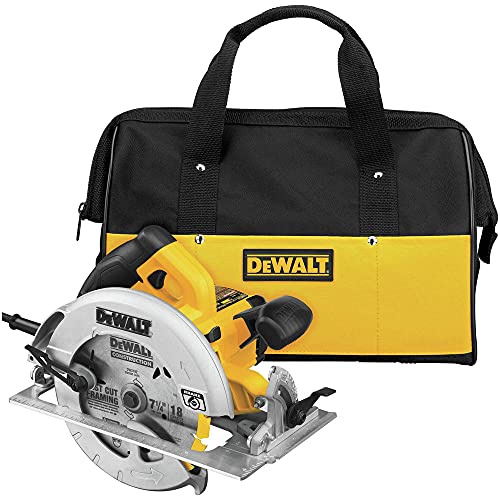
DEWALT DWE575SB 7-1/4 in Circular Saw
Once projects move past assembly into cutting plywood and framing lumber, a circular saw becomes essential, and this corded model ranks among the lightest full size saws sold. An electric brake stops the blade quickly after the trigger releases, a genuine safety feature rather than a spec sheet line. Corded power removes battery planning from long cutting sessions.
Pros
- Light for a full size saw
- Electric brake improves safety
- No battery runtime limits
Cons
- Cord management on site is annoying
- Dust collection is basic

Milwaukee 2720-20 M18 FUEL SAWZALL Reciprocating Saw
A reciprocating saw stays a specialist tool right up until old pipe, thick branches or a deck need tearing out, and then nothing else works as well. The 2720-20 pairs a brushless motor with a long stroke for fast cutting through mixed material. It lands last on this list because most people should buy it fourth or fifth, not first.
Pros
- Cuts wood, nails and pipe alike
- Tool free blade changes
- Serious speed for teardown work
Cons
- Heavy vibration during long cuts
- Least used tool for most owners
Side by side
| # | Model | Motor | Best for | Score | Price |
|---|---|---|---|---|---|
| 1 | DEWALT DCD791D2 20V MAX XR Brushless Drill Driver Kit | Brushless | Best overall | 9.4 | Check price |
| 2 | Milwaukee 2853-20 M18 FUEL Impact Driver | POWERSTATE brushless | Best for fasteners | 9.2 | Check price |
| 3 | Makita XPH12Z 18V LXT Brushless Hammer Driver Drill | Brushless | Best for masonry | 9.0 | Check price |
| 4 | BOSCH GSR12V-300B22 12V Max Brushless Drill Driver Kit | Brushless | Best for tight spaces | 8.8 | Check price |
| 5 | CRAFTSMAN CMCD700C1 V20 Cordless Drill Driver Kit | Brushed | Best budget | 8.6 | Check price |
| 6 | DEWALT DWE575SB 7-1/4 in Circular Saw | 7-1/4 in | Best for sheet goods | 8.3 | Check price |
| 7 | Milwaukee 2720-20 M18 FUEL SAWZALL Reciprocating Saw | POWERSTATE brushless | Best for demolition | 8.0 | Check price |
What to look for
Which battery platform should you pick first? Batteries and chargers make up the expensive part of cordless ownership, and they never cross brands. Choosing DEWALT 20V MAX, Milwaukee M18, Makita LXT or CRAFTSMAN V20 early means every future tool costs less, since you buy it bare. Look at which platform carries the tools you expect to add in two years, not just the one needed this weekend.
Does a brushless motor matter for every tool? A brushless motor runs cooler, lasts longer and squeezes more work from a charge, though the gap widens most on tools working hard for long stretches. A drill used for a few dozen screws a month gets by fine on a brushed motor. An impact driver or a reciprocating saw doing sustained heavy work makes brushless worth the extra cost.
What order should you buy power tools in? Most people are served well by drill first, impact driver second, circular saw third, then oscillating or reciprocating tools as specific jobs demand them. A large combo kit bought up front usually means paying for at least two tools that sit unused. Adding bare tools to an existing platform spreads the cost and keeps the collection honest.
Why does amp hour rating matter as much as voltage? Voltage sets how much power a tool can deliver, while amp hours set how long it runs before a recharge. A 2.0Ah pack handles drilling and driving fine, while sawing, sanding and grinding drain it fast. Owners doing sustained work consistently report that stepping up to 4.0Ah or 5.0Ah packs changes the experience more than upgrading the tool itself.
Questions worth asking
What is the first power tool to buy?
A cordless drill driver, without much debate. It handles drilling, driving, furniture assembly and repairs, and stays useful no matter which direction your projects take.
Do I need both a drill and an impact driver?
They overlap but do not replace each other. A drill controls torque precisely and holds round shank bits, while an impact driver delivers far more rotational force for long screws and lag bolts without wrecking your wrist.
Is a corded tool still worth buying?
Yes, for tools that run continuously. Circular saws, bench tools and shop vacuums benefit from unlimited runtime, and corded models often cost less for equivalent power.
What does a brushless motor actually change?
Brushless motors remove the friction and wear of carbon brushes, improving efficiency, extending tool life and increasing runtime per charge. The tool also runs cooler under sustained load.
Can I mix batteries between tool brands?
No. Battery interfaces, voltages and electronics stay proprietary, and third party adapters can void warranties and create safety risks. Commit to one platform instead.
Is a 12V tool enough for home use?
For assembly, hardware, cabinetry and repairs, 12V brushless tools are genuinely capable and easier to handle. Step up to 18V or 20V once you start boring large holes or working framing lumber.
How many batteries do I actually need?
Two marks the practical minimum, so one charges while the other works. Owners running longer sessions usually settle on one compact pack for light tools and one high capacity pack for saws.
Are power tool combo kits good value?
Only if every tool in the box gets used. A drill and impact driver two piece kit is almost always worthwhile, while five and six piece kits often bundle a flashlight and a radio that go untouched.
What power tool should you buy after a drill?
An impact driver comes next for most people, since it handles long fasteners and lag bolts a drill struggles with. A circular saw follows once projects move into cutting plywood or framing lumber.
Our pick
DEWALT’s DCD791D2 delivers the most hours of use in a typical home workshop, and it sits on a platform with real room to grow. Add Milwaukee’s 2853-20 once fasteners start fighting back, and lean on CRAFTSMAN’s CMCD700C1 to test whether the hobby sticks before committing further.
Jake Monroe
Jake worked as a residential contractor for over a decade before shifting to full-time writing. He evaluates power tools, hand tools and workshop gear through the lens of someone who has actually used them on job sites, not just read the box.


