Roof Vent Fans That Drop Into a Standard RV Opening
The MaxxAir MaxxFan Deluxe delivers the highest airflow and can run partly open in light rain. The Fan-Tastic Vent 807350 suits owners who want quieter overnight operation. The Camco 12V Standard fan offers the simplest budget swap into an existing 14 by 14 inch opening.
The MaxxAir MaxxFan Deluxe suits RV owners who camp through unpredictable weather, since its lid can stay cracked open in light rain while pulling up to 900 CFM; the tradeoff is a higher power draw than budget 12V fans. Most roof vent fans drop into the same 14 by 14 inch opening used since the 1980s, so swapping one in rarely means cutting into the roof.
Airflow, noise level, and rain tolerance vary more between models than most buyers expect. We compared specs across seven current vent fans to match them against different RV sizes and budgets.
The top picks, ranked

MaxxAir MaxxFan Deluxe 00-07500K
This fan can stay cracked open during light rain, a feature most roof vents skip entirely. Its 10-speed motor pulls up to 900 CFM on high, the strongest airflow in this lineup. A smoke-tinted lid also blocks more direct sun than clear alternatives.
Pros
- Rain-sensor lid allows airflow during light rain
- Highest CFM rating among the seven fans compared
- Reversible motor both pulls and exhausts air
Cons
- Draws more power than budget 12V fans
- Installation kit sold separately from the base unit
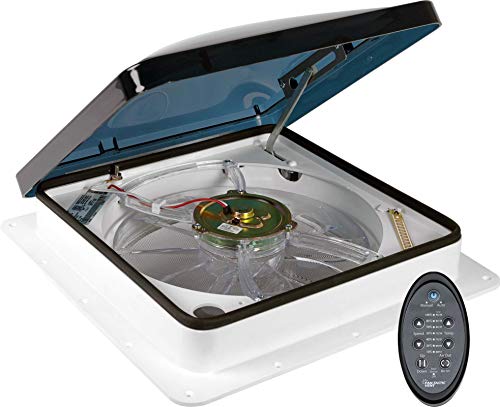
Fan-Tastic Vent 807350 Endless Breeze
Fan-Tastic tuned this model to run quieter at low and mid speeds, useful for owners who leave it on overnight. A built-in sensor closes the lid automatically once rain starts. This trim level ships with a remote control included.
Pros
- Auto-close sensor needs no manual action
- Runs quieter than most fans at low and mid speeds
- Remote control comes included at this trim level
Cons
- Fewer speed settings than MaxxAir’s 10-speed motor
- Priced above basic non-sensor fans

Heng’s Vortex II 12V Roof Vent Fan
Heng’s skips rain-sensing extras to keep this fan’s price below premium picks. A 12 inch blade moves more air than typical budget fans its size. Reversible intake and exhaust modes cover both cooling and venting duty.
Pros
- 12 inch blade outmoves typical budget-tier fans
- Reverses between intake and exhaust airflow
- Costs less than rain-sensor equipped models
Cons
- No automatic rain-closing feature included
- Two speed settings limit fine airflow control

Ventline Diamond Plus Powered Roof Vent Fan
Several RV manufacturers install this fan as original factory equipment, so its mounting pattern matches many existing setups. A manual crank opens the lid, then the motor takes over airflow. Single-speed operation keeps the design simple.
Pros
- Mounting pattern matches many factory installs
- Manual crank needs no motor to open the lid
- Lower power draw than multi-speed competitors
Cons
- Single speed only, with no airflow adjustment
- Manual crank takes more effort than a powered lid
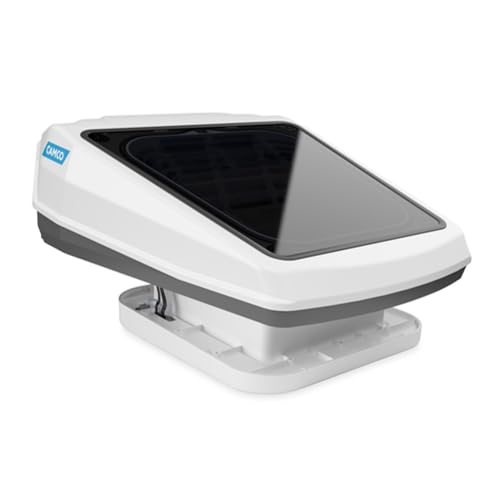
Camco 12V Standard Electric RV Roof Vent Fan
Camco built this fan for owners replacing a broken factory vent, not chasing extra features. Single-speed operation and a manual lift lid keep the design as simple as it gets. It fits the same 14 by 14 inch opening as every fan in this comparison.
Pros
- Lowest cost among the seven fans compared
- Straightforward install suits a direct factory swap
- Lower draw suits smaller battery banks
Cons
- Lowest airflow rating in this lineup
- No rain sensor or remote control option

Broan-NuTone 12V RV Vent Fan Replacement
Broan-NuTone seals this fan’s motor housing tighter than typical budget models, a plus in humid or coastal climates. Moisture ingress shortens motor life faster in less sealed designs. Airflow lands in the mid-range for this comparison.
Pros
- Sealed housing suits humid or coastal climates
- Two-speed control adds some airflow flexibility
- Brand reliability carries over from its bath fan lineup
Cons
- No rain-open feature during active rainfall
- Airflow trails both the MaxxAir and Fan-Tastic models

Valterra RV Roof Vent Fan
Valterra strips out remotes and rain sensors, leaving a fan with fewer parts that can fail. That simplicity suits owners who just need airflow restored after a factory fan quits. It still fits the standard 14 by 14 inch vent opening.
Pros
- Fewer parts mean fewer things that can fail
- Fits standard 14 by 14 inch vent openings
- Airflow suits basic ventilation needs
Cons
- No speed adjustment beyond a single setting
- Lacks any weather-sensing automation
How they stack up
| # | Model | Airflow | Best for | Score | Price |
|---|---|---|---|---|---|
| 1 | MaxxAir MaxxFan Deluxe 00-07500K | Up to 900 CFM | Best overall | 9.5 | Check price |
| 2 | Fan-Tastic Vent 807350 Endless Breeze | Up to 850 CFM | Best for quiet operation | 9.1 | Check price |
| 3 | Heng’s Vortex II 12V Roof Vent Fan | Up to 700 CFM | Best value | 8.7 | Check price |
| 4 | Ventline Diamond Plus Powered Roof Vent Fan | Up to 650 CFM | Best for OEM replacement | 8.4 | Check price |
| 5 | Camco 12V Standard Electric RV Roof Vent Fan | Up to 500 CFM | Best budget | 8.1 | Check price |
| 6 | Broan-NuTone 12V RV Vent Fan Replacement | Up to 600 CFM | Best for humid climates | 8.0 | Check price |
| 7 | Valterra RV Roof Vent Fan | Up to 550 CFM | Best for basic ventilation needs | 8.0 | Check price |
What matters most
What a portable RV vent fan actually replaces Most fans sold as portable RV vent fans are self-contained units built to drop into the existing 14 by 14 inch roof opening. Hand tools handle the swap, unlike ducted HVAC systems that need professional installation. Owners typically keep the original mounting screws and just replace the fan and lid assembly.
How much airflow different RV sizes need A single fan rated near 500 CFM, like the Camco, ventilates a small travel trailer adequately. Larger Class A or C rigs benefit from the MaxxAir’s 900 CFM rating, or from running two smaller fans for cross-ventilation. Match fan output to interior volume rather than buying on price alone.
Rain sensing versus manual lid operation Rain-sensing fans, including the MaxxAir MaxxFan Deluxe and Fan-Tastic Vent 807350, can stay partly open or close automatically once rain starts. That matters most for boondockers who leave a rig unattended for hours. Manual lid fans, like the Ventline, need someone present to close them before weather rolls in.
Power draw and its effect on battery life Power draw across these seven fans ranges from 2.5 to 4.8 amps, depending on motor size and speed setting. Owners running a fan overnight on battery power should favor lower-draw models like the Ventline or Camco. Higher-draw fans like the MaxxAir make more sense with shore power or a larger battery bank.
Frequently asked questions
Do all RV roof vent fans fit the same size opening?
Most fit the 14 by 14 inch opening standard since the 1980s, but measuring the existing vent before ordering still confirms the fit.
Can I install an RV vent fan myself?
Yes, most swaps take under an hour with a screwdriver, since the new fan reuses the existing mounting screws and sealant line.
What is the difference between a rain-sensing and manual vent fan?
A rain-sensing model like the MaxxAir MaxxFan Deluxe stays open or closes on its own in light rain, while a manual fan needs someone to shut the lid by hand.
How much airflow does a travel trailer need from a vent fan?
Around 500 to 700 CFM covers most small to mid-size trailers, while larger rigs do better with a higher-CFM fan or two fans running together.
Will running a vent fan overnight drain my RV battery?
Lower-draw fans near 2.5 amps, like the Camco or Ventline, pull far less than fans near 4.8 amps, like the MaxxAir on its highest speed.
Is it safe to run a roof vent fan while towing?
No, manufacturers recommend closing and latching the lid before driving to avoid wind damage to the lid hinge.
Are 12 volt RV vent fans different from household exhaust fans?
Yes, RV vent fans draw from the rig’s 12V DC battery system, while household fans run on 120V AC household power.
How long does an RV roof vent fan typically last?
Most last 5 to 10 years depending on climate and motor sealing, with moisture-resistant models like the Broan-NuTone often lasting longer near the coast.
MaxxAir MaxxFan Deluxe vs Fan-Tastic Vent 807350: which is quieter?
The Fan-Tastic Vent 807350 runs quieter at low and mid speeds, while the MaxxAir prioritizes maximum airflow at 900 CFM on high.
Our pick
The MaxxAir MaxxFan Deluxe earns the top spot for its rain-open lid and 900 CFM ceiling, worth the extra power draw for owners who camp through unpredictable weather. Budget-focused owners doing a straightforward factory-fan swap should pick the Camco 12V Standard instead. Anyone camping in humid or coastal climates should weigh the Broan-NuTone’s sealed housing above raw airflow numbers.
Tony Russo
Tony trained as an automotive technician and spent years in service and parts retail before moving into writing. He focuses on garage tools, car care products and accessories from a hands-on maintenance perspective.


