Which RV Tire Pressure Monitor Suits Your Rig Size?
TireMinder A1AS fits most rigs, tracking 22 tire positions with a booster already in the box. TST 507 uses flow through sensors, so an air hose connects without unscrewing anything. EEZTire TPMS10ATC pairs faster and holds 26 positions on one screen.
TireMinder A1AS earns the default recommendation for towables and motorhomes alike. Its booster ships inside the kit, which settles the dropout problem that follows long fifth wheels. Cap style sensors are the tradeoff, since inflating a tire means unscrewing one first.
Tires on a trailer fail quietly, with no feedback through the steering wheel. We compared sensor counts against real axle setups, checked whether a repeater arrives in the box or costs extra, and weighed cap sensors against flow through bodies. Owner feedback on battery life, false alarms and screen glare shaped the order.
Before you buy
What to look for in an RV tire pressure monitor Count your tires first, then add the towed vehicle and the spare. A motorhome pulling a car needs ten slots before anyone discusses features. Range matters next, since aluminium siding and a long wheelbase both swallow signal. Sensor design decides how often you will fight a compressor hose. Check battery access last, because sealed sensors turn disposable after a season or two.
Cap sensors vs flow through sensors Cap sensors thread onto the valve stem and read pressure through it. Light, cheap and quick to replace, they remain the common choice. Flow through bodies build a valve inside the sensor, letting a hose connect while it stays fitted. Dual rear wheels are where that pays, given how awkward an inner valve is to reach. Extra mass on a rubber stem is the cost, and metal stems reduce the flex that follows.
How far the signal reaches on a long rig A 40 foot fifth wheel places the rear sensor well beyond casual radio range. Dropouts appear as one position blinking in and out, almost always the furthest back. Boosters mount midway, often inside a pass through storage bay, and relay the signal forward. TireMinder packs one in the box, while TST sells its repeater separately. Budget for that hardware once a rig passes roughly 30 feet.
Setting alarm thresholds you will actually trust Factory windows sit too wide to catch a slow leak early. Around 10 to 15 percent below cold placard pressure works as a low alarm on most trailer tires. Heat triggers commonly sit near 158 degrees Fahrenheit, which flags a dragging brake before the tread lets go. Motorhomes running different front and rear pressures need per tire limits, which is exactly where a single global setting frustrates owners. An alarm that cries wolf gets muted, and a muted alarm protects nobody.
The top picks, ranked

TireMinder A1AS RV TPMS
Twenty two sensor positions cover a motorhome, a towed car and a trailer on one monitor. Booster hardware arrives in the kit, which is why owners of 40 foot fifth wheels land here. Each cap sensor runs on a coin cell you can swap at any hardware counter.
Pros
- Booster pushes signal past the rear axle
- Scales from truck to towed car to trailer
- Coin cells swap without binning the sensor
Cons
- Sensors unscrew before you can add air
- Small screen washes out in direct sun
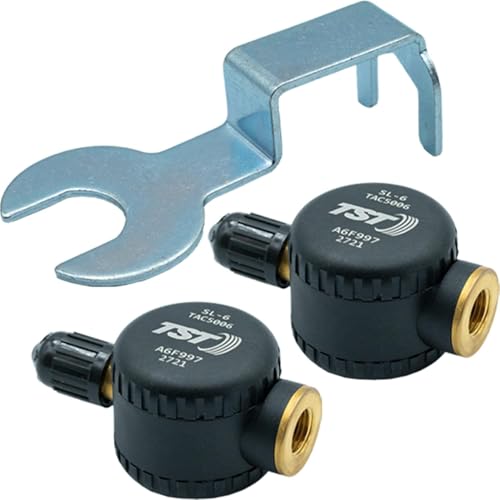
TST 507 TPMS with Flow-Through Sensors
Each sensor houses its own valve, so a compressor hose threads on while the sensor stays fitted. Inner duals gain the most, given how the hidden valve sits behind the outer rim. Colour screen cycles positions and stores a separate high and low limit for every tire.
Pros
- Air goes in with the sensor still on
- Separate limits for steer, drive and trailer tires
- Colour screen stays legible in daylight
Cons
- Heavier bodies swing on rubber valve stems
- Long rigs need the repeater as an extra buy

EEZTire TPMS10ATC
Pairing runs in sequence rather than through nested menus, so a full set registers in minutes. One grid screen holds up to 26 positions, enough for a triple axle trailer plus duals. Anti theft nuts and batteries come packed in, leaving nothing else to order.
Pros
- Handles 26 positions on a single monitor
- Registration takes minutes, not menu digging
- Anti theft nuts supplied with the sensors
Cons
- One global threshold instead of per tire limits
- Cap design still blocks quick inflation

Tymate M7-3 Tire Pressure Monitoring System
Four external sensors suit a single axle travel trailer or the tow vehicle by itself. Pressure and temperature update live, and an audible alert fires on either reading. Charging happens through a solar lid, with USB as the backup during cloudy weeks.
Pros
- Solar lid keeps the monitor topped up
- Fast leak warning fires before pressure bottoms out
- Footprint fits a crowded truck dash
Cons
- Four positions only, with no room for duals
- Owners report dropouts on long trailers without a repeater

GUTA Solar Wireless TPMS
Solar cells sit in the lid, removing the charging cable that usually crosses a windscreen. Four sensors report pressure and temperature, and both alarm points move to match your door placard figure. Coverage stops at a tow vehicle or a short single axle trailer.
Pros
- Nothing cabled running across the dash
- Alarm points follow placard pressure, not a fixed default
- Temperature shown per tire alongside pressure
Cons
- Sensor count cannot be expanded
- Winter storage leaves the panel short of light

SYKIK Tire SRTP800 TPMS
Buses, toy haulers and heavy trailers drove this design, and the grid shows several axles at once. Sensor range extends into commercial inflation figures, which matters on a loaded fifth wheel. Setup rewards patience, because the menus assume you already know TPMS vocabulary.
Pros
- Reads the high inflation figures heavy tires run
- Whole rig visible on one grid
- Duals and triple axles map cleanly
Cons
- Menus assume prior TPMS knowledge
- More system than a short travel trailer needs

TireMinder Smart TPMS
Readings land on a phone over Bluetooth instead of a dedicated screen. Dash space stays clear for anyone already running a phone mount and charge lead. Range is the catch, so a booster plus the app left open become mandatory on anything long.
Pros
- One less screen and power lead on the dash
- Trip readings log inside the app
- Sensors share the A1AS cap design
Cons
- Alerts depend on the app staying open
- Bluetooth reach trails a dedicated radio monitor
Compared at a glance
| # | Model | Sensors supported | Best for | Score | Price |
|---|---|---|---|---|---|
| 1 | TireMinder A1AS RV TPMS | Up to 22 | Best overall | 9.4 | Check price |
| 2 | TST 507 TPMS with Flow-Through Sensors | Flow through with integrated valve | Best for frequent air checks | 9.2 | Check price |
| 3 | EEZTire TPMS10ATC | Up to 26 | Best value | 9.0 | Check price |
| 4 | Tymate M7-3 Tire Pressure Monitoring System | 4 external | Best budget | 8.8 | Check price |
| 5 | GUTA Solar Wireless TPMS | 4 external | Best for a clean dash | 8.6 | Check price |
| 6 | SYKIK Tire SRTP800 TPMS | Large multi axle count | Best for large rigs | 8.3 | Check price |
| 7 | TireMinder Smart TPMS | Smartphone app | Best app based option | 8.0 | Check price |
Common questions
Do you need a TPMS on an RV?
Pressure loss on a trailer produces no feedback through the steering wheel. A monitor buys minutes of warning before heat strips the tread, which is the usual towable failure.
How many sensors do you need for a truck and fifth wheel?
Count every tire on both vehicles. A dual rear axle truck with a triple axle trailer reaches ten. Extra slots leave room to watch the spare.
What is the difference between flow through and cap TPMS sensors?
Flow through sensors carry a valve inside the body, so air goes in while they stay fitted. Cap sensors come off first. Flow through bodies also weigh more on the stem.
Will a trailer TPMS reach a monitor in the truck?
On shorter trailers, usually. Past roughly 30 feet, fit the repeater. Rear axle positions otherwise blink out and return at random.
Can you monitor the spare tire?
Yes, whenever a sensor slot sits free. Assigning the spare catches a slow leak long before that tire is needed on a shoulder.
How long do RV TPMS sensor batteries last?
Roughly one to two seasons, shorter with heat and high mileage. Coin cell sensors take a fresh battery; sealed units get replaced whole.
Do metal valve stems matter with TPMS sensors?
On high pressure trailer tires they do. A sensor swinging on a long rubber stem flexes it at highway speed. Metal or short stems cut that stress.
Which RV TPMS has the longest range?
Systems shipping with a booster reach furthest untouched, and TireMinder A1AS is the example here. TST 507 matches it once the separate repeater goes in.
Is a flow through sensor worth the extra weight?
For dual rear wheels, yes, since reaching the inner valve is otherwise a knuckle scraping job. Single axle trailers with open valve access gain little.
Final word
TireMinder A1AS is the pick for most owners, because its included booster removes the dropout complaint that trails every rival system. Anyone topping up duals weekly should choose TST 507 instead and accept heavier sensor bodies on the stems. Save the four sensor Tymate kit for a short single axle trailer where the monitor sits a few feet from the wheels.
Tony Russo
Tony trained as an automotive technician and spent years in service and parts retail before moving into writing. He focuses on garage tools, car care products and accessories from a hands-on maintenance perspective.