Which Portable RV Surge Protector Matches Your Rig?
The Progressive Industries EMS-PT50X leads for full-time RVers, since it catches wiring faults before power reaches the rig. Owners of 30 amp trailers get the same protection scaled down with the EMS-PT30X. Budget-focused campers who mainly worry about spikes should look at the Camco PowerDefender 30 Amp instead.
Faulty campground wiring wrecks more RV electronics than lightning does. The Progressive Industries EMS-PT50X catches those wiring faults before power ever reaches the rig, not just voltage spikes, though it costs more than surge-only units. Owners of smaller 30 amp trailers get the same protection scaled down with the EMS-PT30X.
A basic surge protector blocks spikes but stays silent on reversed polarity or an open ground, both of which a full electrical management system catches. We compared amperage rating, joule capacity, fault detection, and owner reports on false trips across seven current models.
The shortlist, ranked

Progressive Industries EMS-PT50X Portable Surge Protector
It checks for open ground, reversed polarity, and abnormal voltage before letting any power through, not just surge spikes. A digital display shows live voltage and fault codes right at the pedestal. Full-time RVers cite it most often for catching park wiring problems other protectors miss.
Pros
- Detects wiring faults beyond simple surge spikes
- Digital display shows live voltage instantly
- Reconnects automatically once power stabilizes
Cons
- Costs more than surge-only protectors
- Bulkier than basic plug-in models

Progressive Industries EMS-PT30X Portable Surge Protector
The same full diagnostic protection as the 50 amp version comes sized down for smaller trailers on 30 amp service. It disconnects the instant it detects a fault, then reconnects once power reads safe again. Owners of travel trailers and pop-up campers make up most of its reported use.
Pros
- Full diagnostic protection at 30 amp size
- Disconnects and reconnects automatically on faults
- Compact enough for smaller trailers
Cons
- Not rated for 50 amp rigs
- Costs more than surge-only 30 amp units

Southwire 34931 Surge Guard Portable 30 Amp
Surge suppression pairs with basic wiring fault detection here, at a lower cost than a full EMS unit. LED indicators show status rather than a digital readout. Owners upgrading from a bare surge strip mention the wiring check as their main reason for switching.
Pros
- Wiring fault detection at a lower cost than full EMS
- LED lights give quick status at a glance
- Compact portable housing
Cons
- No digital voltage readout
- Less detailed diagnostics than Progressive Industries models

Camco PowerDefender 50 Amp Portable Surge Protector
A high joule rating absorbs the large spikes common at older campground pedestals. Its weatherproof housing tolerates sitting outside connected for extended stays. Class A motorhome owners running 50 amp service make up most of its reported use.
Pros
- High joule rating handles large voltage spikes
- Weatherproof housing suits extended outdoor use
- Sized correctly for large motorhome service
Cons
- No open ground or reversed polarity detection
- Heavier than smaller 30 amp units

Camco PowerDefender 30 Amp Portable Surge Protector
Surge suppression alone, without full wiring diagnostics, keeps this unit’s price down. LED indicators confirm it is actively protecting the connection. Weekend campers mainly worried about lightning and grid spikes find it sufficient for occasional trips.
Pros
- Lowest cost surge protection in this comparison
- Simple LED status confirms active protection
- Lightweight for easy bay storage
Cons
- No wiring fault detection like open ground
- Fewer diagnostic details than EMS models
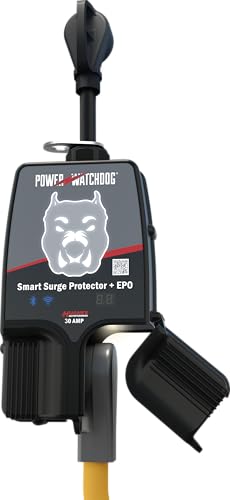
Hughes Autoformers Power Watchdog PWD30-EPO
A Bluetooth link sends live voltage, amperage, and fault data to a phone app, so owners can check status without walking to the pedestal. Full surge and wiring fault protection still runs at 30 amp service underneath. RVers who like tracking power data across a trip mention the app most often.
Pros
- App monitoring checks status without leaving the rig
- Full surge and wiring fault protection included
- Historical data logging through the app
Cons
- Bluetooth range limits monitoring distance
- App dependency adds a step versus a simple display

Southwire 44290 Surge Guard Portable 50 Amp
Basic wiring fault detection joins surge suppression at 50 amp capacity here, sized for larger rigs. A rugged case is built to sit outside at the pedestal for an entire stay. Frequent full-hookup travelers mention it holds up well across many campgrounds per season.
Pros
- Wiring fault detection at 50 amp capacity
- Rugged case suits frequent campground use
- Simpler operation than full EMS displays
Cons
- No digital voltage readout
- Heavier than 30 amp portable units
How to pick the right one
What to look for in a portable RV surge protector Match amperage to your rig’s actual electrical service; a 30 amp protector cannot safely run 50 amp service. Joule rating measures how large a spike the unit absorbs before it sacrifices itself. Full electrical management systems add wiring fault detection on top of basic surge suppression. Weatherproof housing matters most since these units typically sit outside at the pedestal for the whole stay.
Surge protection vs full electrical management systems A basic surge protector blocks voltage spikes but says nothing about reversed polarity or an open ground wire. Full EMS units, like the Progressive Industries line, test the pedestal wiring itself before letting power through. Older campgrounds see wiring faults often enough that many full-time RVers treat EMS as non-negotiable. Weekend campers visiting newer parks may find surge-only protection adequate for their exposure.
30 amp vs 50 amp: matching your rig Travel trailers and pop-ups typically run 30 amp service, while larger fifth wheels and motorhomes often need 50 amp. Running a 30 amp protector on 50 amp service undersizes the protection and risks damage. Check your rig’s shore power cord and breaker panel rating before buying, not just its trailer class. Adapters exist, but a correctly sized protector avoids that extra point of failure.
Portable vs hardwired surge protection Portable units plug in at the pedestal and travel with the rig between campgrounds, suiting anyone who moves sites often. Hardwired versions install permanently near the RV’s main panel and protect regardless of which unit sits at the pedestal. Full-time travelers generally prefer portable units for that flexibility across different campgrounds. Owners who rarely move their RV may prefer a hardwired unit with less to connect at each stop.
How they stack up
| # | Model | Amperage | Best for | Score | Price |
|---|---|---|---|---|---|
| 1 | Progressive Industries EMS-PT50X Portable Surge Protector | 50 amp | Best overall | 9.4 | Check price |
| 2 | Progressive Industries EMS-PT30X Portable Surge Protector | 30 amp | Best for 30 amp rigs | 9.2 | Check price |
| 3 | Southwire 34931 Surge Guard Portable 30 Amp | 30 amp | Best value | 8.9 | Check price |
| 4 | Camco PowerDefender 50 Amp Portable Surge Protector | 50 amp | Best for large motorhomes | 8.7 | Check price |
| 5 | Camco PowerDefender 30 Amp Portable Surge Protector | 30 amp | Best budget | 8.4 | Check price |
| 6 | Hughes Autoformers Power Watchdog PWD30-EPO | 30 amp | Best for smartphone monitoring | 8.2 | Check price |
| 7 | Southwire 44290 Surge Guard Portable 50 Amp | 50 amp | Best for frequent full-hookup travel | 8.0 | Check price |
Questions worth asking
Do I need a surge protector for my RV?
Campground power quality varies widely, and a single bad pedestal can damage an RV’s electrical system in seconds. Most experienced RVers treat a surge protector as standard equipment.
What is the difference between a surge protector and an EMS for RVs?
A surge protector only blocks voltage spikes. A full electrical management system also checks for open ground, reversed polarity, and abnormal voltage before allowing power to the rig.
Can I use a 30 amp surge protector on a 50 amp RV?
Not directly, since amperage rating must match the service. A 50 amp rig needs a 50 amp rated protector, sometimes paired with an adapter, never a mismatched capacity unit.
How do I know if my RV surge protector is working?
Most models show status through LED indicators or a digital display confirming active protection. EMS units typically display a fault code when they detect and correct a wiring problem.
Are portable RV surge protectors weatherproof?
Most quality models use weather-resistant housings since they sit outside at the pedestal for the length of a stay, though prolonged standing water should still be avoided.
What joule rating do I need for an RV surge protector?
Higher joule ratings absorb larger spikes before the unit sacrifices itself to protect the rig. Full-time travelers visiting varied campgrounds generally benefit from a higher rated unit.
Can a bad campground pedestal damage my RV without a surge protector?
Yes. Reversed polarity or an open ground can damage appliances and create a shock hazard, exactly what full EMS units are built to catch before power reaches the rig.
Do RV surge protectors work with generators?
Most portable surge protectors work with generator power as well as shore power, though a stable, properly grounded generator output is still required for correct operation.
Is a portable or hardwired surge protector better for full-time RVing?
Portable units suit full-time RVers who change campgrounds often, since the protection travels with the rig. Owners who rarely move may prefer a hardwired unit instead.
Our pick
Full-time and frequent travelers should choose the Progressive Industries EMS-PT50X or EMS-PT30X depending on rig size, since wiring fault detection catches problems surge-only units miss. Weekend campers mainly worried about spikes can save with the Camco PowerDefender line instead. Anyone wanting phone-based status checks without walking to the pedestal should look at the Power Watchdog PWD30-EPO.
Tony Russo
Tony trained as an automotive technician and spent years in service and parts retail before moving into writing. He focuses on garage tools, car care products and accessories from a hands-on maintenance perspective.