Portable Recorders Built to Capture Clean, Usable Audio
Zoom’s H6essential leads this list with four XLR inputs and swappable capsules for most recording needs. Tascam’s DR-40X gives similar flexibility at a lower cost, and the Zoom H1essential covers pocket-sized daily carry. Podcasters wanting dual mic inputs without bulk should look at the Zoom H5.
Zoom’s H6essential stands as the strongest all-around portable recorder for podcasters, musicians, and field recordists alike. Four XLR inputs and swappable XY capsules cover interviews, bands, and ambient sound with one body. Its multitrack design does make it bulkier than pocket-sized alternatives.
Recording format, microphone type, input count, storage limits, and battery life were compared across current Zoom, Tascam, Sony, and Roland models. Owner feedback on handling noise and menu complexity also shaped how each recorder was ranked.
The top picks, ranked

Zoom H6essential
Six tracks record at once through an interchangeable XY capsule and four locking XLR/TRS combo inputs. Files save as 32-bit float WAV, so clipped levels can be recovered in post without a re-take. AA batteries or USB-C power keep it running through long location sessions.
Pros
- Swappable mic capsules adapt to interviews, music, or ambient sound
- 32-bit float format removes the need to set gain perfectly
- Four XLR inputs cover a full band or a multi-person panel
Cons
- Bulkier and heavier than single-mic handheld recorders
- Menu system takes time to learn for first-time users
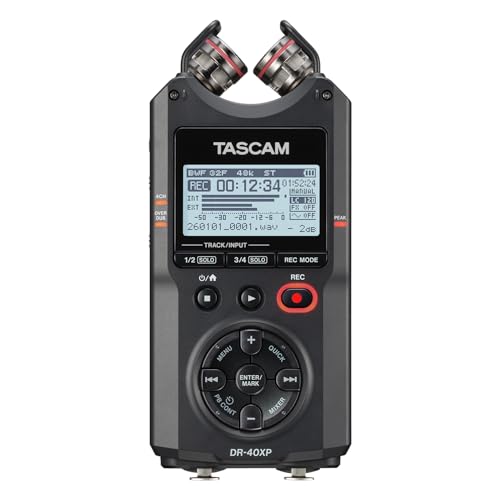
Tascam DR-40X
An adjustable XY stereo mic pairs with two XLR/TRS combo jacks for external microphones. The unit doubles as a USB audio interface, so it can feed a laptop directly for streaming. Two AA batteries power roughly 17 hours of continuous recording.
Pros
- Works as a USB audio interface for direct-to-computer recording
- Adjustable mic angle handles wide rooms or close-up voice
- Runs on widely available AA batteries
Cons
- Caps out at 24-bit rather than 32-bit float
- A 128GB card limit trails newer Zoom models

Zoom H1essential
This recorder fits in a shirt pocket yet still records in 32-bit float, so loud passages will not clip. XLR inputs get dropped to keep the body small, relying on a single fixed XY capsule instead. A built-in speaker lets owners review a take without headphones.
Pros
- Small enough to carry daily without a bag
- 32-bit float avoids the need to ride gain levels
- A built-in speaker allows quick playback checks
Cons
- No XLR inputs for external microphones
- A fixed capsule cannot be swapped for other mic types
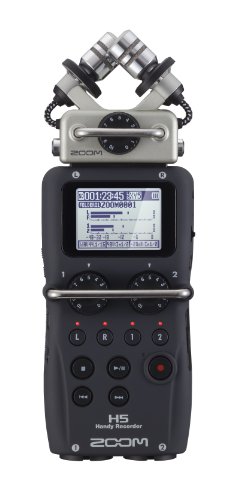
Zoom H5
An interchangeable XY capsule combines with two locking XLR/TRS inputs, so a host can plug in lavalier or shotgun mics for guests. A removable windscreen and shock-mounted capsule cut down on handling noise during sit-down interviews. Two AA batteries last roughly 20 hours between changes.
Pros
- A swappable capsule can be replaced with a shotgun or MS mic
- Shock mount and windscreen reduce interview handling noise
- Long AA battery life supports multi-hour recording sessions
Cons
- No 32-bit float recording like newer essential-series models
- Larger footprint than single-capsule pocket recorders

Roland R-07
Bluetooth remote control lets an owner start and stop recording from a phone without touching the body and adding handling noise. Onboard wind noise reduction processing helps outdoors without a foam cover. A rugged case survives being carried loose in a field bag.
Pros
- Bluetooth remote avoids handling noise during unattended recording
- Wind noise reduction processing works without an external windscreen
- Compact body withstands daily outdoor use
Cons
- No XLR inputs for professional external microphones
- The Bluetooth remote drains battery faster than standalone recording

Tascam DR-05X
This straightforward stereo recorder targets practice sessions and rehearsal capture. A fixed XY condenser mic handles a full band or a solo instrument without extra setup. It also works as a USB audio interface for overdubbing directly into a DAW.
Pros
- Simple one-purpose design with minimal menu diving
- Doubles as a USB interface for DAW overdubbing
- Runs on inexpensive AAA batteries
Cons
- A fixed mic cannot be swapped or repositioned
- No XLR inputs limit use with dedicated microphones

Sony ICD-UX570
Built for spoken-word capture rather than music, this recorder uses a simple one-button interface for starting a lecture or meeting recording. A flip-out USB connector plugs straight into a laptop for file transfer without cables. Built-in memory plus a microSD slot means storage rarely runs out mid-semester.
Pros
- One-button operation with no menus to navigate mid-lecture
- A flip-out USB connector skips cables for file transfer
- Long battery life covers back-to-back class sessions
Cons
- Linear PCM tops out at 16-bit, below musician-grade recorders
- No XLR or line inputs for external microphones
The lineup, side by side
| # | Model | Recording Format | Best for | Score | Price |
|---|---|---|---|---|---|
| 1 | Zoom H6essential | WAV/BWF up to 32-bit float, 192kHz | Best overall | 9.4 | Check price |
| 2 | Tascam DR-40X | WAV/MP3 up to 24-bit, 96kHz | Best value | 9.1 | Check price |
| 3 | Zoom H1essential | WAV up to 32-bit float, 96kHz | Best budget | 8.8 | Check price |
| 4 | Zoom H5 | WAV up to 24-bit, 96kHz | Best for podcasting and interviews | 8.5 | Check price |
| 5 | Roland R-07 | WAV/MP3 up to 24-bit, 96kHz | Best for field recording | 8.3 | Check price |
| 6 | Tascam DR-05X | WAV/MP3 up to 24-bit, 96kHz | Best for music practice | 8.1 | Check price |
| 7 | Sony ICD-UX570 | MP3/Linear PCM up to 16-bit, 48kHz | Best for lectures and meetings | 8.0 | Check price |
How to choose
What to look for in a portable recorder Recording format sets the ceiling for audio quality. WAV or 32-bit float files hold more detail than MP3 and survive louder peaks without clipping. Mic type matters just as much, since fixed XY capsules suit casual use while interchangeable capsules let one recorder switch roles. Storage capacity and battery life decide how long a session can run before a card swap or a charge.
Best for podcasting and interviews Dual XLR or combo TRS inputs let a host plug in separate microphones for each guest instead of relying on one onboard capsule. Phantom power support opens the door to studio-style condenser mics. Shock mounts and windscreens matter here too, since handheld interviews pick up more handling noise than a stationary setup.
Best for music and field recording Musicians and field recordists both benefit from swappable capsules and higher input counts, since a rehearsal or an outdoor soundscape needs more flexibility than spoken word. Wind noise reduction and rugged housings matter outdoors. Multitrack inputs with phantom power matter most for full-band sessions in a rehearsal space.
Best for lectures and meetings Spoken-word recording rarely needs multitrack inputs or 32-bit float headroom, so a simple built-in mic and one-button controls matter more than swappable capsules. Battery life becomes the deciding factor for back-to-back classes or all-day meetings. Direct USB file transfer also saves time compared with pulling a memory card after each session.
Common questions
What is the best portable recorder for podcasting?
The Zoom H5 suits most podcasters. Its two combo XLR/TRS inputs accept external microphones for co-hosts or guests, and the interchangeable capsule still handles room-only recording when needed.
Are handheld recorders better than a phone for interviews?
A dedicated recorder like the Zoom H6essential adds XLR inputs, phantom power, and 32-bit float headroom that phone microphones cannot match, especially in noisy rooms or outdoors.
Zoom H5 vs Tascam DR-40X, which should I buy?
Choose the Zoom H5 for a swappable mic capsule and longer AA battery life. Pick the Tascam DR-40X if a built-in USB audio interface matters more than capsule flexibility.
How long does a portable recorder’s battery last?
Battery life varies by model. The Sony ICD-UX570 runs up to 35 hours on its built-in battery, while AA-powered recorders like the Zoom H5 last around 20 hours per set.
Can a pocket-size recorder handle lecture audio?
Yes. Compact models such as the Zoom H1essential or Sony ICD-UX570 handle lecture and meeting audio well, since spoken word needs less headroom than music or field recording.
What is 32-bit float recording and do I need it?
32-bit float recording, used in the Zoom H6essential and H1essential, captures very loud and very quiet sound without clipping, so gain levels do not need to be set perfectly in advance.
Is a portable recorder worth it for music practice?
For solo practice or rehearsal capture, a simple fixed-mic model like the Tascam DR-05X is usually enough, since it skips the multitrack inputs that raise the cost of band-focused recorders.
What storage card size do I need for field recording?
Field recording sessions with the Roland R-07 or Zoom H6essential benefit from a large microSD card, since both support cards up to 1TB for long unattended takes.
Final word
Anyone recording interviews, bands, or multi-mic setups should pick the Zoom H6essential, since four XLR inputs and 32-bit float format leave the most room to grow. Solo podcasters who only need two mic inputs should choose the Zoom H5 instead, and anyone recording lectures on a budget will get more mileage from the Sony ICD-UX570’s 35-hour battery.
Marcus Chen
Marcus covered consumer electronics for enthusiast tech publications for six years before joining ChoiceCrest. He specializes in translating manufacturer spec sheets into plain-language buying advice, with a focus on audio, computing accessories and smart-home gear.


