Portable Projectors Bright Enough for Daytime Viewing
The Anker Nebula Capsule 3 Laser is the strongest all-around pick, pairing laser brightness with a built-in Google TV platform in a can-sized body that fits in one hand. The XGIMI Halo+ suits buyers who want a brighter image for larger screens, while the Kodak Luma 350 fits anyone who wants a simple pocket projector on a budget.
The Anker Nebula Capsule 3 Laser stands out because laser light source technology delivers sharper, more accurate color than the LED bulbs used in most pocket-sized projectors. Its main limitation is lower peak brightness than larger, non-portable projector designs built for bigger rooms.
We compared brightness, battery life, smart platform support and portability across each listing rather than running our own home theater shootout.
How to choose
What brightness and light source actually affect Brightness determines how visible a projected image stays in a room with some ambient light, and laser or LED light sources affect both brightness and color accuracy differently. A higher brightness rating, like on the XGIMI Halo+, supports larger screens in less-than-fully-dark rooms, while dimmer pocket projectors need a darker space to look sharp. Light source technology also affects color, with laser projectors like the Anker Nebula Capsule 3 Laser generally producing more accurate color than standard LED bulbs. Resolution and keystone correction round out the core specs that determine how usable a projected image looks in different rooms and angles.
Built-in smart platforms versus external streaming devices A built-in smart platform, like Google TV on the Anker Nebula Capsule 3 Laser and XGIMI MoGo 3 Pro, Android TV on the XGIMI Halo+ and BenQ GV31, or webOS on the LG CineBeam Q, runs streaming apps directly without a separate device plugged in. The Kodak Luma 350 skips a built-in platform entirely to keep its price lower, requiring an external streaming stick or cable connection for apps like Netflix or YouTube. Buyers already invested in one smart TV ecosystem, like Samsung’s, may prefer the Samsung The Freestyle for matching software across their TV and projector.
Matching a portable projector to indoor, outdoor or travel use Indoor casual viewing, like a bedroom or living room movie night, works well with any of the smart-platform projectors here, with brightness mattering most in rooms with some daylight or lamp light. Outdoor use benefits from a rugged build and auto-leveling features, which is why the BenQ GV31 targets camping trips and backyard movie nights specifically. Travelers who prioritize minimal size and weight over maximum brightness should lean toward the Anker Nebula Capsule 3 Laser or Kodak Luma 350, both built around a pocket-friendly footprint.
Battery life and power options Battery life ranges from roughly two to three hours across most projectors here, short enough that a feature film may require a mid-session recharge or power bank. The XGIMI Halo+’s swappable battery base stands out by allowing a fresh battery to be swapped in rather than waiting for a recharge. Some designs, like the Samsung The Freestyle, rely on a separate external battery pack entirely for portable use, since the projector itself does not include one built in.
The top picks, ranked

Anker Nebula Capsule 3 Laser
A laser light source produces more accurate color and sharper detail than the LED bulbs used in most compact projectors this size. Built-in Google TV runs streaming apps directly on the projector, without needing a separate streaming stick plugged in. A soda-can-sized body with a built-in handle makes it easy to carry between rooms or outdoors.
Pros
- Laser light source improves color accuracy over standard LED projectors
- Built-in Google TV skips the need for a separate streaming device
- Compact, can-sized body is easy to carry between locations
Cons
- Lower peak brightness than larger non-portable projectors
- Shorter battery life than projectors with bigger battery packs

XGIMI Halo+
Higher brightness output than pocket-sized competitors supports a larger, more visible image in rooms with some ambient light. An auto keystone and auto focus system adjusts the picture automatically when the projector is moved or angled. Built-in Android TV runs streaming apps natively, and a swappable battery base extends runtime away from an outlet.
Pros
- Higher brightness supports larger screens in rooms with ambient light
- Auto keystone and focus simplify setup when moving the projector
- Swappable battery base extends runtime beyond a fixed internal battery
Cons
- Larger and heavier than pocket-sized projectors
- Higher price than simpler battery-only portable projectors

XGIMI MoGo 3 Pro
An intelligent screen adaptation system automatically adjusts focus, keystone and screen alignment without manual input, useful for quick setup in a new location each time. Harman Kardon tuned speakers improve built-in audio over typical pocket projector speakers. Google TV certification brings a full streaming app library directly to the device.
Pros
- Automatic screen adaptation removes manual setup steps
- Harman Kardon tuned speakers improve built-in audio quality
- Full Google TV app library available without extra hardware
Cons
- Battery life is shorter than projectors with a swappable battery base
- Audio improvements add some bulk compared to the smallest pocket projectors
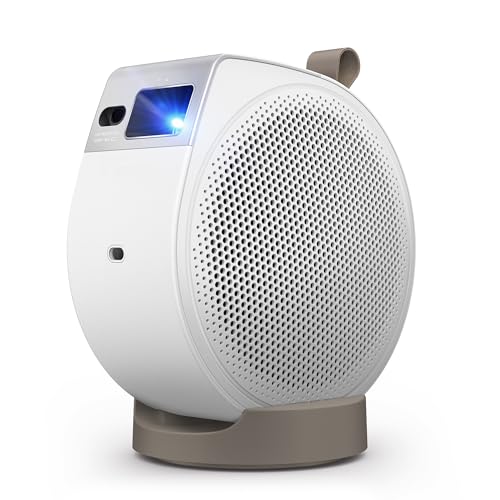
BenQ GV31
A built-in handle and rugged design target outdoor movie nights and camping trips better than projectors built mainly for indoor use. An adjustable projection angle and auto-leveling keystone correction simplify setup on uneven outdoor surfaces. Android TV built into the device supports streaming without a separate dongle.
Pros
- Rugged design suits outdoor movie nights and camping use
- Auto-leveling keystone simplifies setup on uneven surfaces
- Longer battery life than several pocket-sized competitors
Cons
- Lower brightness than larger home theater projectors
- Bulkier than the smallest pocket-sized portable projectors

Samsung The Freestyle (2nd Gen)
A 180 degree rotating design projects onto walls, ceilings or floors without needing a separate tripod or stand for different angles. Built-in Samsung Smart TV platform matches the software found on the brand’s television lineup. An ambient mode can also turn the projected image into simple decor lighting when not streaming content.
Pros
- Rotating design projects onto walls, ceilings or floors without a stand
- Samsung Smart TV platform matches the brand’s television software
- Ambient mode adds decorative lighting beyond video playback
Cons
- Needs a separate external battery pack for fully portable use
- Brightness trails laser-based competitors in well-lit rooms

LG CineBeam Q (PU700R)
A cube-shaped body stands upright on its own without needing a separate stand, unlike wider rectangular portable projectors. WebOS, the same smart platform used on LG televisions, runs streaming apps directly without extra hardware. Automatic focus and keystone correction adjust the image when the cube is repositioned.
Pros
- Cube shape stands upright without needing a separate stand
- WebOS platform matches LG’s television smart TV software
- Automatic focus and keystone simplify repositioning
Cons
- Brightness is lower than larger non-cube portable projectors
- Cube shape takes up more desk space than flatter designs
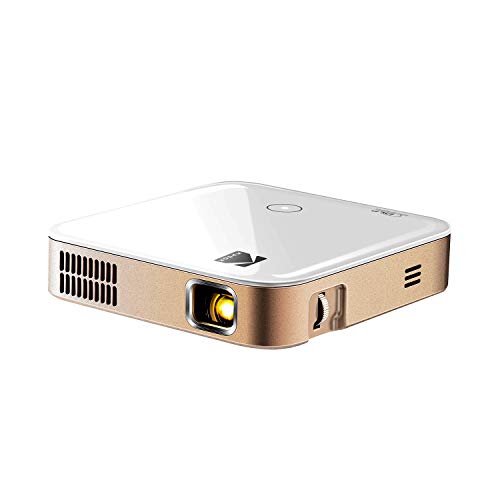
Kodak Luma 350
A pocket-sized body keeps this projector’s price well below smart-platform competitors, aimed at casual, occasional use rather than a primary home theater setup. A built-in battery allows cordless operation for a couple of hours without an outlet nearby. Basic keystone correction requires manual adjustment rather than the automatic systems found on pricier projectors.
Pros
- Lower price than smart-platform portable projectors
- Pocket-sized body is easy to carry and store
- Built-in battery allows cordless short-session use
Cons
- No built-in smart platform, so an external streaming device is needed
- Manual keystone correction takes more setup effort than automatic systems
The lineup, side by side
| # | Model | Light Source | Best for | Score | Price |
|---|---|---|---|---|---|
| 1 | Anker Nebula Capsule 3 Laser | Laser | Best Overall | 9.0 | Check price |
| 2 | XGIMI Halo+ | Higher output than pocket projectors | Best for Brighter, Larger Screen Viewing | 8.8 | Check price |
| 3 | XGIMI MoGo 3 Pro | Google TV certified | Best for Automatic Setup | 8.6 | Check price |
| 4 | BenQ GV31 | Rugged outdoor-focused build | Best for Rugged Outdoor Use | 8.3 | Check price |
| 5 | Samsung The Freestyle (2nd Gen) | 180 degree rotating projector head | Best for Flexible Projection Angles | 8.4 | Check price |
| 6 | LG CineBeam Q (PU700R) | Upright cube shape | Best for Compact Cube Design | 8.2 | Check price |
| 7 | Kodak Luma 350 | Pocket-sized body | Best Budget Pocket Pick | 8.0 | Check price |
Questions worth asking
Are portable projectors bright enough to use during the day?
Most need at least some darkness to look sharp, though higher brightness models like the XGIMI Halo+ handle rooms with mild ambient light better than dimmer pocket projectors.
Do portable projectors need a separate streaming device?
Not if they include a built-in smart platform, like Google TV on the Anker Nebula Capsule 3 Laser. The Kodak Luma 350 lacks a built-in platform and needs an external device.
What is the difference between laser and LED projector light sources?
Laser, used in the Anker Nebula Capsule 3 Laser, generally produces more accurate color than the LED bulbs used in most other portable projectors on this list.
How long does the battery last on a portable projector?
Typically around two to three hours per charge, though the XGIMI Halo+ offers a swappable battery base for extending runtime beyond a single charge.
Can a portable projector be used outdoors?
Yes, especially rugged designs like the BenQ GV31, which includes auto-leveling keystone correction for uneven outdoor surfaces.
What is auto keystone correction on a projector?
It automatically adjusts the image shape when the projector is angled rather than perfectly level, a feature included on the XGIMI Halo+, XGIMI MoGo 3 Pro and LG CineBeam Q.
Is a cube-shaped projector better than a rectangular one?
Not necessarily better, just different. The LG CineBeam Q’s cube shape stands upright without a stand, while rectangular designs may offer other tradeoffs in brightness or battery life.
Can a portable projector project onto a ceiling?
Some can. The Samsung The Freestyle’s 180 degree rotating head is specifically built to project onto walls, ceilings or floors without a separate mount.
What is the most affordable portable projector option?
The Kodak Luma 350 keeps costs down by skipping a built-in smart platform, making it the most budget-friendly pocket-sized option here.
Final word
The Anker Nebula Capsule 3 Laser earns the top recommendation for most buyers, since its laser light source and built-in Google TV cover color accuracy and streaming convenience in one of the smallest bodies available. Anyone planning to project onto a larger screen in a room with some ambient light should choose the XGIMI Halo+ instead, since its higher brightness and swappable battery handle that better. Buyers who mainly want an occasional, low-cost pocket projector should skip smart platforms entirely and pick the Kodak Luma 350.
Marcus Chen
Marcus covered consumer electronics for enthusiast tech publications for six years before joining ChoiceCrest. He specializes in translating manufacturer spec sheets into plain-language buying advice, with a focus on audio, computing accessories and smart-home gear.


