Which portable jump starter can crank your truck
NOCO Boost Pro GB150 leads on 3000 peak amps, enough for big gas V8s and diesels near 7 liters. NOCO Boost HD GB70 fits half ton pickups in a five pound package. Clore Automotive Jump-N-Carry JNC660 publishes 425 cranking amps, the figure that matters in a cold shop.
NOCO Boost Pro GB150 answers most truck owners who want one pack covering every vehicle on the property. Its 3000 amp rating reaches big gas V8s and light duty diesels, while thick cables stop voltage sagging mid crank. Bulk is the tradeoff. At roughly 7.5 pounds it lives in a toolbox, never a glovebox.
Trucks are the hardest case for portable power, since diesels crank against high compression and many wire two batteries in parallel. We compared published peak amp and engine displacement ratings, cable gauge and length, clamp jaw design, recharge input, and owner reports of output below freezing. Sustained cranking current counted for more here than headline surge numbers.
How to pick the right one
What to look for in a truck jump starter Start with rated engine displacement rather than the amp number printed on the box. Makers publish what their unit will crank: NOCO Boost HD GB70 lists diesels to about 6 liters, the GB150 to about 7. Cable gauge and length come next, since thin leads drop voltage before current reaches the post and short leads never stretch past an air box. Clamp jaws have to bite through corrosion on a neglected terminal. Weight decides where the pack lives, and a pack left in the garage helps nobody at a trailhead. Extras such as USB output, a work light or a compressor only count if they replace something you already carry.
Peak amps vs cranking amps, and which one starts an engine Peak amps describe a surge lasting a fraction of a second. Cranking amps describe sustained current while the starter motor turns, which is what actually fires a cold diesel. Clore publishes both for the JNC660 at 1700 peak and 425 cranking; most lithium packs list peak alone. No standard forces brands to measure the same way, so a 4000 amp claim and a 2000 amp claim are not directly comparable. Treat peak as a rough class marker and lean on the engine displacement rating instead. Clamp contact and cable gauge quietly settle the rest.
Jump starters, chargers and maintainers do different jobs A jump starter supplies one burst so the engine turns over now. A charger such as NOCO GENIUS10 refills the battery over several hours and can hold it at full charge indefinitely. Maintainers are simply chargers running at low current for storage. Jumping does not fix the battery: an alternator only partially restores a deeply drained cell, so a battery that died overnight still needs a proper charge afterwards. Owning one of each solves more failures than owning two jump starters. Seasonal trucks and RVs gain the most, because a battery sitting unused sulfates within a few months.
Diesel pickups, cold mornings and safe connections Diesels crank against high compression, and many trucks split the load across two batteries in parallel. Connect to the battery whose main cable runs to the starter, and let glow plugs finish their cycle before cranking. Lithium capacity falls as temperature drops, so a pack left in an unheated bed overnight may deliver well under its rating. Keep it in the cab through winter. Lead acid units like the JNC660 hold up better in that cold, which is why shops in northern states still run them. Clamp red to the positive post first, black to bare engine ground rather than the negative post, and recharge right after every use.
Our top picks
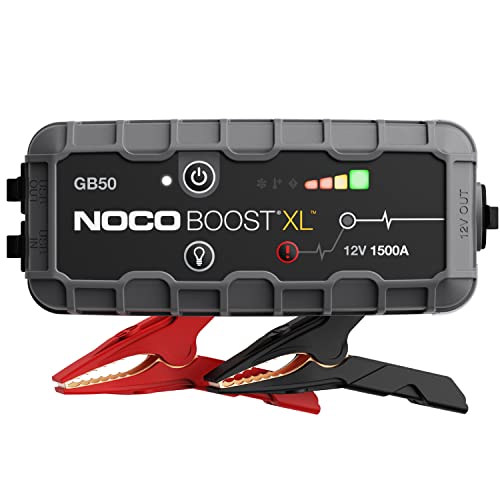
NOCO Boost Pro GB150 Jump Starter
Rated at 3000 peak amps, this pack covers gas engines to about 9 liters and diesels to roughly 7. Heavy gauge cables and wide jaw clamps carry that current without the voltage sag thin leads cause. Spark proof output and reverse polarity protection forgive a clamp that slips off a post in the dark.
Pros
- Current to spare on light duty diesels
- Spark proof output and reverse polarity protection
- Doubles as a power bank and work light
Cons
- Too bulky for a glovebox at 7.5 pounds
- Recharging from a standard adapter takes hours
NOCO Boost HD GB70 Jump Starter
Two thousand peak amps covers gas engines to about 8 liters and diesels to roughly 6, which takes in most half ton and three quarter ton pickups. Around five pounds, it slides under a rear seat instead of filling a toolbox. Manual override forces output into a battery so flat the pack cannot detect it.
Pros
- Power to size ratio suits a daily pickup
- Manual override revives deeply discharged batteries
- Holds its charge for months in storage
Cons
- Rating stops short of the largest diesels
- Cables are shorter than shop grade units

HULKMAN Alpha85 Jump Starter
A colour screen reports exact charge percentage and jump status, replacing the guesswork of four blinking LEDs. Output peaks at 2000 amps from a 20000mAh cell, rated for gas engines near 8.5 liters and diesels around 6. USB-C runs both directions, so a laptop brick refills it on a desk.
Pros
- Screen shows a real state of charge
- USB-C input recharges from a laptop brick
- Small for its rated output
Cons
- Clamps feel lighter than shop grade jaws
- Idle screen draws power over long storage

GOOLOO GT4000S Jump Starter
Four thousand peak amps targets the heaviest light truck work, with a claimed reach to diesel engines near 10 liters. Inside sits a 26800mAh cell, so several starts fit between charges and the USB-C port pushes 100W to a laptop. Refilling a cell that size takes proportionally longer.
Pros
- Highest peak rating in this group
- 100W USB-C powers laptops and tool chargers
- Large cell supports several jumps per charge
Cons
- Heavy, and a full recharge runs long
- Peak figures are momentary surge, not sustained output
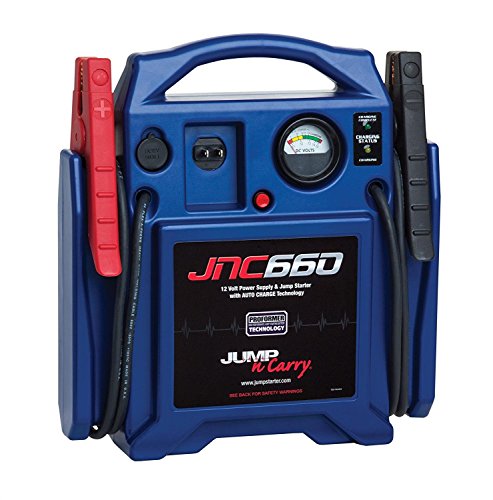
Clore Automotive Jump-N-Carry JNC660
A PROFORMER lead acid battery replaces lithium here, giving 1700 peak amps and 425 cranking amps, the figure that carries a long crank. Cables run 46 inches, enough to reach a battery buried behind an air box. Cold weather does not sap it the way it saps a lithium pack.
Pros
- Sustained cranking output, not just a surge rating
- 46 inch cables reach awkward battery locations
- Freezing mornings barely dent its output
Cons
- Roughly 18 pounds to carry across a yard
- Needs regular topping up to stay healthy

NOCO GENIUS10 Battery Charger
Charging is the job here, not jump starting: 10 amps flows into a 6V or 12V battery, then holds it topped up for months. Mode selection covers flooded, AGM, gel and lithium, so a lithium accessory battery never receives a lead acid profile. Repair mode targets sulfated batteries a basic charger refuses to touch.
Pros
- Keeps a seasonal truck battery alive through winter
- Chemistry specific profiles prevent overcharging
- Recovers some sulfated batteries
Cons
- No jump start capability at all
- Mains power only, so it stays home

DEWALT DXAEPS14 Portable Power Station Jump Starter
Jump starting at 1400 peak amps shares one housing with a 120 PSI compressor, which matters when the real failure is a soft trailer tire. A 12V socket and USB ports run accessories with the engine off. Weight passes 30 pounds, so it rides in the bed rather than travelling with you.
Pros
- Compressor inflates truck and trailer tires
- One box jumps, inflates and charges devices
- Housing survives life in a work truck bed
Cons
- Lowest jump rating here for big diesels
- Over 30 pounds limits real portability
How they stack up
| # | Model | Peak amps | Best for | Score | Price |
|---|---|---|---|---|---|
| 1 | NOCO Boost Pro GB150 Jump Starter | 3000 A | Best overall | 9.4 | Check price |
| 2 | NOCO Boost HD GB70 Jump Starter | 2000 A | Best for daily driver trucks | 9.1 | Check price |
| 3 | HULKMAN Alpha85 Jump Starter | 2000 A | Best value | 8.9 | Check price |
| 4 | GOOLOO GT4000S Jump Starter | 4000 A | Best for large diesels | 8.7 | Check price |
| 5 | Clore Automotive Jump-N-Carry JNC660 | 1700 A | Best for shop and fleet use | 8.5 | Check price |
| 6 | NOCO GENIUS10 Battery Charger | 10 A, 6V and 12V | Best charger and maintainer | 8.3 | Check price |
| 7 | DEWALT DXAEPS14 Portable Power Station Jump Starter | 1400 A | Best all in one with compressor | 8.0 | Check price |
Frequently asked questions
How many amps do I need to jump start a diesel truck?
Go by rated engine displacement instead of amps. NOCO Boost HD GB70 lists diesels to about 6 liters, the GB150 to about 7, and GOOLOO GT4000S claims up to 10. Larger engines need the larger units.
Will a lithium jump starter work in freezing weather?
It works, though output drops as temperature falls. Store the pack inside the cab overnight and warm it in your hands first. Lead acid units such as the JNC660 suffer far less in cold.
What is the difference between a jump starter and a battery charger?
One delivers a short high current burst to crank the engine. A charger like NOCO GENIUS10 restores the battery itself over several hours. Neither replaces the other for a truck that sits.
How do you jump a truck with two batteries?
Clamp onto the battery whose cable runs to the starter, often the driver side on a diesel. Red goes to positive, black to clean engine ground. Let glow plugs cycle fully before cranking.
How often should you recharge a portable jump starter?
Every three months suits a lithium pack, plus a top up before any cold snap. Recharge straight after a jump as well, because one start can consume a large share of the stored energy.
NOCO GB70 vs GB150: which one fits a pickup?
GB70 covers half ton and three quarter ton trucks and stores under a seat. GB150 makes sense for a bigger diesel, a work truck that sits for weeks, or a household jumping several vehicles.
Can a jump starter damage truck electronics?
Correctly connected units with reverse polarity protection are safe on modern trucks. Damage usually traces back to reversed clamps or repeated cranking. Follow the connection order and pause between attempts.
Is a 4000 amp jump starter twice as strong as a 2000 amp one?
No. Peak amps measure a momentary surge, and brands measure it differently. Sustained cranking current, cable gauge and clamp contact decide whether a cold engine actually turns over.
Can you leave a jump starter in the truck year round?
Lithium packs tolerate a cab but lose capacity in an unheated bed through winter. Heat is the other risk, since a closed cab in summer shortens cell life. Check the charge every three months.
Which jump starter is best for a work truck or fleet?
Clore Automotive Jump-N-Carry JNC660, because 425 cranking amps and 46 inch cables suit repeated starts on different vehicles. DEWALT DXAEPS14 fits better when soft tires are the more common call.
Our pick
NOCO Boost Pro GB150 is the pick for most truck owners, since a 3000 amp rating and heavy cables cover big gas V8s and light duty diesels without hedging. Half ton drivers short on storage lose little by dropping to NOCO Boost HD GB70, while a cold shop is better served by Clore Jump-N-Carry JNC660 and its published cranking amps. Whichever you buy, add NOCO GENIUS10, because a jumped battery still needs hours on a real charger before the next cold morning.
Tony Russo
Tony trained as an automotive technician and spent years in service and parts retail before moving into writing. He focuses on garage tools, car care products and accessories from a hands-on maintenance perspective.