Which Portable Charger Should Ride in Your Car?
NOCO Boost Plus GB40 solves the trip ending failure, pushing 1000 amps into a dead 12 volt battery from a two pound box. Anker 737 Power Bank keeps laptops running between stops at 140 watts. Jackery Explorer 240 v2 adds a real AC outlet for camp gear.
NOCO Boost Plus GB40 earns glovebox space for most drivers, because it restarts a stalled engine without a second car. Weight lands near two pounds. Stored charge survives months between trips. Capacity is the limit, since it will not run a laptop through an afternoon.
One search phrase covers three unrelated jobs. Jump starters dump hundreds of amps for a few seconds, power banks feed USB devices for hours, and power stations run mains plugs. We compared published amp and watt-hour ratings, port layouts, recharge inputs and owner reports on cold weather starts.
The shortlist, ranked
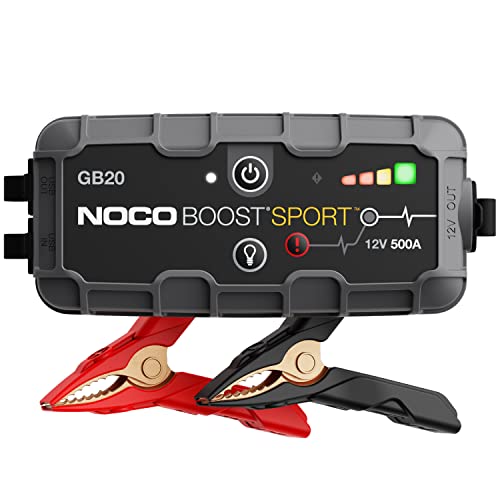
NOCO Boost Plus GB40
Two pounds of lithium cover gas engines up to 6 litres and diesels up to 3 litres. Spark proof clamps and reverse polarity protection forgive a wrong hookup in the dark. A 400 lumen work light and a USB-A port give it a job between emergencies.
Pros
- Fits a glovebox or door pocket
- Clamps tolerate reversed leads
- Holds its charge for months in storage
Cons
- Micro USB input recharges slowly
- Too small to power devices for long

HULKMAN Alpha85 Jump Starter
V8 trucks and big diesels want surge current, and 2000 peak amps doubles what the GB40 offers. A colour LCD reports charge state and fault conditions instead of blinking lights. Bulk follows the power, so this one lives in the trunk rather than a door pocket.
Pros
- Cranks large gas and diesel engines
- Screen shows status before you crank
- USB-C input refills it quickly
Cons
- Heavier than pocket jump starters
- Thick clamp cables need storage room

Anker 737 Power Bank (PowerCore 24K)
USB-C laptops take a full refill from 24000 mAh of cells. Output peaks at 140 watts, which keeps a 16 inch MacBook Pro charging at close to normal speed. Its screen reports watts in and out, so a slow cable shows itself immediately.
Pros
- Charges laptops, not only phones
- Refills itself at 140 watts
- Live wattage readout shows real draw
Cons
- Heavy for a jacket pocket
- Cannot jump start a vehicle

Jackery Explorer 240 v2
256 watt-hours of LiFePO4 feed a standard AC outlet rated at 300 watts. Camera chargers, small coolers and barrel plug laptops run without adapters. Refilling happens from a wall socket, the 12 volt car socket or a solar panel.
Pros
- Real AC outlet for non-USB gear
- LiFePO4 cells survive many cycles
- Tops up from the car while you drive
Cons
- Bulky for daily commuting
- No jump start function

NOCO GENIUS5 Smart Battery Charger
Cars parked between trips slowly lose charge, and 5 amps of smart charging treats the cause instead of the symptom. Modes cover 6 volt, 12 volt, AGM and lithium packs. Repair mode can revive a battery that dropped below what a basic charger will even accept.
Pros
- Keeps a battery healthy through storage
- Handles AGM and lithium safely
- Recovers deeply discharged batteries
Cons
- Needs a mains outlet, so no roadside use
- Hours slower than a jump start

Anker 335 Car Charger (67W)
Two USB-C ports split 67 watts drawn straight from the 12 volt socket. That covers an ultrabook and a phone together, with no internal battery to remember. Temperature and surge protection sit behind the ports for long drives.
Pros
- Runs a laptop directly in the car
- Two devices at usable speed
- Nothing to recharge before a trip
Cons
- Only useful with the engine running
- Does nothing once you leave the vehicle

DBPOWER 800A Portable Car Jump Starter
DBPOWER lists 800 peak amps and gas engines up to 7.2 litres. Owners report dependable starts on four and six cylinder cars, with weaker results on cold diesels. An 18000 mAh cell also refills a phone several times between stops.
Pros
- Doubles as a phone power bank
- Flashlight helps with roadside work
- Covers most small car emergencies
Cons
- Thinner clamp cables than premium units
- Cold diesel starts are inconsistent
How they compare
| # | Model | Peak current | Best for | Score | Price |
|---|---|---|---|---|---|
| 1 | NOCO Boost Plus GB40 | 1000 amps | Best overall | 9.4 | Check price |
| 2 | HULKMAN Alpha85 Jump Starter | 2000 amps | Best for large engines | 9.2 | Check price |
| 3 | Anker 737 Power Bank (PowerCore 24K) | 24000 mAh | Best for laptops | 9.0 | Check price |
| 4 | Jackery Explorer 240 v2 | 256 watt-hours | Best for AC devices | 8.8 | Check price |
| 5 | NOCO GENIUS5 Smart Battery Charger | 5 amps | Best for battery maintenance | 8.6 | Check price |
| 6 | Anker 335 Car Charger (67W) | 67 watts | Best for in-car charging | 8.3 | Check price |
| 7 | DBPOWER 800A Portable Car Jump Starter | 800 amps | Best budget | 8.0 | Check price |
Before you buy
What to pack for a road trip Match the device to the failure you expect. A dead battery in a motel car park needs a jump starter, and no power bank will do it. Phone and laptop top-ups between stops call for USB-C output or a car charger. Camping with a cooler or camera gear pushes you toward watt-hours and an AC outlet.
How to read amp and watt-hour ratings Peak amps describe a burst lasting a fraction of a second, not sustained output. Cranking amps show real ability, though few listings publish that figure. Engine size ratings are the practical shortcut, so match yours and leave margin. Power banks and stations use mAh and watt-hours instead, which measure stored energy rather than starting punch.
Charging laptops and camp gear on the move USB-C Power Delivery has replaced most barrel chargers, and 100 watts covers nearly every laptop sold today. Anker’s 737 reaches 140 watts for the largest 16 inch machines. Gear with only a wall plug needs a station such as the Explorer 240 v2. Check appliance wattage first, because a 300 watt outlet will not run a kettle or a hair dryer.
Cold weather, storage and battery health Lithium cells lose output in freezing temperatures, exactly when an engine needs the most help. Keep a jump starter in the cabin overnight in winter, not the trunk. Self discharge means a top-up every few months even if you never use it. Cars that sit between trips do better on a GENIUS5 maintainer than on repeated jumps, which hide a failing battery.
Questions worth asking
How many amps do I need in a jump starter?
Around 1000 peak amps covers most four and six cylinder cars. Large V8s and diesels benefit from 2000. Cold climates justify the extra headroom.
Can a regular power bank jump start a car?
No, unless it is built as a jump starter with proper clamps. USB packs deliver a few amps, while cranking needs hundreds. These are two different devices that happen to share a shelf.
Is a portable power station worth it for road trips?
Yes when you run mains gear away from outlets. Coolers, camera chargers and CPAP machines all qualify. Pure USB users are better served by a power bank.
How often should a jump starter be recharged?
Every three to six months while it sits unused. Lithium cells self discharge slowly even in a sealed case. A flat jump starter is worse than none, because you still count on it.
Will a car charger drain my battery overnight?
Not while the engine runs, since the alternator supplies everything. Some cars keep the socket live with the ignition off, and that does drain it. Unplug before parking for the night.
What is the difference between a jump starter and a battery charger?
Jump starters deliver a short burst to crank the engine. Chargers such as the GENIUS5 refill the battery over several hours. Jumping the same car repeatedly masks a battery that needs replacing.
Can I charge a laptop in the car without an inverter?
Yes if the laptop accepts USB-C Power Delivery. A 67 watt car charger handles most ultrabooks comfortably. Older barrel plug machines still need an inverter or a power station.
Are LiFePO4 power stations better for a hot car?
They tolerate heat and many more charge cycles than older lithium chemistry. Weight runs slightly higher for the same capacity. For gear that lives in a parked vehicle, that tradeoff pays off.
NOCO GB40 vs HULKMAN Alpha85: which one fits my car?
Four and six cylinder cars start fine on the GB40, which also fits a glovebox. Trucks, V8s and larger diesels want the Alpha85 and its 2000 amp peak. Alpha85 buyers trade pocketability for headroom.
Is it safe to leave a jump starter in the car in winter?
Storage in freezing conditions is safe but reduces available output. Bring it indoors before a cold morning start if you can. Never charge a lithium jump starter below freezing.
Our take
For a single device in the glovebox, NOCO Boost Plus GB40 earns its space, because a dead battery is the one failure that ends a trip. Drivers of V8 trucks and diesels should step up to the HULKMAN Alpha85 for the extra 1000 amps of peak current. Families who work or camp along the route will use the Anker 737 or the Jackery Explorer 240 v2 far more often.
Tony Russo
Tony trained as an automotive technician and spent years in service and parts retail before moving into writing. He focuses on garage tools, car care products and accessories from a hands-on maintenance perspective.