Portable tire inflators that survive daily shop use
Milwaukee 2848-20 fits working techs best, pairing a 150 PSI ceiling with a TrueFill preset that stops on target. DeWalt DCC020IB adds mains and 12V power in one housing. VIAIR 400P moves 2.30 CFM, so 19.5 inch truck rubber fills in realistic time rather than all afternoon.
Milwaukee 2848-20 is the pick for most working mechanics. Set a target pressure, walk away, and TrueFill shuts the pump off within a couple of PSI. That covers a Transit, a Civic and everything between without babysitting a gauge. Airflow is the weak spot, so anyone filling 19.5 inch or RV tires should jump to the VIAIR entry.
Shop use punishes inflators in ways driveway use never does. Heat builds after the second or third tire. Cheap gauges drift by several PSI inside a year. Accessory socket plugs melt under sustained current. Ranking here came from published maximum pressure, free-flow CFM ratings, stated duty cycles and power options, plus owner reports on gauge accuracy after months of daily fills.
The best picks, ranked

Milwaukee 2848-20 M18 Inflator
Dial a target pressure and TrueFill runs the pump, checks the reading, then stops on its own. That frees a tech to work the opposite side of the vehicle. Maximum pressure reaches 150 PSI, enough for light truck and trailer tires alongside passenger rubber, and it draws from the same M18 packs already on the charger shelf.
Pros
- Preset shutoff repeats the same pressure wheel to wheel
- No cords or clamps needed anywhere on a lot
- Shares batteries with an existing M18 kit
Cons
- Modest airflow, so large tires take patience
- Bare tool, so a battery and charger cost extra

DeWalt DCC020IB 20V MAX Corded and Cordless Air Inflator
One housing accepts a 20V MAX pack, a 120V mains lead or a 12V vehicle socket, which kills the dead battery problem on a long day. High pressure output reaches 160 PSI for tires, while a separate high volume port handles air beds and pool floats. Both outlets read through the same backlit digital gauge.
Pros
- Mains lead removes runtime limits inside the bay
- Highest pressure ceiling among these seven
- High volume port covers non-tire inflation jobs
Cons
- Bulkier than single-mode cordless units
- Socket mode runs slower than battery or mains

VIAIR 400P Automatic Portable Compressor
Free flow airflow is rated at 2.30 CFM, and that number is what separates a compressor from a handheld pump when a 19.5 inch tire sits flat. Clamps bolt straight onto the vehicle battery, so a fused accessory socket never caps current. Working pressure tops out at 150 PSI with a stated 33 percent duty cycle at 100 PSI.
Pros
- Fills heavy truck and RV tires in workable time
- Clamp connection avoids melted socket plugs
- Sand tray and long air hose ship in the box
Cons
- Needs hood access to the battery terminals
- Heavy and bulky next to cordless inflators

ARB CKMP12 Portable Air Compressor
Designed for airing up after a trail run, the CKMP12 clamps to a 12V battery behind a sealed motor housing that keeps dust and water out. Maximum pressure of 150 PSI covers 4×4 and light truck tires. A thermal cutout guards the motor through repeat cycles, and every hose and clamp stores in the hard case.
Pros
- Sealed build shrugs off dust, mud and rain
- Thermal cutout prevents burnout on repeat fills
- Case keeps hose and clamps together in a van
Cons
- Slower than the VIAIR 400P on large tires
- Analog gauge needs watching during a fill

Fanttik X8 Apex Tire Inflator
Storage happens in a door pocket rather than a toolbox, since power comes from an internal battery charged over USB-C. A dual cylinder pump carries it to 150 PSI, with presets for car, motorcycle, bicycle and ball. Airflow is capped by size, so treat it as a top-up and roadside tool instead of a way to fill a dead tire.
Pros
- Small enough to carry in a jacket or door bin
- USB-C charging skips a proprietary charger
- Bright screen stays readable on a night callout
Cons
- Low airflow makes full inflations slow
- Internal battery cannot be swapped mid job

Makita DMP180ZX 18V LXT Inflator
Pressure tops out near 120 PSI, which covers passenger cars and most light vans but falls short of heavy trailer specs. Preset pressure with automatic shutoff keeps readings repeatable down a row of vehicles. Its case for purchase rests on the battery platform, so it makes sense in a bay standardized on 18V LXT.
Pros
- Compact body slips between a wheel and a lift arm
- Auto stop stays consistent across repeat fills
- Runs the LXT packs a Makita shop already stocks
Cons
- Lower ceiling than the 150 PSI picks
- Not suited to heavy trailer or truck pressures
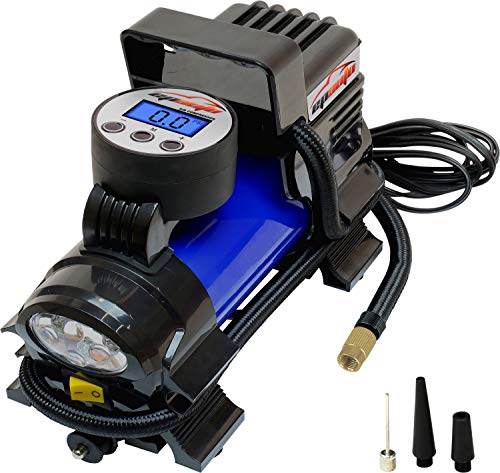
EPAuto 12V DC Portable Air Compressor Pump
Power arrives through the vehicle 12V accessory socket, which keeps setup simple while capping current and therefore speed. Around 100 PSI is the ceiling, fine for passenger car tires and useless for commercial rubber. Think of it as a backup unit to leave in a customer trunk, not the compressor a busy bay leans on.
Pros
- Plugs into any vehicle without opening the hood
- Digital shutoff prevents overfilling
- Small enough to stock in every service vehicle
Cons
- Socket power limits speed on a low tire
- Not rated for back to back sustained use
What to look for
What matters in a tire inflator for shop use Maximum PSI takes the headline, yet airflow decides how long you stand there holding a chuck. A handheld rated at 150 PSI may still move under 1 CFM, while the VIAIR 400P is rated at 2.30 CFM free flow. Duty cycle is the second number worth checking, because a unit with no published rating usually overheats after two or three tires. Gauge behavior counts just as much. A preset that stops within a couple of PSI saves a separate dial gauge check on every wheel. Hose length and chuck style round it out, since a short hose forces the pump onto hot brake dust.
Battery, mains or 12V clamps: picking a power source Each power source fails in its own way. Accessory socket units sit behind a 10 or 15 amp fuse, which explains both their slow fills and the occasional melted plug. Battery inflators dodge that problem but empty a pack quickly at high pressure, so a spare battery stops being optional in a working bay. Direct clamps to the vehicle battery deliver the most current and the most hassle, since the hood has to come up every time. DeWalt DCC020IB sidesteps the decision by accepting all three inputs in one housing, which is why it suits a tech splitting time between the bay and a service truck.
Best inflator for passenger cars and light vans Most shop inflation work is small corrections rather than filling flats. A tire down by 6 PSI comes back on almost any unit in seconds, so repeatability beats raw airflow. Milwaukee 2848-20 and Makita DMP180ZX both fit that rhythm, since one preset set at 35 PSI repeats across four wheels without thinking. Keep a calibrated dial gauge in the drawer regardless. Digital readouts drift as they age, and a customer complaint about a TPMS light usually traces back to a bad reading rather than a bad sensor.
Heavy truck, RV and off-road tires Past roughly 80 PSI, small pumps slow sharply and heat becomes the limiting factor. Airing up a set of 35 inch tires after a trail run, or taking an RV to 110 PSI, calls for a clamped 12V compressor rather than a handheld. VIAIR 400P is the practical volume pick. ARB CKMP12 trades some speed for a sealed housing that tolerates mud, spray and roadside grit. Shops doing both kinds of work are better off owning one of each than asking a cordless pump to do a job outside its rating.
Side by side
| # | Model | Max pressure | Best for | Score | Price |
|---|---|---|---|---|---|
| 1 | Milwaukee 2848-20 M18 Inflator | 150 PSI | Best overall | 9.4 | Check price |
| 2 | DeWalt DCC020IB 20V MAX Corded and Cordless Air Inflator | 160 PSI on the high pressure hose | Best value | 9.2 | Check price |
| 3 | VIAIR 400P Automatic Portable Compressor | 2.30 CFM free flow | Best for truck and RV tires | 9.0 | Check price |
| 4 | ARB CKMP12 Portable Air Compressor | 150 PSI | Best for roadside and off-road calls | 8.8 | Check price |
| 5 | Fanttik X8 Apex Tire Inflator | 150 PSI | Best compact cordless | 8.6 | Check price |
| 6 | Makita DMP180ZX 18V LXT Inflator | About 120 PSI | Best for shops already on Makita batteries | 8.3 | Check price |
| 7 | EPAuto 12V DC Portable Air Compressor Pump | About 100 PSI | Best budget | 8.0 | Check price |
Frequently asked questions
What PSI rating do I need in a portable tire inflator?
Passenger cars run 35 to 45 PSI, light truck tires reach about 80, and some RV and commercial tires sit at 110 or higher. A 150 PSI rating covers all of those with headroom.
Is CFM or PSI more important for a mechanic?
CFM sets the speed, PSI sets whether the job is possible at all. Daily shop work saves more time through airflow, which is why the VIAIR 400P at 2.30 CFM outpaces higher PSI handhelds.
How accurate are digital tire inflator gauges?
Preset shutoffs on the Milwaukee and DeWalt units repeat closely enough for routine work. Owners still report drift over time, so verify against a calibrated dial gauge before adjusting a customer TPMS.
Can a cordless inflator fill a completely flat tire?
Yes, though slowly. Expect several minutes to bring a passenger tire from flat to 35 PSI, and expect the pack to come out near empty. Heavy vehicles need a clamped 12V compressor.
What does duty cycle mean on an air compressor?
Duty cycle states how much of a given period the unit can run before it must cool. VIAIR quotes 33 percent at 100 PSI, meaning about a third of the time under load and the rest resting.
Milwaukee 2848-20 vs DeWalt DCC020IB: which should a shop buy?
Choose Milwaukee where the shop already runs M18 tools and values the tight preset. Choose DeWalt when one unit must cover a mains outlet in the bay, a battery on the lot and a 12V socket on the road.
Why do cigarette lighter inflators blow fuses?
Accessory sockets are typically fused at 10 to 15 amps, and a compressor under load runs close to that limit. Sustained use trips the fuse or cooks the plug, which is exactly why clamp connections exist.
Do portable inflators work with nitrogen filled tires?
They add ordinary compressed air, diluting the nitrogen mix without causing harm. Shops selling nitrogen service should top up from the nitrogen supply instead to keep the fill consistent.
How long should a portable inflator last in a busy bay?
Lifespan tracks duty cycle more than brand. Units run past their rated cycle cook their motors within a season, while a clamped compressor rested between tires lasts years of daily service.
Which portable inflator is best for a mobile mechanic van?
ARB CKMP12 suits mobile work, since the sealed housing and hard case handle weather and rough transport. Pair it with a cordless unit such as the Milwaukee 2848-20 for quick pressure checks on arrival.
The verdict
Milwaukee 2848-20 is the inflator most working techs should buy, because a reliable preset and M18 compatibility strip friction from dozens of small jobs each week. Choose DeWalt DCC020IB instead when a single unit has to serve the bay, the service truck and roadside calls. Shops touching 19.5 inch or RV tires need the VIAIR 400P alongside it, since no cordless pump matches 2.30 CFM.
Tony Russo
Tony trained as an automotive technician and spent years in service and parts retail before moving into writing. He focuses on garage tools, car care products and accessories from a hands-on maintenance perspective.