Dog Harnesses Built for Big Breeds on the Move
For large dogs that travel often, the Ruffwear Front Range Dog Harness balances padding, control, and durability better than most large-size harnesses. Giant breeds needing extra strength do better with the Julius-K9 IDC Powerharness. Owners on a tighter budget can start with the PetSafe Easy Walk No-Pull Harness.
Ruffwear’s Front Range Dog Harness fits large dogs needing a secure, padded build for daily walks and travel. It gives owners two leash attachment points without adding bulk. Sizing runs snug on barrel-chested breeds, and the price sits above budget options.
Fit gets harder once a dog outgrows generic mediums, since chest girth, breed shape, and pulling strength all shift the equation. We compared listed weight capacities, buckle materials, owner feedback on chafing, and how each harness handles car rides or trail hikes.
Our top picks

Ruffwear Front Range Dog Harness
Padded chest panel and foam-lined belly strap spread pressure across a large dog’s frame. An aluminum V-ring on the back and a webbing loop on the chest give two leash attachment points. Four adjustment points let it fit dogs with deep chests or thick necks.
Pros
- Even weight distribution across chest and belly
- Reflective trim adds visibility on low-light walks
- Machine washable straps
Cons
- Sizing runs snug for barrel-chested breeds
- No built-in handle for lifting

Kurgo Tru-Fit Smart Harness with Steel Nesting Buckles
A padded chest plate pairs with a metal tether loop rated for a seatbelt clip, sold separately. Steel nesting buckles replace plastic clips at the main closure points. Five adjustment straps fit dogs with wide rib cages or long torsos.
Pros
- Steel buckles resist cracking in cold weather
- Tether loop works with car seatbelt clips
- Padded chest plate reduces pressure on the breastbone
Cons
- Seatbelt clip attachment sold separately
- Heavier than mesh-style harnesses

Julius-K9 IDC Powerharness
Double-layered nylon webbing forms a rigid chest plate on this harness, with a top handle for guiding dogs over obstacles. Velcro side patches accept optional labels or reflective panels. Sizing extends into ranges suited to mastiffs and Great Danes.
Pros
- Handle gives added control on stairs or trails
- Reinforced stitching holds up under heavy pulling
- Velcro patches allow patch customization
Cons
- No front leash ring for pull training
- Bulkier fit than mesh harnesses

Rabbitgoo No-Pull Dog Harness
Padded mesh lining pairs with front and back leash rings for pull training or casual walks. Quick-release buckles at the neck and girth speed up putting it on. Large sizing covers big dogs without the cost of premium hiking-focused brands.
Pros
- Front ring helps discourage pulling
- Padded mesh stays cool in warm weather
- Quick-release buckles simplify fitting
Cons
- Straps can loosen on very active dogs
- No dedicated lift handle
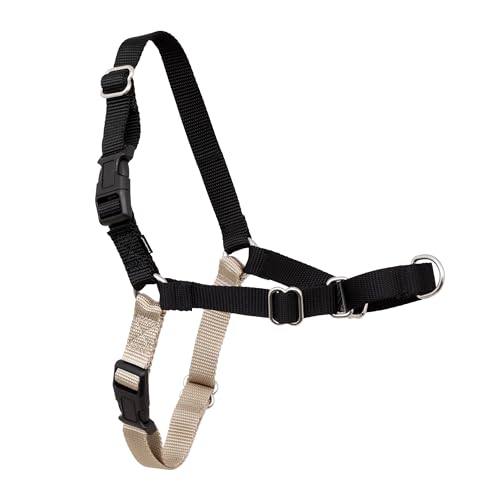
PetSafe Easy Walk No-Pull Harness
A front martingale-style loop tightens slightly when a dog pulls, steering it back toward the handler. Nylon straps and quick-snap buckles keep the design simple. Fit relies on chest girth rather than breed size charts.
Pros
- Lower cost compared to padded alternatives
- Simple two-strap design is easy to put on
- Effective at reducing pulling for many dogs
Cons
- No back attachment point
- Less padding than premium harnesses
Chai’s Choice Outdoor Adventure Harness
Reflective piping and a padded top handle suit trail walks at dawn or dusk. Front and back leash rings support loose-leash training and off-trail control. Breathable Oxford fabric resists soaking through on wet hikes.
Pros
- Handle aids control on uneven trails
- Reflective piping improves visibility
- Breathable fabric dries quickly after rain
Cons
- Runs narrow in the neck for thick-necked breeds
- Buckles are plastic rather than metal

Kong Comfort Padded Dog Harness
A step-in design uses neoprene padding along the chest and belly straps to reduce rubbing on daily walks. A single back clip keeps the profile low for dogs that dislike gear near their chest. It suits calmer large dogs more than heavy pullers.
Pros
- Step-in design is fast to put on
- Neoprene padding limits chafing
- Lightweight build suits warm-weather walks
Cons
- No front clip for pull training
- Limited adjustability for unusual body shapes
How they stack up
| # | Model | Sizing Range | Best for | Score | Price |
|---|---|---|---|---|---|
| 1 | Ruffwear Front Range Dog Harness | Large to XL, up to 42 in chest | Best overall | 9.4 | Check price |
| 2 | Kurgo Tru-Fit Smart Harness with Steel Nesting Buckles | Large to XXL, up to 46 in chest | Best for car travel | 9.1 | Check price |
| 3 | Julius-K9 IDC Powerharness | Large to 3XL, up to 51 in chest | Best for giant breeds | 8.9 | Check price |
| 4 | Rabbitgoo No-Pull Dog Harness | Large to XXL, up to 44 in chest | Best value | 8.6 | Check price |
| 5 | PetSafe Easy Walk No-Pull Harness | Large, fits 28 to 40 in chest | Best budget | 8.4 | Check price |
| 6 | Chai’s Choice Outdoor Adventure Harness | Large to XXL, up to 40 in chest | Best for hiking | 8.2 | Check price |
| 7 | Kong Comfort Padded Dog Harness | Large, up to 38 in chest | Best for everyday comfort | 8.0 | Check price |
What to look for
What Changes When You Size Up to a Large-Dog Harness Large-dog harnesses need wider webbing, reinforced stitching, and bigger buckles than standard sizes. Chest girth matters more than weight alone, since deep-chested breeds like Dobermans differ from broad-chested breeds like Bulldogs. Padding along the chest and belly spreads pressure during pulling. Attachment point count also shapes how much control a harness gives on a leash.
How Do You Size a Harness for a Giant Breed? Giant breeds such as Mastiffs, Great Danes, and Saint Bernards often exceed the chest measurements on standard large or XL charts. Harnesses like the Julius-K9 IDC Powerharness extend into 3XL ranges with reinforced webbing built for higher pulling force. A top handle helps guide these dogs on stairs or through doorways. Measuring chest girth at the widest point before ordering matters, since giant-breed proportions vary widely between breeds.
Choosing a Harness for Hiking and Outdoor Trips Trail walks add demands that everyday harnesses do not always meet, including wet fabric, uneven ground, and low light. Reflective trim helps at dawn or dusk when visibility drops. A padded handle on top gives hikers a way to steady a dog crossing streams or scrambling over rocks. Breathable fabric matters too, since soaked webbing can chafe skin on longer hikes.
Car Travel and the Attachment Points That Matter Dogs riding in vehicles need a harness with a rear tether loop rated for a seatbelt clip. Steel buckles hold up better than plastic ones under sudden stops. Front-clip designs help during loading and unloading, since handlers can redirect a dog without lifting it. Checking whether a seatbelt attachment ships included, or sold separately, avoids surprises after purchase.
Good to know
What is the best dog harness for large breeds?
Based on specifications and owner feedback, the Ruffwear Front Range Dog Harness balances padding, control, and durability for most large dogs. Giant breeds may need the Julius-K9 IDC Powerharness instead, since it extends into larger sizes.
How do I measure my dog for a harness?
Wrap a soft tape around the widest part of the chest, just behind the front legs. Compare that measurement to each harness listing’s chest girth range rather than relying on weight alone.
Can a harness stop a large dog from pulling?
Front-clip harnesses like the PetSafe Easy Walk redirect a dog sideways when it pulls, which reduces forward force. They work best alongside leash training rather than as a standalone fix.
Is a front-clip or back-clip harness better for big dogs?
Front-clip designs give more steering control for dogs still learning loose-leash walking. Back-clip harnesses feel more comfortable for calmer dogs on relaxed walks.
Which harness works best for car travel?
The Kurgo Tru-Fit Smart Harness includes a rear tether loop built for seatbelt clips, which makes it a common pick for car rides.
Do padded harnesses cause less chafing on long walks?
Owners report that foam or neoprene padding along the chest and belly straps reduces rubbing compared to thin webbing alone, especially on dogs with short fur.
What is the best harness for giant breeds like mastiffs or great danes?
The Julius-K9 IDC Powerharness extends into 3XL sizing with reinforced double-layered webbing built for heavier pulling force.
Harness vs collar, which is safer for large dogs?
Harnesses spread pulling force across the chest and shoulders instead of the neck, which lowers the risk of tracheal strain in large, strong dogs.
How much does chest padding matter for daily walks?
Foam or neoprene padding spreads leash pressure over a wider area, which matters most for dogs that pull often or have short, thin fur.
Our take
The Ruffwear Front Range Dog Harness stays the strongest all-around pick for large dogs, thanks to its padded chest plate and dual attachment points. Owners of giant breeds over 100 pounds should look at the Julius-K9 IDC Powerharness instead, since its reinforced webbing handles heavier pulling. Budget-focused shoppers can start with the PetSafe Easy Walk No-Pull Harness and upgrade later if needed.
Olivia Hartley
Olivia spent several years working at an animal shelter and a pet-supply retailer before joining the editorial team. She researches pet gear with an emphasis on safety, comfort and the fine print that owners often miss.