Portable camping lanterns: runtime beats raw lumens
Goal Zero Lighthouse 600 leads on versatility, pairing 600 lumens with a 5200 mAh cell that refills a phone. BioLite AlpenGlow 500 renders warmer colour for table light. Black Diamond Moji R+ weighs almost nothing and clips inside a tent. Trip length decides which fits.
Goal Zero Lighthouse 600 suits car campers who want one device for site light and a flat phone. Two panels aim light where it is needed. A 5200 mAh cell plus a fold out crank covers emergencies. Weight is the trade off, so backpackers should look further down.
Lumen ratings describe the brightest setting only, and few people sit under full output all evening. That gap is where lantern buying goes wrong. We compared runtime at mid brightness, battery chemistry, packed weight and IP ratings. Hanging hardware and switch reliability broke the remaining ties, using owner feedback and published specifications.
Before you buy
How many lumens a campsite actually needs Inside a two person tent, 50 to 100 lumens reads comfortably. Push past that and nylon walls bounce glare back at you. A picnic table for four wants roughly 200 to 400 lumens. Cooking under a family awning justifies 500 or more. Remember that every rated figure describes the maximum setting, which also flattens a battery fastest. Check runtime at a middle setting instead, because that is where a lantern spends its evening.
Rechargeable, AA or solar: picking a power source Lithium rechargeables deliver the most light per gram and often double as a power bank. That suits car camping and weekends within reach of a socket. Replaceable AA and D cells win on long trips and in cold weather, since spares swap in seconds and lose less capacity below freezing. Solar sits at the light end. MPOWERD Luci Outdoor 2.0 needs no cable at all, yet it depends on weather and tops out at 75 lumens.
Best camping lanterns for tents and backpacking Packed size and weight decide this branch. Black Diamond Moji R+ clips to a tent loop and barely registers in a pack. Luci Outdoor 2.0 flattens into a lid pocket and needs no spare batteries. Both dim low enough to leave burning while someone sleeps. Leave the Coleman Quad and Lighthouse 600 at home for these trips, since eight D cells or a 5200 mAh battery is dead weight on a hill.
Lighting a group site or a camper awning One central lantern beats four scattered small ones once a group reaches four people. Coleman’s Quad answers the usual argument over who takes the light away, because each panel detaches. Goal Zero’s Lighthouse 600 covers similar ground and adds USB charging, which is often the real purchase reason. Owners report that regular phone charging shortens light runtime noticeably. Carry a separate power bank if phones matter more than the lantern staying lit.
The top picks, ranked
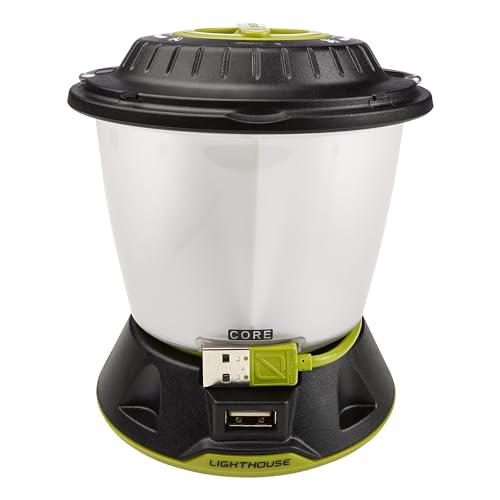
Goal Zero Lighthouse 600 Lantern
Two LED panels sit back to back, so one side can face a tent while the other lights a table. Inside sits a 5200 mAh lithium cell that also feeds a USB output. Crank the fold out handle once the battery dies and you get light for a walk to the toilet block.
Pros
- Runs one panel alone to cut glare on tent nylon
- Hand crank restores light with no socket nearby
- Fold out legs steady it on gravel and grass
Cons
- Heavier than plain LED lanterns of similar output
- Charging a phone cuts light runtime sharply

BioLite AlpenGlow 500
Colour accurate LEDs render food and faces naturally instead of tinting everything blue. Shake the body to cycle multicolour and candle flicker modes, which keeps children occupied after dark. A 6400 mAh battery refills over USB-C and hands power back through a USB-A port.
Pros
- Warmer rendering than budget cool white LEDs
- USB-C input shares the cable your phone already uses
- Magnetic base and hang loop give several mounting spots
Cons
- Colour modes drain the cell faster than white
- Too bulky to stash in a rucksack lid
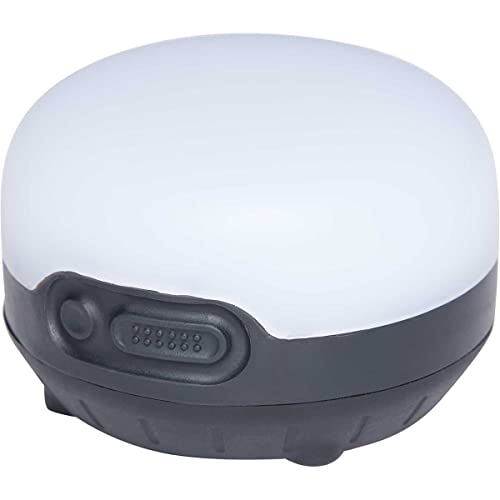
Black Diamond Moji R+ Lantern
Clip this to a tent ceiling loop and you stop noticing it. One hundred lumens fills a two person tent without bouncing glare off the nylon. Bluetooth control through the Black Diamond app adjusts brightness and colour from inside a sleeping bag.
Pros
- Adds negligible weight to an overnight pack
- Double hook loop fits standard tent ceiling tabs
- Dims to a glow you can sleep beside
Cons
- Too dim to light a shared table
- App control adds little for most owners

Coleman Quad LED Lantern
Four panels lift off the central body, so every tent gets its own light. Combined output reaches 800 lumens, which covers cooking under a family awning. Eight D cells add bulk, yet they stretch runtime to 75 hours on the low setting.
Pros
- Splits into four lights for separate tents
- Runs up to 75 hours on low with no socket
- Panels refill on the base between nights
Cons
- Awkward to carry once loaded with eight D cells
- Replacement D cells add a running cost

Streamlight Siege AA Lantern
Streamlight aims this at storms and power cuts rather than glamping. An IPX7 rating covers brief immersion, while rubber armour absorbs drops onto rock. Pull the frosted globe off and the head works as a directional work light.
Pros
- Handles rain, mud and knocks against rock
- Runs on AA cells sold in any corner shop
- Converts from area light to spot light
Cons
- 200 lumens trails the rechargeable models here
- No USB charging and no phone output

Vont 2 Pack LED Camping Lantern
Two collapsible lanterns arrive per box, which settles the argument over one light between two tents. Pull the body upward to switch on, then pull further to raise brightness. Impact resistant ABS and three AA cells keep each unit simple enough to survive a car boot.
Pros
- Two lights in one box for separate tents
- Collapses flat for glovebox storage
- No charging cable to leave behind
Cons
- Cool white output looks harsh over food
- No stated water rating for heavy rain

MPOWERD Luci Outdoor 2.0 Inflatable Solar Lantern
Deflated, Luci packs down to roughly the thickness of a coaster. Its own solar panel refills in about seven hours of sun, so no cable or spare cell travels with it. Seventy five lumens suits a tent ceiling or a pack strap, and the sealed body floats.
Pros
- Charges from daylight with no cable or cells
- Packs flatter than any rigid lantern here
- IP67 sealing and buoyancy suit paddling trips
Cons
- Wants a full sunny day for a complete charge
- Too dim for cooking or group areas
How they compare
| # | Model | Maximum output | Best for | Score | Price |
|---|---|---|---|---|---|
| 1 | Goal Zero Lighthouse 600 Lantern | 600 lumens | Best overall | 9.4 | Check price |
| 2 | BioLite AlpenGlow 500 | 500 lumens | Best for campsite atmosphere | 9.2 | Check price |
| 3 | Black Diamond Moji R+ Lantern | 100 lumens | Best for tents | 9.0 | Check price |
| 4 | Coleman Quad LED Lantern | 800 lumens | Best for group sites | 8.8 | Check price |
| 5 | Streamlight Siege AA Lantern | 200 lumens | Best for wet weather | 8.6 | Check price |
| 6 | Vont 2 Pack LED Camping Lantern | Two lanterns per box | Best budget | 8.3 | Check price |
| 7 | MPOWERD Luci Outdoor 2.0 Inflatable Solar Lantern | 75 lumens | Best ultralight | 8.0 | Check price |
Good to know
How many lumens do you need for a camping lantern?
About 100 lumens suits a tent, 200 to 400 covers a table for four, and 500 or more handles a family awning with cooking. Anything above that mostly buys headroom you rarely use.
Is a rechargeable or battery camping lantern better?
Rechargeables give more light per gram and many feed a phone over USB. Replaceable AA or D cells suit long trips and cold nights, since spares swap in seconds and need no socket.
Can a camping lantern charge your phone?
Some models can. Goal Zero Lighthouse 600 and BioLite AlpenGlow 500 both carry a USB output. Expect light runtime to fall sharply once a phone starts drawing from the same cell.
Are solar camping lanterns bright enough for a campsite?
For tent and path lighting, yes. MPOWERD Luci Outdoor 2.0 puts out 75 lumens, enough to read by but not to cook by. Solar also needs a full day of sun, so treat it as a second light.
What water rating should a camping lantern have?
IPX4 shrugs off rain, which covers ordinary campsite use. IPX7, as on the Streamlight Siege AA, survives brief immersion and suits kayaking or storms. Budget models often state no rating, so keep those under cover.
Goal Zero vs BioLite: which camping lantern should you buy?
Lighthouse 600 is brighter and adds a hand crank, so it doubles as an emergency light. AlpenGlow 500 renders warmer colour and charges over USB-C, which suits eating at a table.
How do you hang a lantern inside a tent?
Most tents include a small ceiling loop. Choose a lantern with a hook, a double loop or a magnetic base. Black Diamond Moji R+ folds out a double hook for this job and stays light enough not to stress the seam.
Do LED lanterns attract insects?
Warmer, lower colour temperature light pulls in far fewer insects than cold blue white LEDs. Lanterns with colour settings, including the AlpenGlow 500, let you switch to amber once midges arrive.
Which camping lantern is best for power cuts at home?
Streamlight Siege AA runs on cells you can stockpile and survives being dropped. Goal Zero Lighthouse 600 adds a crank for open ended outages. Both beat a solar lantern indoors, where recharging is the problem.
The bottom line
Buy the Goal Zero Lighthouse 600 for car camping, since one item handles site lighting, a flat phone and a dead battery through the crank. Backpackers should take the Black Diamond Moji R+ and save the grams, because tent lighting needs 100 lumens rather than 600. Families running several tents get more from the Coleman Quad, which hands every person a removable panel.
Derek Holt
Derek has a background coaching recreational and amateur athletes and has worked the sales floor at specialty fitness retailers. He focuses on equipment durability, ergonomics and realistic use cases rather than marketing claims.


