Which Portable Air Conditioner Actually Cools Your Room
Midea’s Duo MAP14HS1TBL leads on dual hoses and an inverter compressor, so real cooling tracks its 10,000 BTU SACC rating. Light sleepers should look at LG’s LP1419IVSM, listed from 44 decibels. For a 150 square foot bedroom, Black+Decker’s BPACT08WT is enough machine.
Midea’s Duo MAP14HS1TBL answers the usual complaint that a portable unit never quite cools the room. Twin hoses draw condenser air from outside, so warm air is not pulled in through doors and gaps to replace it. Its inverter compressor then eases off once the room settles. Bulk is the trade, because the fatter twin hose kit covers more of the window.
Two BTU figures appear on nearly every listing, and the larger one rarely describes real cooling. Hose count matters as much as capacity. Single hose units blow room air outside, and something warm has to take its place. We compared SACC ratings, hose configuration, compressor type, published decibel figures and drainage design across seven models. Owner reports on window kit fit and bucket emptying settled the rest.
Before you buy
What the BTU numbers on the listing actually mean Two ratings appear on most boxes, and they differ by roughly a third. ASHRAE measures capacity under favourable lab conditions. SACC, the newer standard, subtracts heat leaking back through the duct and air infiltrating the room, so it describes what you will feel. A 14,000 BTU ASHRAE unit typically lands near 10,000 SACC. Size from the SACC figure and read the bigger number as marketing.
Single hose vs dual hose: what changes in a real room One hose sends room air out of the window, and that volume has to be replaced through doors, gaps and vents by warmer air. Dual hose designs pull condenser air from outside, leaving the room at neutral pressure. That gap widens in sealed rooms and in genuine heat waves. Small bedrooms narrow it again, which is why the Black+Decker and LG still make sense on one hose. Twin hose kits do cover more of the window, so measure the opening first.
Sizing a unit for a bedroom, lounge or garage Around 4,500 to 6,000 BTU SACC serves a 150 square foot bedroom, the band the Black+Decker BPACT08WT sits in. Lounges of 400 to 550 square feet want 8,000 to 10,000 SACC, putting the Midea Duo and Frigidaire in range. Push the requirement up for west facing glass, high ceilings, kitchens and top floor rooms. Oversizing costs comfort as well as capacity, because a large compressor cools quickly, shuts off and leaves the humidity behind.
Draining, venting and storing it over winter Modern units evaporate most condensate through the exhaust and need manual draining only in damp conditions, which is exactly where the Honeywell MN4CFSWW0 earns its place. Seal the window panel with foam tape, since a gap there undoes any advantage a second hose gives you. Keep the hose short and as straight as possible, because every loop radiates heat back into the room. Run fan mode for an hour at season end to dry the coil. Store the cabinet upright so compressor oil stays put.
The shortlist, ranked

Midea Duo MAP14HS1TBL Smart Inverter Portable Air Conditioner
Separating the exhaust loop from room air is why measured cooling here tracks the rating more closely than single hose rivals manage. An inverter compressor varies speed instead of slamming on and off, which lowers both noise and steady state power draw. Heat mode stretches its season into spring and autumn.
Pros
- Dual hoses stop warm air being pulled in from other rooms
- Inverter compressor holds temperature without loud cycling
- Heat mode covers cool spring and autumn evenings
Cons
- Twin hose kit blocks more of the window opening
- Large and heavy to carry between floors

LG LP1419IVSM Dual Inverter Portable Air Conditioner
LG lists 44 decibels on the lowest setting, closer to a desk fan than a compressor. Dual inverter hardware ramps speed smoothly, removing the thump that wakes people when a conventional unit restarts. One hose does the venting, so pull down slows in a leaky room.
Pros
- Among the quietest portables on published figures and owner reports
- Smooth ramping avoids the loud start up thump
- Wi-Fi app allows scheduling from another room
Cons
- Single hose creates negative pressure in sealed rooms
- Tall cabinet needs clearance in front of the window

Whynter ARC-14S Dual Hose Portable Air Conditioner
Whynter has sold this dual hose design for years, so filters, hoses and window panels stay easy to source. Self evaporating operation recycles condensate through the exhaust, leaving the drain port for genuinely humid weather. Fan speeds move in fixed steps rather than varying with load.
Pros
- Dual hose layout suits open plan rooms
- Self evaporating operation rarely needs manual draining
- Long running model with spare parts still available
Cons
- No inverter, so compressor cycling is audible
- Heavier than single hose units at the same rating

Black+Decker BPACT08WT Portable Air Conditioner
Eight thousand BTU on the ASHRAE scale works out near 4,500 BTU SACC, which realistically covers a bedroom or home office rather than a lounge. Setup is the simplest here, with a slide out window bracket and one hose. A 24 hour timer can chill a bedroom before bedtime.
Pros
- Light enough for one person to shift between rooms
- Window kit fits most sash windows in minutes
- Modest power draw suits older circuits
Cons
- Undersized for anything bigger than a small bedroom
- Bucket needs emptying in humid weather
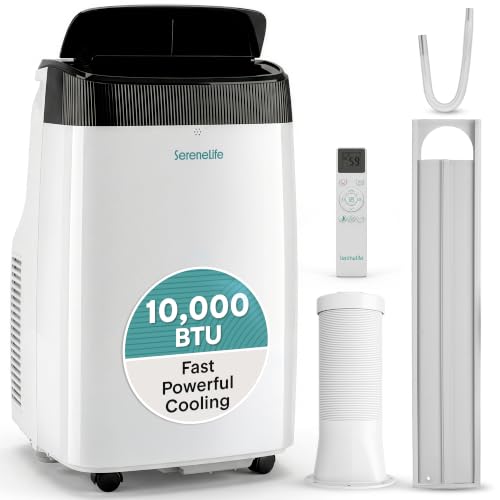
SereneLife SLPAC10 Portable Air Conditioner
Cooling, dehumidifying and fan modes share a narrow cabinet that rolls through standard doorways on castors. Ten thousand BTU handles a bedroom or a small lounge without a complicated install. Controls stay basic, with a simple display and remote instead of app scheduling.
Pros
- Narrow cabinet rolls easily between rooms
- Dehumidify mode earns its keep outside summer
- Straightforward controls with no app setup
Cons
- Louder than inverter driven rivals
- No Wi-Fi or smart scheduling

Honeywell MN4CFSWW0 Portable Air Conditioner
Moisture removal is where this one separates itself, pulling a large volume of water per day out of coastal or basement air. Auto evaporation pushes most of that condensate out through the exhaust, so the bucket rarely fills. Washable dual filters remove any cartridge costs over a long season.
Pros
- Strong dehumidification for damp coastal rooms
- Auto evaporation avoids constant bucket emptying
- Washable filters need no replacement cartridges
Cons
- Single hose slows pull down in large rooms
- Compressor is audible at higher fan settings

Frigidaire FHPH132AB1 Portable Air Conditioner with Heat
Heat mode turns a three month appliance into one used most of the year, which suits a converted garage or a conservatory. Cooling sits at 13,000 BTU ASHRAE, near 8,000 SACC, enough for a medium lounge. App control lets you warm the room before you get home.
Pros
- Heat mode keeps it working through spring and autumn
- App control allows remote scheduling
- Covers a medium lounge on its SACC rating
Cons
- Heat mode supplements central heating rather than replacing it
- Single hose design struggles in draughty rooms
The lineup, side by side
| # | Model | Cooling | Best for | Score | Price |
|---|---|---|---|---|---|
| 1 | Midea Duo MAP14HS1TBL Smart Inverter Portable Air Conditioner | 14,000 BTU ASHRAE, 10,000 BTU SACC | Best overall | 9.4 | Check price |
| 2 | LG LP1419IVSM Dual Inverter Portable Air Conditioner | 14,000 BTU ASHRAE, 10,000 BTU DOE | Best for quiet running | 9.2 | Check price |
| 3 | Whynter ARC-14S Dual Hose Portable Air Conditioner | 14,000 BTU ASHRAE | Best for large rooms | 9.0 | Check price |
| 4 | Black+Decker BPACT08WT Portable Air Conditioner | 8,000 BTU ASHRAE, 4,500 BTU SACC | Best budget | 8.8 | Check price |
| 5 | SereneLife SLPAC10 Portable Air Conditioner | 10,000 BTU | Best compact value | 8.6 | Check price |
| 6 | Honeywell MN4CFSWW0 Portable Air Conditioner | 14,000 BTU ASHRAE | Best for humid climates | 8.3 | Check price |
| 7 | Frigidaire FHPH132AB1 Portable Air Conditioner with Heat | 13,000 BTU ASHRAE, 8,000 BTU SACC | Best for year round use | 8.0 | Check price |
Questions worth asking
What is the difference between ASHRAE and SACC BTU ratings?
ASHRAE measures capacity under ideal lab conditions. SACC accounts for duct heat and air infiltrating the room, so it runs roughly a third lower. Compare models by SACC and you will not end up with something undersized.
Is a dual hose portable air conditioner better than a single hose?
In sealed rooms and high heat, yes, because it avoids the negative pressure that drags hot air in from elsewhere. Dual hose kits are bulkier and cover more window. In a small bedroom, the practical gap is modest.
What size portable air conditioner do I need for a bedroom?
About 4,500 to 6,000 BTU SACC covers a typical 150 square foot bedroom. Add capacity for west facing windows, a top floor or a loft conversion. Going too large leaves the room cold and clammy as the compressor short cycles.
Do portable air conditioners need to be drained?
Most self evaporate through the exhaust hose and want draining only in humid weather. The Honeywell MN4CFSWW0 handles that automatically in nearly all conditions. Check for a drain plug before running any unit in a basement.
Can a portable air conditioner be used without a window?
Exhaust air has to leave the room somehow, through a window, a wall vent or a sliding door kit. Venting into the same room simply adds heat. Dumping it into a loft or ceiling void moves hot, moist air somewhere it causes damage.
How noisy are portable air conditioners?
Most land between 50 and 55 decibels at full fan. Inverter models such as the LG LP1419IVSM drop near 44 decibels on low. Compressor cycling, rather than fan noise, is usually what wakes people at night.
Are inverter portable air conditioners worth it?
They hold a steadier temperature and draw less power once the room is cool, since compressor speed varies instead of switching fully on and off. That also removes the loud restart. Overnight and all day running is where both benefits show.
Do portable air conditioners use a lot of electricity?
A 14,000 BTU ASHRAE unit typically draws between 1,100 and 1,400 watts while the compressor runs. Inverter models spend much of their time well below that once the room settles. Sealing the window kit cuts run time more than any setting does.
Where should you place a portable air conditioner in a room?
Put it near the window so the hose stays short and straight, with a few inches of clearance around the cabinet. Blocked intakes force the compressor to work longer. Aim the outlet along the room rather than into furniture.
Can a portable air conditioner heat a room in winter?
Units with heat mode, such as the Frigidaire FHPH132AB1 and the Midea Duo, add supplemental warmth in shoulder seasons. Deep winter still needs central heating. Treat heat mode as a bonus, never as the reason to buy.
Final word
Pick the Midea Duo MAP14HS1TBL if you want cooling that lives up to its rating, since dual hoses, an inverter compressor and a heat mode together fix the usual portable complaints. Light sleepers get more from the LG LP1419IVSM and can live with its single hose in a bedroom sized space. Small office or spare room? The Black+Decker BPACT08WT covers it without dominating the floor.
Dana Whitfield
Dana spent eight years buying and merchandising for a regional kitchenware retailer before moving into editorial work. She has handled thousands of SKUs across cookware, small appliances and kitchen organization, and focuses on the practical differences that matter once a product is actually in daily use.