Chlorine vs Saltwater Pool Chemicals Compared
Clorox Pool and Spa XtraBlue 3 inch Chlorine Tablets handle routine sanitising with added clarifier and scale control. HTH Super Shock Treatment resets a cloudy pool after heavy use. Kem-Tek Algaecide 60 Plus covers the green-water problem chlorine alone cannot fix.
Products overlap and labels rarely explain which problem they solve, which makes this aisle confusing. Clorox Pool and Spa XtraBlue tablets cover the weekly sanitiser job for most backyard pools. HTH Super Shock Treatment clears water after a party or a storm, and Kem-Tek Algaecide 60 Plus stops algae that survives normal chlorine levels.
We compared active ingredients, stabiliser content, dose rates and dissolve behaviour, then weighed what pool owners report about cloudiness, high cyanuric acid and stubborn spring algae. Always follow the label dosing for your pool volume.
The shortlist, ranked

Clorox Pool and Spa XtraBlue 3 Inch Chlorine Tablets
Stabilised trichlor tablets release chlorine slowly in a floater or skimmer, holding a residual for about a week. Added clarifier and scale inhibitor cut the need for two extra bottles. Because trichlor carries cyanuric acid, test that level monthly and dilute if it climbs too high.
Pros
- One product covers sanitising, clarifying and scale
- Slow dissolve holds a residual for about a week
- Individually wrapped tablets store cleanly
Cons
- Raises cyanuric acid over the season
- Trichlor is acidic and pulls pH down
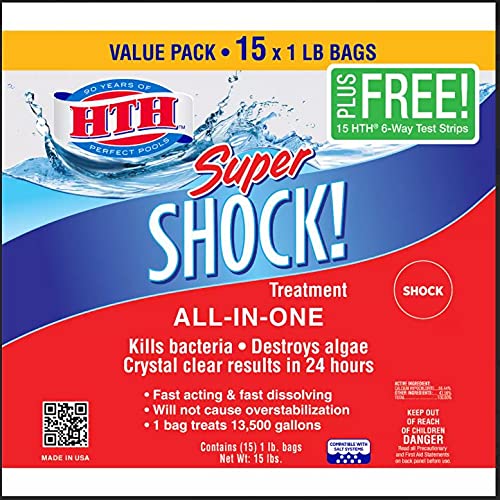
HTH Super Shock Treatment
Cal hypo granules deliver a fast chlorine spike that burns off chloramines after heavy swimmer load or a rainstorm. Water is usually swimmable again within 24 hours at label dose. Unlike trichlor, it adds no cyanuric acid, useful when stabiliser already sits high.
Pros
- Clears chloramines and the associated smell
- Adds no cyanuric acid to the water
- Pre-measured bags simplify dosing
Cons
- Adds calcium hardness over repeated use
- Must be pre-dissolved in vinyl pools to avoid bleaching

Kem-Tek Algaecide 60 Plus Concentrated Algaecide
A 60 percent poly quat formula resists foaming, unlike cheaper quat algaecides. It works as a preventative dosed weekly and as a treatment for early green algae. Dose rates stay low, so a single bottle covers a season on an average backyard pool.
Pros
- High concentration means small weekly doses
- Does not foam like lower-grade quats
- Works alongside chlorine rather than replacing it
Cons
- Will not clear an established black algae outbreak alone
- Copper-free formula acts slower than copper algaecides

Clorox Pool and Spa pH Down
Sodium bisulfate granules lower pH once it drifts above 7.8, which happens constantly in pools running liquid chlorine or salt systems. High pH makes chlorine less effective and causes scale on tile lines. Broadcast it slowly across the deep end with the pump running, then retest after a few hours.
Pros
- Restores chlorine effectiveness at high pH
- Granular form is safer to handle than muriatic acid
- Works quickly, retest within hours
Cons
- Overdosing drops alkalinity as well as pH
- Needs frequent retesting in salt pools

Pool Mate Alkalinity Increaser
Sodium bicarbonate raises total alkalinity, which acts as a buffer and stops pH bouncing after every rainstorm. Fix alkalinity before chasing pH, since low alkalinity makes pH almost impossible to hold. Most pools target a range between 80 and 120 parts per million.
Pros
- Stops pH swinging after rain or heavy use
- Single ingredient, predictable dosing
- Safe to handle without special equipment
Cons
- Raises pH slightly as a side effect
- Large doses cloud the water for a day

Robarb Super Blue Clarifier
A polymer clarifier binds fine particles too small for the filter into clumps the filter can catch. Use it after shocking, once the water is chemically clear but still hazy. It works with sand, cartridge and DE filters, though sand filters need a backwash the following day.
Pros
- Catches particles the filter would otherwise pass
- Compatible with all common filter types
- Small doses go a long way
Cons
- Overdosing clogs cartridge filters quickly
- Does nothing if the real problem is low chlorine

Natural Chemistry Metal Free Stain and Scale Preventer
A sequestrant binds dissolved iron, copper and manganese so they stay in solution instead of staining the plaster. It suits pools filled from a well or fed by copper heat exchangers. Expect to redose monthly, since sequestrants break down under sunlight and chlorine.
Pros
- Prevents brown and green metal staining
- Useful before a fresh fill from a well
- Compatible with chlorine and salt systems
Cons
- Needs monthly redosing to stay effective
- Does not remove stains that have already set
What to look for
What pool chemicals does a backyard pool actually need? Four categories cover nearly every backyard pool: a sanitiser, a shock, a pH or alkalinity adjuster and an algaecide. Everything else is situational. Test free chlorine, pH, total alkalinity and cyanuric acid weekly with strips or a drop kit first. Buying products before testing is how sheds fill with bottles that address problems the pool does not have.
Chlorine tablets vs shock: when to use each Tablets release chlorine slowly to maintain a residual between one and three parts per million. Shock delivers a large dose at once to burn off chloramines and kill what the residual missed. Trichlor tablets add cyanuric acid every time, so a pool on tablets all summer often ends the season with stabiliser too high. Cal hypo shock such as HTH Super Shock adds none.
How to balance pH and alkalinity in the right order Correct total alkalinity first, aiming for 80 to 120 parts per million with a product like Pool Mate Alkalinity Increaser. A buffered pool holds pH steady instead of swinging after rain. Only then adjust pH into the 7.2 to 7.6 range using pH Down. Chlorine loses much of its killing power above pH 8.0, which is why balance matters more than adding more chlorine.
Green water, cloudy water and stains: matching the fix Green means algae, so shock hard and follow with a poly quat algaecide such as Kem-Tek 60 Plus. Cloudy but chemically balanced water is a filtration problem, where a clarifier like Robarb Super Blue helps. Brown or green stains on plaster usually point to metals from well water, which a sequestrant prevents. Matching the product to the actual symptom saves both money and swimming days.
Compared at a glance
| # | Model | Active | Best for | Score | Price |
|---|---|---|---|---|---|
| 1 | Clorox Pool and Spa XtraBlue 3 Inch Chlorine Tablets | Trichlor, stabilised | Best overall sanitiser | 9.4 | Check price |
| 2 | HTH Super Shock Treatment | Calcium hypochlorite | Best shock treatment | 9.2 | Check price |
| 3 | Kem-Tek Algaecide 60 Plus Concentrated Algaecide | Poly quat 60 percent | Best algaecide | 9.0 | Check price |
| 4 | Clorox Pool and Spa pH Down | Sodium bisulfate | Best for pH control | 8.7 | Check price |
| 5 | Pool Mate Alkalinity Increaser | Sodium bicarbonate | Best for stabilising water balance | 8.5 | Check price |
| 6 | Robarb Super Blue Clarifier | Polymer clarifier | Best for cloudy water | 8.3 | Check price |
| 7 | Natural Chemistry Metal Free Stain and Scale Preventer | Sequestering agent | Best for well water and metal stains | 8.0 | Check price |
Common questions
What pool chemicals do I need to start the season?
A stabilised chlorine tablet, a bag of shock, alkalinity increaser, pH down and an algaecide cover the opening. Test the water first, so only the chemicals actually needed get dosed. Cyanuric acid should be checked before adding any stabilised chlorine.
How often should I shock a pool?
Roughly every one to two weeks in swimming season, and after heavy use or a rainstorm. Chloramine smell is the usual sign it is due. Follow the label dose for your pool volume.
Why is my pool still green after adding chlorine?
Either the chlorine is not holding because cyanuric acid runs too high, or pH sits above 8.0 and chlorine loses effectiveness. Test both before adding more. An algaecide helps only once the chlorine level holds.
Is chlorine or bromine better for a backyard pool?
Chlorine costs less, stays more available and holds up better outdoors under sunlight. Bromine tolerates heat better and suits spas. Most outdoor pools do better on chlorine.
What does algaecide do that chlorine does not?
Chlorine kills algae when levels hold, but a poly quat algaecide prevents new growth between doses. It works as a preventative used weekly, not a rescue for a fully green pool. Shock first, then dose the algaecide.
Can I mix pool chemicals together?
Never combine concentrated products in a bucket or a floater. Cal hypo and trichlor together are dangerous. Add each product separately to the pool with the pump running.
What causes cloudy pool water?
Fine particles that pass through the filter, out-of-range pH or high calcium hardness. If chemistry tests fine, a clarifier plus a filter clean usually fixes it. Sand filters may need backwashing after clarifier use.
How do I stop metal stains in the pool?
Use a sequestrant such as Natural Chemistry Metal Free, especially when filling from a well. Dose before the fill where possible and redose monthly. Existing stains need a dedicated stain remover instead.
Tablets vs liquid chlorine: which is better for a home pool?
Tablets dissolve slowly through a floater or skimmer and need less frequent attention. Liquid chlorine acts fast and adds no cyanuric acid, but it needs regular top ups and careful handling. Many owners run tablets weekly and liquid chlorine for a quick boost.
Our take
Clorox Pool and Spa XtraBlue tablets handle the weekly sanitising job while adding clarifier and scale control. Keep HTH Super Shock on hand for the reset after storms and busy weekends. Add Kem-Tek Algaecide 60 Plus as prevention, and test the water before reaching for anything else.
Jake Monroe
Jake worked as a residential contractor for over a decade before shifting to full-time writing. He evaluates power tools, hand tools and workshop gear through the lens of someone who has actually used them on job sites, not just read the box.