Which Point-of-Use Water Heater Fits Under Your Sink?
The Bosch Tronic 3000 T mini-tank plugs into a standard 120-volt outlet for one sink, the EcoSmart POU 3.5 covers light tankless use on the same circuit, and the Rheem RETEX-06 delivers stronger continuous flow but needs a 240-volt circuit. Available voltage at the install site decides which option is realistic.
A point-of-use water heater solves one specific problem: a sink or bathroom far from the main water heater that always runs cold for too long. The Bosch Tronic 3000 T mini-tank plugs into any standard 120-volt outlet and needs no electrical panel work, making it the easiest option to actually install. A sink needing continuous hot water flow rather than a small reserve tank is better matched to a tankless model like the EcoSmart POU 3.5, though its flow rate stays modest on a 120-volt circuit.
Voltage requirements trip up more buyers in this category than any other spec, since a 240-volt tankless unit looks similar on a listing page to a 120-volt mini-tank but needs completely different wiring. We compared listed voltage, tank or tankless design, flow rate, and installation requirements, then checked owner reports on actual wait time improvement at the fixture.
What to look for
What a point-of-use water heater actually solves A point-of-use heater sits close to one fixture, like a bathroom sink or a kitchenette, cutting the wait for hot water that happens when the fixture sits far from the home’s main water heater. It is not a replacement for a whole-home water heater and is not sized to supply a shower and a sink at the same time in most cases. Choosing between a mini-tank and a tankless design is the first real decision, before even comparing specific models.
Mini-tank versus tankless for a single fixture A mini-tank, like the Bosch Tronic 3000 T or Stiebel Eltron SHC 2.5, keeps a small reserve of already-hot water ready, which works well for a fixture used in short bursts throughout the day. A tankless unit, like the EcoSmart POU 3.5, heats water on demand with no standby loss but can run low on flow rate if demand exceeds its rated GPM.
Why voltage decides what is realistic to install A 120-volt unit, like most products on this list, usually plugs into or wires to an existing standard outlet or circuit without panel changes. A 240-volt unit, like the Rheem RETEX-06, or a 220-volt unit, like the Titan N-120, needs a dedicated higher-voltage circuit that most homes do not already have near a small fixture, which usually means hiring an electrician before installation can start.
Matching output to climate and fixture demand Colder incoming water temperature needs more energy to reach a usable output, which is why higher-output units like the Titan N-120 exist for colder climates or higher-demand fixtures. A warmer climate or a low-demand fixture, like a small bathroom sink, does fine with a lower-output 120-volt option like the Eemax SPEX3512 FlowCo.
The best picks, ranked

Bosch Tronic 3000 T Mini-Tank Electric Water Heater
A small 4-gallon tank keeps a reserve of hot water ready at the fixture, removing the long wait a tankless unit on a weak circuit can still have. It plugs into a standard 120-volt outlet, so most installs need no panel or breaker work at all. This is the point-of-use category’s easiest option to actually get installed without an electrician.
Pros
- No electrical panel work needed for most installs
- Ready reserve of hot water, no flow-rate wait
- Compact enough for under-sink or closet mounting
Cons
- Limited to one fixture at a time
- Runs out if multiple uses happen back to back
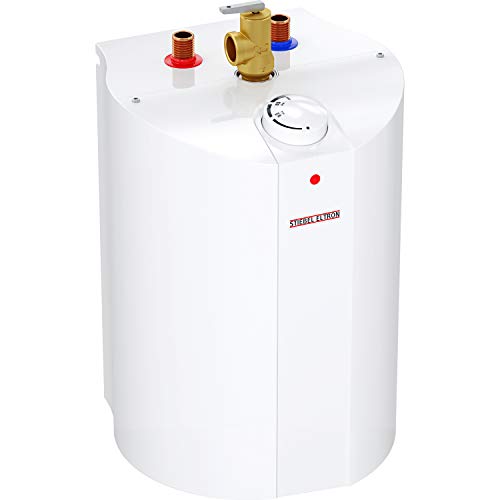
Stiebel Eltron SHC 2.5 Mini-Tank Electric Water Heater
A smaller 2.5-gallon tank suits a single bathroom sink or a small kitchenette rather than a shower or multiple fixtures. Stiebel Eltron’s build quality is frequently cited in plumbing forums as more durable than lower-cost mini-tanks. It mounts under a sink or inside a cabinet without needing much clearance.
Pros
- Compact footprint fits tight cabinet spaces
- Reputation for durable long-term construction
- Simple 120-volt installation
Cons
- Small tank size limits it to light single-sink use
- Not suited to a shower or multiple fixtures

EcoSmart POU 3.5 Point-of-Use Tankless Water Heater
This is one of the few tankless point-of-use heaters that runs on standard 120-volt power rather than requiring a 240-volt circuit. Flow rate stays modest, around half a gallon per minute, which limits it to a single low-flow fixture like a bathroom sink. A dedicated 30-amp breaker is still required even on the 120-volt circuit.
Pros
- Runs on 120-volt power unlike most tankless units
- No tank means no standby heat loss
- Compact size fits tight under-sink spaces
Cons
- Low flow rate limits it to light single-fixture use
- Still requires a dedicated breaker, not a simple plug-in

Eemax SPEX3512 FlowCo Point-of-Use Water Heater
FlowCo is built for installation without an electrician in most cases, running on a standard 120-volt circuit at 3.5kW. It suits a single bathroom or kitchen sink rather than a higher-demand fixture like a shower. Eemax markets this specifically toward DIY installers rather than commercial applications.
Pros
- Designed for straightforward DIY installation
- Runs on a standard 120-volt circuit
- Compact size for under-sink mounting
Cons
- Limited to light single-sink demand
- Not rated for shower-level flow

Rheem 81VP6S Point-of-Use Electric Water Heater
A 6-gallon tank holds more reserve hot water than the smaller mini-tanks on this list, suiting a fixture with slightly higher demand, like a kitchenette sink used for dishes. It still runs on a standard 120-volt circuit despite the larger tank size. An automatic thermostat and over-temperature protector cover basic safety requirements.
Pros
- Larger reserve tank than compact mini-tanks
- Still runs on a standard 120-volt circuit
- Backed by Rheem’s established service network
Cons
- Larger physical size needs more installation clearance
- Still limited to one fixture area, not whole-home use
Rheem RETEX-06 Point-of-Use Electric Tankless Water Heater
A tankless design means no standby heat loss and no risk of running out mid-use, as long as the flow rate stays within the unit’s 1.0 GPM rating. This model requires a 240-volt circuit instead of the 120-volt options elsewhere on this list, which usually means an electrician is needed for installation. It outperforms 120-volt tankless units on flow rate in exchange for that wiring requirement.
Pros
- Higher flow rate than 120-volt tankless options
- No standby heat loss from a storage tank
- No risk of running out during continuous use
Cons
- Requires a 240-volt circuit, usually needing an electrician
- Not a simple plug-in install like mini-tank options

Titan N-120 Tankless Water Heater
Titan’s N-120 outputs more power than the 120-volt options on this list, which helps in colder climates where incoming water temperature is lower and needs more energy to reach a usable output temperature. It requires a 220-volt circuit rated for 54 amps, a heavier electrical demand than any other product here. This model suits a single demanding fixture rather than point-of-use installs limited to light sink use.
Pros
- Higher output suited to colder incoming water temperatures
- No storage tank or standby heat loss
- Digital temperature control on some versions
Cons
- Heaviest electrical demand of any product on this list
- Installation almost always requires a licensed electrician
The lineup, side by side
| # | Model | Tank Size | Best for | Score | Price |
|---|---|---|---|---|---|
| 1 | Bosch Tronic 3000 T Mini-Tank Electric Water Heater | 4 gallons | Best Overall | 9.2 | Check price |
| 2 | Stiebel Eltron SHC 2.5 Mini-Tank Electric Water Heater | 2.5 gallons | Best for a Single Bathroom Sink | 9.0 | Check price |
| 3 | EcoSmart POU 3.5 Point-of-Use Tankless Water Heater | Tankless, no storage | Best 120-Volt Tankless Option | 8.6 | Check price |
| 4 | Eemax SPEX3512 FlowCo Point-of-Use Water Heater | Tankless, point-of-use | Best for Quick DIY Installation | 8.7 | Check price |
| 5 | Rheem 81VP6S Point-of-Use Electric Water Heater | 6 gallons | Best for Higher-Capacity Tank Storage | 8.8 | Check price |
| 6 | Rheem RETEX-06 Point-of-Use Electric Tankless Water Heater | Tankless, point-of-use | Best for Continuous Flow | 8.5 | Check price |
| 7 | Titan N-120 Tankless Water Heater | Tankless | Best for Cold-Climate or Higher-Output Needs | 8.3 | Check price |
Frequently asked questions
Can a point-of-use water heater run on a regular 120-volt outlet?
Several can, including the Bosch Tronic 3000 T mini-tank and the EcoSmart POU 3.5 tankless unit, though the tankless option still needs a dedicated 30-amp breaker rather than a shared household outlet.
What is the difference between a mini-tank and a tankless point-of-use heater?
A mini-tank stores a small reserve of hot water ready to use, while a tankless unit heats water on demand with no storage, trading standby readiness for no standby heat loss.
Do point-of-use water heaters need a dedicated circuit?
Most do, even the 120-volt models. A dedicated breaker, often 20 to 30 amps depending on the unit, is standard, though that is a smaller electrical requirement than the 240-volt units need.
How much hot water does a point-of-use heater provide?
A mini-tank like the Rheem 81VP6S holds 6 gallons, enough for several uses before needing to reheat, while a tankless unit provides continuous flow up to its rated GPM as long as power supply allows.
Is a point-of-use water heater enough for a shower?
Generally not on 120 volts. Most 120-volt point-of-use units are sized for a sink, not a shower, which needs higher flow rate and output than these smaller units provide.
Why do some point-of-use heaters need 240 volts instead of 120?
A 240-volt unit, like the Rheem RETEX-06, can deliver more heating power and therefore higher flow rate than a 120-volt unit, at the cost of needing a dedicated higher-voltage circuit.
Can I install a point-of-use water heater myself?
120-volt mini-tank and some tankless models, like the Bosch Tronic 3000 T or Eemax SPEX3512, are commonly installed without an electrician, though local code and existing wiring should always be checked first.
Does a point-of-use heater reduce my water heating costs?
It can, by avoiding the need to run hot water from a distant main heater until it reaches temperature, which wastes both water and energy on a long supply run.
What size point-of-use heater do I need for a kitchenette?
A 6-gallon mini-tank like the Rheem 81VP6S suits a kitchenette sink used for dishes better than a 2.5-gallon tank sized for a single bathroom sink.
Our take
For most homeowners adding hot water to a single sink without rewiring, the Bosch Tronic 3000 T mini-tank is the easiest and most reliable starting point. Anyone who prefers continuous flow over a storage tank should look at the EcoSmart POU 3.5 instead, as long as the fixture’s demand stays within its modest flow rate. A higher-demand fixture or a cold climate justifies the extra wiring cost of a 240-volt unit like the Rheem RETEX-06.
Jake Monroe
Jake worked as a residential contractor for over a decade before shifting to full-time writing. He evaluates power tools, hand tools and workshop gear through the lens of someone who has actually used them on job sites, not just read the box.


