Which pocket hole jig fits your kind of build?
Kreg 720PRO leads this ranking. Its Automaxx clamp grips stock from half an inch to one and a half inches with no dial to turn. Kreg 520PRO folds the same geometry into a travel size body. Massca M2 suits long production runs on an aluminium frame.
Kreg 720PRO earns the top spot for anyone building cabinets or face frames most weekends. Automaxx clamping sizes itself to each board, so parts from half an inch to one and a half inches need no dial. GripMaxx pads stop the creep that skews holes. Bulk is the tradeoff, since this jig wants a bench rather than a toolbox.
Every jig here looks alike in a listing photo: drill guide, step bit, stop collar. Real differences hide in clamping, hole spacing and whether the body reads thickness for you. We compared published thickness ranges, guide hole counts, dust ports and included hardware. Owner reports on blowout, collar slip and guide wear broke the ties.
How to pick the right one
What separates one pocket hole jig from another Four things actually differ across these jigs. Clamping comes first, since a self-adjusting body holds the board itself while a bare guide block needs a face clamp in your other hand. Guide count sets how many screws land per setup, from one on the Kreg Mini to three on the 310 and the Milescraft 1321. Guide material decides how long the angle stays true, and hardened steel outlasts composite. Chip handling finishes the list, because only the 720PRO here accepts a shop vacuum hose.
How to match screw length to board thickness Two settings have to agree: the jig thickness and the stop collar on the step bit. Three quarter inch stock takes a one and a quarter inch screw. One and a half inch stock takes a two and a half inch screw. Get either wrong and the tip breaks through the show face. Thread type matters just as much. Coarse threads bite in softwood and plywood, while fine threads hold in oak and maple without splitting the fibres.
Which clamping style suits how you work Count the holes in a typical session before choosing. Bare guide blocks such as the Kreg Mini and 310 reach places a clamping jig cannot, yet each hole means positioning a face clamp by hand. Self-adjusting bodies, the 720PRO and Armor Tool AutoJig among them, roughly halve handling time on a batch of rails. Massca M2 sits between those camps: metal frame, repeatable scale, your own clamp. Occasional repairs favour the small blocks, drawer runs favour the clamping jigs.
Best jigs for cabinets, furniture and outdoor builds Cabinet boxes and face frames throw chips fast, which is where the 720PRO dust port earns its keep. Chairs and tables bring angled hardwood joints, so fine thread screws plus a steel guide hold tolerance better than composite. Plywood carcases want coarse threads and a jig that spans wide rails, like the three hole Milescraft 1321. Outdoors, switch to stainless or blue-coat screws. Cap every pocket with a glued plug, because an open hole collects water and rots the joint from inside.
Our top picks

Kreg Pocket-Hole Jig 720PRO
Automaxx clamping sizes itself to each board, which takes the thickness dial out of the workflow. GripMaxx pads bite the face and hold the part square while the step bit cuts. A docking station carries the bit, driver and screws, so a small shop stops hunting for them.
Pros
- Skips the thickness dial between parts
- GripMaxx pads hold the workpiece still
- Onboard docking for bit, driver and screws
Cons
- Bench sized rather than toolbox sized
- Costliest jig in the Kreg range
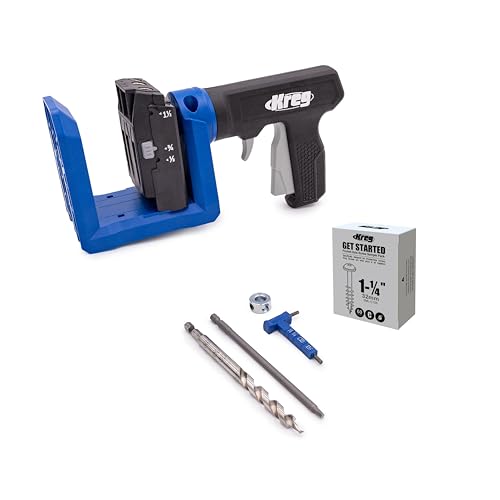
Kreg Pocket-Hole Jig 520PRO
Kreg fits the Automaxx clamp into a body you can hold one handed or bolt down. Drilling geometry matches the 720PRO across the same half inch to one and a half inch range. Woodworkers splitting time between a garage and a job site gain the most from it.
Pros
- Clamps stock without a bench vise
- Travels inside a tool bag
- Same hole geometry as the 720PRO
Cons
- Narrow base is less stable on wide panels
- Chip extraction lags the 720PRO

Kreg Pocket-Hole Jig Mini KPHJMINI
One hardened guide sits in a palm sized block, paired with a face clamp you already own. Stock from half an inch to one and a half inches drills cleanly, just one hole per setup. Shelf brackets, furniture repairs and shop jigs are where this block pays off.
Pros
- Rides in an apron pocket
- Reaches inside an assembled carcase
- Least expensive route into pocket joinery
Cons
- Single hole slows batch work
- Face clamp is not included

Massca M2 Pocket Hole Jig System
An anodised aluminium frame replaces moulded plastic, so a locked setting holds across a long run. Thickness sets once against a printed scale, then every drawer box matches the first. Spacing between the two guides adjusts, which helps on narrow rails.
Pros
- Metal frame keeps settings repeatable
- Adjustable spacing fits narrow rails
- Clear scale for setting thickness
Cons
- Thickness resets by hand when stock changes
- Clamping depends on your own bench clamp
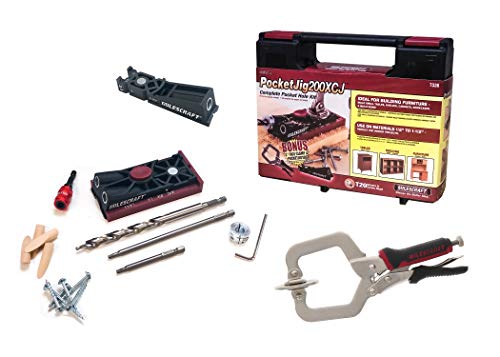
Milescraft 1321 PocketJig200 Kit
Three guides in a row let two or three screws land along a wide rail without repositioning. Step bit, stop collar, square drive bit and wrench arrive in the box, so day one needs nothing extra. Composite construction is the compromise that keeps the jig light.
Pros
- Three holes cover wide stock in one setup
- Square drive bit ships with the step bit
- Light enough to hold against a vertical part
Cons
- Composite guides wear faster than steel
- No dust port at all

Armor Tool AutoJig APJ1400 Pocket Hole Jig
A single lever sets and locks the clamp on whatever thickness arrives under it. That helps when your free hand is steadying an eight foot rail. Heavier castings and bench mounting points separate this jig from the plastic crowd.
Pros
- One lever clamps and releases
- Long boards need no second pair of hands
- Solid bench mounting points
Cons
- Heavier than the portable Kreg jigs
- Fewer matching accessories than Kreg

Kreg Pocket-Hole Jig 310
No built-in clamp is the whole point: this block slides into assembled carcases and up against walls. Three hardened steel guides handle half inch to one and a half inch stock once the collar is set. Add a Kreg face clamp for anything longer than a short rail.
Pros
- Reaches into finished assemblies
- Hardened steel guides resist wear
- Packs flat in a tool bag
Cons
- Every hole needs a clamp placed by hand
- Slower than the self-clamping PRO jigs
Side by side
| # | Model | Material thickness | Best for | Score | Price |
|---|---|---|---|---|---|
| 1 | Kreg Pocket-Hole Jig 720PRO | 1/2 to 1 1/2 inches | Best overall | 9.4 | Check price |
| 2 | Kreg Pocket-Hole Jig 520PRO | 1/2 to 1 1/2 inches | Best value | 9.2 | Check price |
| 3 | Kreg Pocket-Hole Jig Mini KPHJMINI | 1/2 to 1 1/2 inches | Best budget | 9.0 | Check price |
| 4 | Massca M2 Pocket Hole Jig System | 1/2 to 1 1/2 inches | Best for repeat production runs | 8.7 | Check price |
| 5 | Milescraft 1321 PocketJig200 Kit | 1/2 to 1 1/2 inches | Best starter kit | 8.5 | Check price |
| 6 | Armor Tool AutoJig APJ1400 Pocket Hole Jig | 1/2 to 1 1/2 inches | Best for one-handed clamping | 8.3 | Check price |
| 7 | Kreg Pocket-Hole Jig 310 | 1/2 to 1 1/2 inches | Best for tight spaces | 8.0 | Check price |
Questions worth asking
What is the best pocket hole jig for beginners?
Kreg 520PRO fits most first buys, since the clamp is built in and thickness sets itself. Working to a tight budget? Milescraft 1321 includes every bit needed to start.
How strong is a pocket hole joint?
Strong under shear load, which covers shelves, face frames and cabinet boxes. Racking and repeated flex are the weak points, so chairs and tables want glue in the joint as well.
What screw length do I need for 3/4 inch plywood?
One and a quarter inches, coarse thread. Coarse threads grip plywood and softwood, where fine threads strip the hole.
Kreg 520PRO vs 720PRO, which one should I buy?
Automaxx clamping and the thickness range are identical. Bench work, wide panels and dust extraction point to the 720PRO. A jig that rides to job sites points to the 520PRO.
Do pocket hole jigs need a special drill bit?
Yes. A stepped bit cuts the pilot and the pocket in one pass, and its stop collar sets the depth. Every jig listed here ships with one.
Can you use a pocket hole jig on hardwood?
Oak and maple drill fine with fine thread screws, slower drill speed and frequent chip clearing. Hardened steel guides, as in the Kreg 310, keep the angle true where composite drifts.
Is dust collection on a pocket hole jig worth it?
Worth it past a few dozen holes in one session. Chips pack into an unported guide and shallow out the hole, which the 720PRO vacuum port prevents.
How do you hide pocket holes?
Glue a matching wood plug in, sand it flush, then finish over it. Planning the joint so holes face inside a cabinet beats patching them later.
Which pocket hole jig works inside an assembled cabinet?
Kreg Mini and Kreg 310, because neither carries a clamp body to get in the way. Both rely on a separate face clamp to hold position.
Do you still need glue with pocket hole screws?
Not for cabinet boxes and shelving, where the screws alone hold. Add glue on chairs, tables and anything that flexes, since a pocket screw resists shear far better than racking.
Our pick
Kreg 720PRO belongs on the bench of anyone building cabinets or furniture, where self-adjusting clamping and a vacuum port pay back across long sessions. Pick the 520PRO instead if the jig travels between a garage and a job site. Drilling a dozen holes a year? Buy the Kreg Mini plus a face clamp and skip the clamping bodies entirely.
Jake Monroe
Jake worked as a residential contractor for over a decade before shifting to full-time writing. He evaluates power tools, hand tools and workshop gear through the lens of someone who has actually used them on job sites, not just read the box.