Picking the Right Pitching Machine for Your Team
The JUGS MVP Combo Pitching Machine is the strongest all-around pick, pitching both baseball and softball from 15 to 70 mph. The Heater Sports Deuce 95 MPH offers similar range at a lower cost, while the First Pitch Original suits teams that want a simple, rugged arm-style machine built for years of practice.
The JUGS MVP Combo Pitching Machine leads this list because it switches between baseball and softball without buying two machines, a real advantage for mixed programs. Its main limitation is weight, since at over 100 pounds it is not something one parent carries to the field alone.
We compared official speed ranges, wheel versus arm feed mechanisms, ball compatibility and owner feedback on durability rather than running our own pitching tests.
What we recommend

JUGS MVP Combo Pitching Machine
This two-wheel machine throws both baseball and softball from the same frame, a rare combination at this level. Speed adjusts from roughly 15 to 70 mph, enough range for coach-pitch drills through varsity batting practice. Folding legs help it fit in a car trunk between fields.
Pros
- Switches between baseball and softball on one frame
- Wide speed range covers youth through high school
- Folding legs simplify transport between fields
Cons
- Heavier than single-sport machines, needs two people to lift comfortably
- Still requires a hand feeder since it has no auto-feed hopper
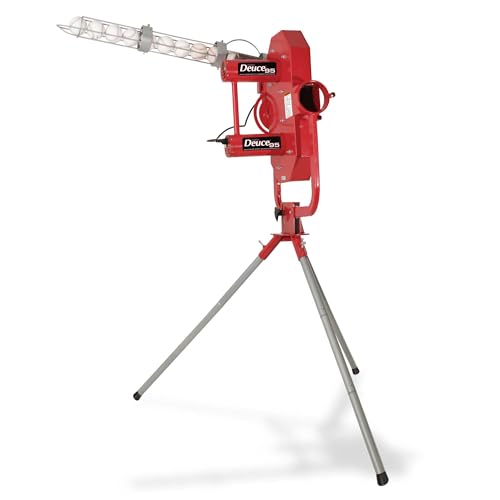
Heater Sports Deuce 95 MPH Pitching Machine
The Deuce pairs two independently adjustable wheels, so one side can throw fastballs while the other throws breaking pitches. Listed speeds run from 15 to 95 mph, covering everything from tee-ball timing drills to advanced batting practice. It runs on standard household power, no generator needed.
Pros
- Two independent wheels allow fastball and breaking pitch mixes
- Top speed suits advanced high school hitters
- Priced well below premium two-wheel machines
Cons
- Softball use is more limited than the JUGS combo
- Owners report the wheels need periodic alignment checks

First Pitch Original Baseball Pitching Machine
This arm-style machine swings a single arm through a full rotation, closer to a real pitching motion than a wheel feed. It tops out near 80 mph from a 1/3 horsepower motor and weighs about 60 pounds. Assembly needs no tools, which matters for coaches setting up before practice.
Pros
- Arm-style throw mimics a real pitcher’s release better than wheels
- No-tool assembly saves setup time before practice
- Lighter frame than most two-wheel combo machines
Cons
- Top speed trails behind two-wheel models like the Deuce
- Single arm design cannot vary pitch type on command

First Pitch Curveball Baseball and Softball Pitching Machine
Two independent 1/3 horsepower motors let this machine throw curveballs, fastballs and even ground balls or pop flies from the same base. Listed speed reaches up to 105 mph on the baseball setting, with a 12 inch softball configuration available. A 360 degree swivel base helps simulate pitches from different angles.
Pros
- Throws curveballs, fastballs, grounders and pop flies from one unit
- Swivel base adds angle variety that fixed machines lack
- Converts between baseball and softball configurations
Cons
- Dual motor design costs more than single wheel machines
- Heavier footprint takes longer to break down after practice

SKLZ Catapult Soft Toss Baseball Pitching Machine
Rather than simulating a pitcher, the Catapult lobs balls on a timer, about every 8 seconds, for soft toss hitting or fly ball fielding reps. It runs on an internal rechargeable battery rated for roughly 8 hours or on AC power. At under 4 pounds, it sets up on a tee stand or tripod in seconds.
Pros
- Lightweight enough to move between stations during practice
- Works for both soft toss hitting and pop fly fielding drills
- Rechargeable battery removes the need for an outlet nearby
Cons
- Not built to simulate real pitch speed or movement
- Plastic ball mode limits use to younger age groups
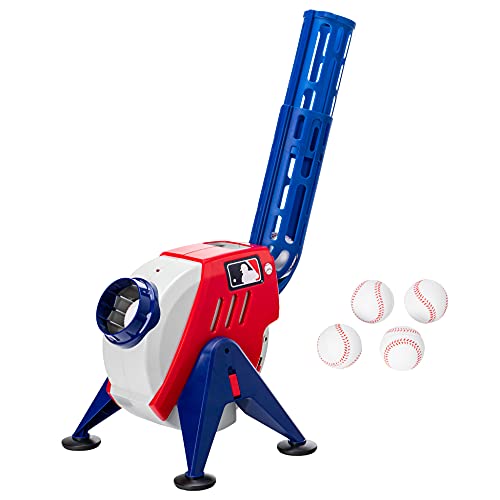
Franklin Sports MLB Power Pitcher Pitching Machine
Designed for beginners, this machine throws foam practice balls at adjustable speeds up to about 20 mph. Three angle settings let a parent switch between grounders, line drives and fly balls. Included foam balls reduce the risk of bruises during a child’s first swings.
Pros
- Foam balls make early practice safer for young beginners
- Adjustable angle covers grounders, liners and fly balls
- Simple enough for a parent to run without baseball experience
Cons
- Speed ceiling is far too low for travel ball age groups
- Foam balls behave differently than real baseballs off the bat
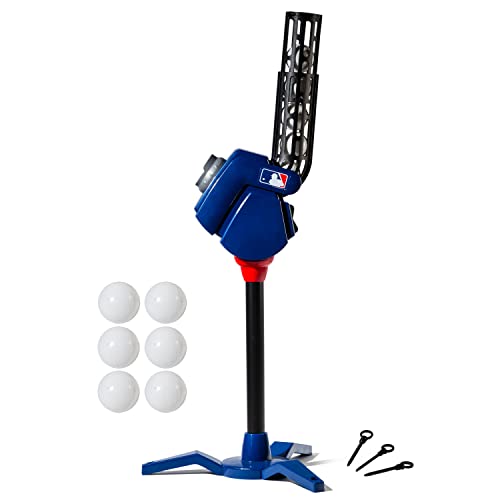
Franklin MLB Superstar 4 in 1 Pitching Machine
This machine adjusts its angle to cover soft toss, ground balls, line drives and pop flies, four drills from one base. It ships with six practice balls so a family can start right out of the box. The lightweight frame suits a backyard or driveway more than a full team practice.
Pros
- Four drill types from one adjustable machine
- Comes with enough balls to start practicing immediately
- Compact enough for backyard storage between uses
Cons
- Not intended for team-level repetition volume
- Plastic balls wear faster than regulation baseballs
How they compare
| # | Model | Ball Type | Best for | Score | Price |
|---|---|---|---|---|---|
| 1 | JUGS MVP Combo Pitching Machine | Baseball and softball, interchangeable wheels | Best Overall | 9.4 | Check price |
| 2 | Heater Sports Deuce 95 MPH Pitching Machine | Regulation baseball | Best Value | 9.0 | Check price |
| 3 | First Pitch Original Baseball Pitching Machine | Regulation baseball | Best for Durability | 8.7 | Check price |
| 4 | First Pitch Curveball Baseball and Softball Pitching Machine | Baseball or 12 inch softball | Best for Breaking Pitches | 9.1 | Check price |
| 5 | SKLZ Catapult Soft Toss Baseball Pitching Machine | Regulation baseball or 9 inch plastic balls | Best for Soft Toss and Fielding Drills | 8.5 | Check price |
| 6 | Franklin Sports MLB Power Pitcher Pitching Machine | Included foam practice balls | Best for Young Kids | 8.3 | Check price |
| 7 | Franklin MLB Superstar 4 in 1 Pitching Machine | Included plastic practice balls, 6 pack | Best Multi-Function for Families | 8.2 | Check price |
What to look for
What to look for in a pitching machine Speed range matters more than top speed alone, since most practice happens well below a machine’s ceiling. Feed type changes the workout too, as wheel machines throw fast and consistent while arm-style units move closer to a real release. Ball compatibility decides whether a family needs extra inventory, since foam, plastic and regulation baseballs are not interchangeable across every model. Power source also matters for anyone practicing away from an outlet.
Choosing by skill level Coach-pitch and early youth hitters do better with foam-ball machines like the Franklin Power Pitcher, where speed stays low and mistakes do not hurt. Middle school and travel ball hitters usually need a two-wheel machine in the 40 to 70 mph range to match game speed. High school and adult leagues push toward machines like the Heater Deuce or First Pitch Curveball, where top speeds climb past 90 mph.
Solo practice versus team sessions A hitter practicing alone benefits most from a timed feeder like the SKLZ Catapult, since nobody needs to load balls between swings. Team sessions favor combo machines such as the JUGS MVP, where one unit serves both baseball and softball squads sharing a field. Larger programs often keep a lighter machine, such as the First Pitch Original, for quick setup at satellite practice fields.
Budget and maintenance tradeoffs Dual motor machines like the First Pitch Curveball cost more up front but add pitch variety that single wheel units cannot match. Simpler arm-style machines need fewer moving parts, which owners report translates to less wheel alignment maintenance over a season. Foam ball machines avoid most upkeep entirely, since there is no wheel speed to calibrate. Budget toward the machine a program will actually use every week, not the one with the highest top speed on paper.
Common questions
What speed pitching machine do I need for high school baseball?
Most high school fastball work happens between 60 and 80 mph, so a machine like the Heater Sports Deuce or JUGS MVP Combo covers that range with room to adjust down for warmups.
Can one pitching machine throw both baseball and softball?
Yes. The JUGS MVP Combo and the First Pitch Curveball both switch between baseball and softball settings, which saves a program from buying two separate machines.
Are arm-style pitching machines better than wheel machines?
Arm-style machines like the First Pitch Original release the ball more like a human pitcher, which some hitters prefer for timing. Wheel machines generally offer a wider adjustable speed range and more consistent repetition.
How fast do youth pitching machines throw?
Beginner machines built for young kids, such as the Franklin Sports Power Pitcher, usually top out around 20 mph, well below what wheel machines for older players can reach.
Do pitching machines need an auto ball feeder?
Not always. A hand-fed machine works fine with a second person loading balls, but a hitter practicing alone benefits from an auto feeder or a timed unit like the SKLZ Catapult.
What is the difference between soft toss machines and pitching machines?
Soft toss machines, like the SKLZ Catapult, lob balls on a timer for bat control drills. Pitching machines simulate game speed pitches using a wheel or arm mechanism.
Is a two wheel pitching machine worth the extra cost?
Two wheel machines such as the Heater Deuce or First Pitch Curveball let each wheel spin differently, which adds breaking pitches that a single wheel machine cannot throw.
Can a pitching machine throw curveballs?
Machines with independently adjustable wheels, including the Heater Sports Deuce and First Pitch Curveball, can throw curveballs by spinning the wheels at different speeds.
What size pitching machine fits in a car?
Lighter arm-style units like the First Pitch Original and compact machines like the SKLZ Catapult fold or disassemble more easily than large two-wheel combo machines.
How much practice space does a pitching machine need?
Most home and backyard machines need at least 40 to 46 feet of clear space to regulation plate distance, plus a protective screen if hitting live.
The verdict
For a program that needs one machine to cover baseball and softball at a wide range of speeds, the JUGS MVP Combo Pitching Machine is the strongest choice despite its weight. Teams on a tighter budget that mainly need fastball and curveball work should look at the Heater Sports Deuce 95 MPH instead. Families with young beginners should skip the high speed machines entirely and start with the Franklin Sports Power Pitcher.
Derek Holt
Derek has a background coaching recreational and amateur athletes and has worked the sales floor at specialty fitness retailers. He focuses on equipment durability, ergonomics and realistic use cases rather than marketing claims.


