Phone Lens Filters for Glare, Bloom and Daylight Video
Moment CineBloom Diffusion Filter takes first place for filmic highlight bloom on iPhone and Android. SANDMARC Variable ND Filter holds a natural shutter in daylight video. PolarPro LiteChaser Pro Circular Polarizer strips reflections off water, glass and leaves. Each one needs a compatible case mount, which buyers often forget.
Moment CineBloom Diffusion Filter is the pick for creators who want a softer look straight out of the camera app. Highlights bloom around streetlights and backlit hair while fine detail stays readable. Two densities let you dial the strength. Its 67mm thread is the catch, because a lens case or adapter has to come with it.
Mounting confuses buyers more than optics do. We compared thread sizes, magnetic systems, clip widths, stop ranges and reported color cast across current Amazon listings. Owner feedback on ultra wide vignetting shaped the order too. A filter that darkens the corners defeats its own purpose.
The top picks, ranked
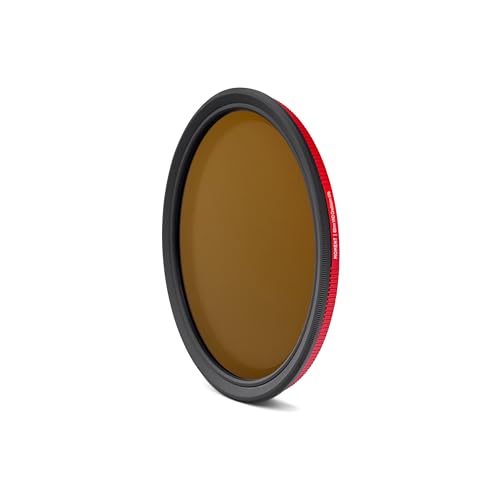
Moment CineBloom Diffusion Filter 67mm
Two densities ship separately: 10 percent for a hint of glow, 20 percent for obvious halation. Neon signs, streetlamps and rim lit hair pick up a soft ring while edges hold their definition. Attachment runs through a 67mm lens mount, so a Moment case or third party adapter is required.
Pros
- Two densities cover subtle and heavy looks
- Bloom survives video compression better than an app blur
- Same 67mm thread fits mirrorless camera lenses
Cons
- Case or adapter is a separate purchase
- Frame edges can clip on ultra wide phone lenses
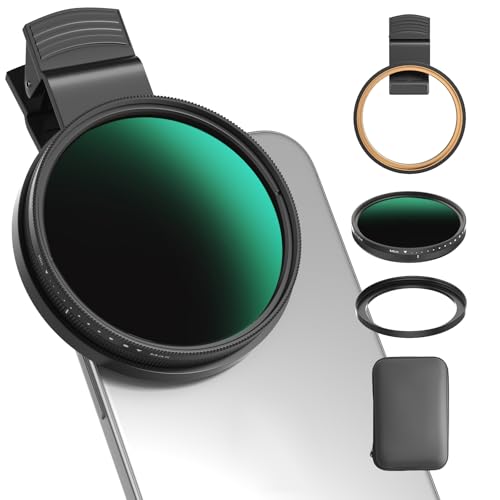
SANDMARC Variable ND Filter for iPhone
Daylight video wants a 1/48 or 1/50 shutter, and this filter buys the stops to keep it. Rotating the outer ring sweeps roughly two to five stops with no clicks or jumps. A clip mount ships alongside case options, so the glass follows you to the next iPhone.
Pros
- Holds natural motion blur in bright sun
- Clip mount spans several iPhone generations
- Stepless rotation avoids abrupt exposure shifts
Cons
- Turning past the marked range invites cross banding
- Clip can cover the ultra wide lens on some models

PolarPro LiteChaser Pro Circular Polarizer
Reflections off water, window glass and wet foliage disappear in a way no editing slider matches. An anodized aluminum frame twists onto the LiteChaser Pro case and locks flush. Skies darken by roughly a stop, and green leaves gain saturation without added noise.
Pros
- Removes window and water glare at the source
- Locks flush so it will not spin loose in a pocket
- Deepens blue sky with no noise penalty
Cons
- Tied to the LiteChaser case ecosystem
- Effect weakens when shooting into or away from the sun
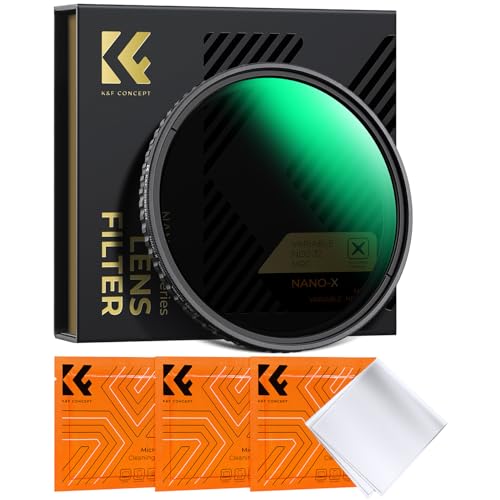
K&F Concept Nano-X Variable ND2-ND32
Hard stops at each end of the rotation keep you out of the black cross zone. Density spans ND2 to ND32, which works out to one through five stops. Nano coating holds color shift mild, and a single white balance tweak clears what remains.
Pros
- Hard stops block rotation into cross banding
- 67mm thread also fits mirrorless lenses
- Front thread accepts a standard lens cap
Cons
- Slight warm cast at maximum density
- Still needs a 67mm case mount on a phone

Freewell Sherpa Magnetic Filter System
Magnetic rings sit on a matched Sherpa case, so a swap takes about a second. Polarizer, neutral density and mist options snap on in any order and stack. Shooters who change looks between frames gain the most, since nothing can cross thread at dusk.
Pros
- One handed swaps in about a second
- Magnets hold stacked filters without slipping
- Case shields the camera island when filters come off
Cons
- Case is model specific, so a new phone means a new case
- Magnetic rings add bulk in a jacket pocket

APEXEL Phone Camera Lens Filter Kit
A spring clip plus polarizer, neutral density and starburst glass makes this a learning set. The clip grips most phones, including moderately thick cases, and needs no branded mount. Glass and edge finishing trail the named brands, which shows against strong backlight.
Pros
- Three filter effects arrive in one box
- Clip fits Android and iPhone with no special case
- Cheapest route to learning what a polarizer does
Cons
- Uncoated edges flare against strong backlight
- Clip alignment needs a check on every shot

NEEWER 67mm ND Filter Kit ND8 ND64 ND1000
Fixed densities beat variable glass when the goal is silky water or blurred crowds. ND8, ND64 and ND1000 cover three, six and ten stops in one pouch. Pair the ND1000 with a tripod and a manual camera app to smooth a waterfall at midday.
Pros
- Ten stop option enables daytime long exposures
- Fixed density rules out cross banding
- Foam lined pouch keeps glass separated in a bag
Cons
- Swapping filters is slower than turning a ring
- Framing through ND1000 needs a tripod and app
Side by side
| # | Model | Filter type | Best for | Score | Price |
|---|---|---|---|---|---|
| 1 | Moment CineBloom Diffusion Filter 67mm | Diffusion | Best overall | 9.4 | Check price |
| 2 | SANDMARC Variable ND Filter for iPhone | Variable ND | Best for video | 9.2 | Check price |
| 3 | PolarPro LiteChaser Pro Circular Polarizer | Circular polarizer | Best for reflections | 9.0 | Check price |
| 4 | K&F Concept Nano-X Variable ND2-ND32 | Variable ND | Best value | 8.8 | Check price |
| 5 | Freewell Sherpa Magnetic Filter System | Magnetic system | Best for fast swapping | 8.6 | Check price |
| 6 | APEXEL Phone Camera Lens Filter Kit | Clip-on kit | Best budget | 8.3 | Check price |
| 7 | NEEWER 67mm ND Filter Kit ND8 ND64 ND1000 | Fixed ND set | Best for long exposure | 8.0 | Check price |
How to choose
What to look for in a phone lens filter Mount type decides your options, so settle it before comparing glass. Threaded filters use a 67mm standard shared with mirrorless lenses. Magnetic kits lock to a branded case, and clips need no case at all. Coating comes next, because uncoated glass flares against streetlights. Aluminum frames also beat plastic rings, which warp and then bind on the thread.
Clip-on, threaded and magnetic mounts compared Clips cost the least and move between phones, yet they shift and need realigning. Threaded systems open the widest catalogue, since any 67mm camera filter screws straight on and never slips mid shot. Magnetic rings give up a little rigidity for one second swaps. Yearly phone upgraders usually regret case locked systems, because each new body means buying the case again.
Filters for daylight video and long exposure Recording at 30fps calls for roughly a 1/60 shutter, which overexposes badly outdoors. Variable ND solves that by cutting light instead of speeding the shutter. Two to five stops handles most sunny days, and six stops covers snow or white sand. Long exposure is a different job, where fixed ND8 to ND1000 lets shutters run for seconds. Stay inside the marked range on a variable filter, or a dark X spreads across the frame.
When a filter will not fix the shot Polarizers do nothing with the sun directly behind or ahead of you, so save them for side lit scenes. Clipped highlights stay clipped, whatever diffusion goes in front. Ultra wide lenses are the other trap, since most mounts cut into the corners. Casual indoor snapshots gain little for the bulk added. Still undecided buyers should learn on a clip kit before committing to a case ecosystem.
Common questions
Do phone lens filters actually work?
Polarizers and neutral density filters change light before it reaches the sensor, so they do things editing cannot. Removing a reflection off a lake is physically impossible in software. Diffusion is the exception, because apps approximate it fairly well.
What does a variable ND filter do on a phone?
Think sunglasses for the lens, cutting incoming light by a stop count you dial in. Video shooters use one to keep a natural 1/48 or 1/60 shutter outdoors. Without it, daylight footage looks stuttery because the shutter runs too fast.
Can I use a polarizer with an iPhone?
Yes, through a case mount such as the LiteChaser Pro or a universal clip. Rotate the front ring until reflections drop away, then frame the shot. Expect one to two stops of light loss, which matters indoors more than outside.
Which filter size fits a phone lens mount?
Most phone photography cases standardize on 67mm, including Moment and several third party mounts. That thread also matches many mirrorless lenses, so filters carry over. Check the case listing first, because a few brands use 62mm.
Is a clip-on filter as good as a threaded one?
Coatings and edge finishing separate them more than the mount does. Clips drift, so alignment needs checking before each frame. Start with a clip kit, then move to threaded glass once you shoot weekly.
Variable ND vs fixed ND: which is better for phones?
Variable ND wins for video, where light changes between shots and one ring covers the range. Fixed ND wins for long exposure, since ND1000 reaches ten stops with no banding risk. Owning one of each covers both jobs.
Do I still need filters if I shoot in ProRAW?
ProRAW adds editing latitude but cannot recover a clipped highlight or delete a reflection. Polarizers and ND filters keep earning their place outdoors. Diffusion is the one effect software fakes reasonably well.
What causes the dark X on a variable ND filter?
Two polarizing layers cross beyond a certain angle and create uneven banding shaped like an X. Hard stop designs such as the K&F Nano-X physically prevent that rotation. Fixed ND filters sidestep the issue completely.
Which filter is best for shooting waterfalls?
A strong fixed ND like ND1000 drops ten stops and allows multi second exposures in daylight. Add a tripod and a manual camera app for shutter control. A polarizer helps alongside it by cutting glare off wet rock.
Will a filter cause vignetting on the ultra wide camera?
Often, yes, because mount rings and clips intrude on a field of view that wide. Main and telephoto lenses stay clear on most systems. Shoot a test frame at every focal length before a real session.
The bottom line
Pick the Moment CineBloom Diffusion Filter if one filter has to change the character of every frame and you already own a 67mm lens case. Video shooters fighting midday sun should take the SANDMARC Variable ND instead, since shutter control matters more outdoors than mood. Anyone learning what these do can start on the APEXEL clip kit and buy threaded glass later.
Marcus Chen
Marcus covered consumer electronics for enthusiast tech publications for six years before joining ChoiceCrest. He specializes in translating manufacturer spec sheets into plain-language buying advice, with a focus on audio, computing accessories and smart-home gear.


