Pan organisers sized for real kitchen cabinets
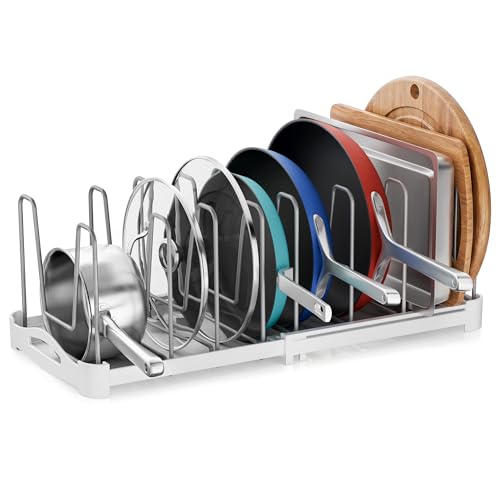
Cuisinel’s heavy duty 5 tier rack fits most kitchens, with sliding dividers that take a 12 inch skillet or a small saucepan. YouCopia StoreMore expands to match odd cabinet widths. For lid chaos alone, Simple Houseware’s vertical rack is the cheapest fix.
Cuisinel’s 5 tier rack suits most kitchens with a standard base cabinet. Dividers slide along the frame, so a 12 inch cast iron skillet and a shallow saucepan share one rack. Height is the catch, since it wants roughly 15 inches of internal clearance that a low mid shelf will not give.
Pan storage fails in predictable ways. Fixed dividers miss your pan sizes, thin frames tip under a loaded skillet, and lids end up balanced loose on the stack. Picks below compare adjustability, frame strength and footprint, then weigh owner feedback on stability once a rack is fully loaded.
What we recommend

Cuisinel Heavy Duty 5 Tier Pan Organiser Rack
Five dividers slide along the base rail, so every slot widens to whatever goes in it. Powder coated tube steel carries cast iron without bowing at the centre. It ships flat packed, stands upright or lies flat on a shelf, and builds with the bundled hardware alone.
Pros
- Dividers move to fit odd pan sizes
- Tube steel frame holds cast iron without flexing
- Works upright in a cabinet or flat on a shelf
Cons
- Wants about 15 inch of internal cabinet height
- Assembly hardware works loose and needs retightening

YouCopia StoreMore Adjustable Pan Organiser
An expanding base stretches the frame to meet cabinet depth instead of stranding space behind it. Dividers lift straight out, freeing a bay wide enough for two large pans side by side. Coated wire keeps enamel and non stick surfaces off bare metal.
Pros
- Expands to awkward cabinet widths
- Coating spares enamel and non stick finishes
- Dividers come out for bulky pots
Cons
- Wire frame is lighter duty than tube steel
- Fully expanded frame rocks on uneven shelves

Simple Houseware Kitchen Cabinet Pan and Pot Lid Organiser Rack
Lids create more cupboard mess than pans do, and each one gets a vertical slot here. Chopping boards and baking trays slide into the same dividers. Its narrow footprint sits beside an existing pan stack rather than replacing it, and it unfolds ready to use.
Pros
- Cheapest fix for loose lids
- Narrow enough to share a shelf with pans
- No assembly beyond unfolding
Cons
- Slot width suits lids more than deep pans
- Light frame slides on smooth shelves

Lynk Professional Roll Out Cabinet Organiser
Full extension glides pull the tray clear of the cabinet, which ends the blind reach to the back. Chrome finished steel takes heavy stacked cookware, and raised side rails stop pans walking off during a pull. Screws go into the cabinet base, so treat this as a fitted upgrade rather than a drop in rack.
Pros
- Brings the back of deep base units into reach
- Rated for heavy stacked cookware
- Raised rails keep pans on the tray
Cons
- Installation is permanent and needs drilling
- Glides take about an inch of cabinet width

mDesign Metal Pot and Pan Organiser Rack
Slim wire reads as visually light, which matters when storage sits on display. Vertical slots hold pans on edge so nothing nests and scratches. Rubber feet grip a worktop, making it usable beside the hob as well as inside a cabinet.
Pros
- Stays tidy looking on display shelving
- Pans stay separated so coatings survive
- Non slip feet allow worktop use
Cons
- Fixed slot width rules out large skillets
- Thin wire flexes under cast iron

Copco Non-Skid 3 Tier Pan Organiser Rack
Three tiers keep total height low enough to slide under a mid shelf that blocks a five tier frame. Non skid coating covers every contact point, so pans and rack both stay put. Sizing targets saucepans and mid sized skillets rather than stockpots, and nothing needs assembling.
Pros
- Clears low cabinet shelves
- Non skid coating protects pan finishes
- Usable straight from the box
Cons
- Three slots cap how much it holds
- Fixed spacing will not take a 12 inch skillet
Rubbermaid Bakeware Organiser Rack
Sheet pans, cooling racks and muffin tins stand upright instead of leaning in a pile. Moulded slots on a coated wire frame keep enamel and non stick trays from chipping. Put it on a worktop or in a tall cabinet and flat bakeware stops mixing with pan stacks.
Pros
- Keeps bakeware out of the pan stack
- Coated slots protect non stick trays
- Stable under heavy sheet pans
Cons
- Not shaped for deep pots
- Takes a full shelf width in most cabinets
What to look for
What to measure before you buy Three numbers decide the shortlist: internal cabinet height, internal depth, and the base diameter of your largest pan. Five tier racks generally want about 15 inches of clearance, which a mid shelf often kills outright. Depth matters most for pull out trays, since glides add length behind the tray. Measure a skillet across the base rather than the handle, because handles overhang a frame without causing trouble. Write the numbers down before reading any listing, as product photos hide scale completely.
Fixed slots vs adjustable dividers Fixed spacing only works when your pans run close in size. Mixed cookware is the norm, which is why sliding dividers on the Cuisinel and removable ones on the YouCopia StoreMore stay useful for longer. Adjustable frames also survive a cookware upgrade rather than becoming the wrong size. Material counts alongside spacing: coated wire is fine for saucepans and enamel, while a loaded 12 inch cast iron skillet wants tube steel underneath. Fixed racks cost less and skip assembly, so a matched saucepan set does fine on one.
Pan storage for small kitchens and low shelves Clearance, not width, limits most small kitchens. Three tier frames such as the Copco rack slide under a shelf that stops anything taller. Lids deserve a rack of their own, since a lid balanced on a stack is what sends the pile sliding. Standing pans on edge uses vertical space that stacking wastes entirely. Racks with rubber feet buy extra room on a worktop when the cupboard is genuinely full.
Deep base cabinets: pull out tray or freestanding rack Reaching the back is the real problem in a 24 inch deep unit, not capacity. Freestanding racks still leave the rear third awkward, because getting anything out means moving the rack first. Full extension trays like the Lynk Professional bring the whole load forward instead. That costs a permanent install, screws into the cabinet base, and roughly an inch of width to the glides. Renters and anyone unwilling to drill are better off with a tall vertical rack kept near the cabinet front.
Compared at a glance
| # | Model | Tiers | Best for | Score | Price |
|---|---|---|---|---|---|
| 1 | Cuisinel Heavy Duty 5 Tier Pan Organiser Rack | 5 adjustable slots | Best overall | 9.4 | Check price |
| 2 | YouCopia StoreMore Adjustable Pan Organiser | Expandable frame | Best value | 9.2 | Check price |
| 3 | Simple Houseware Kitchen Cabinet Pan and Pot Lid Organiser Rack | Multiple vertical dividers | Best budget | 9.0 | Check price |
| 4 | Lynk Professional Roll Out Cabinet Organiser | Full extension slides | Best for deep base cabinets | 8.8 | Check price |
| 5 | mDesign Metal Pot and Pan Organiser Rack | Open wire, slim profile | Best for open shelving | 8.6 | Check price |
| 6 | Copco Non-Skid 3 Tier Pan Organiser Rack | 3 | Best for small cabinets | 8.3 | Check price |
| 7 | Rubbermaid Bakeware Organiser Rack | Sheet pans, trays, cutting boards | Best for sheet pans and lids | 8.0 | Check price |
Questions worth asking
How do you organise pots and pans in a small kitchen?
Stand pans on edge in vertical slots and give lids a separate rack. Vertical storage uses cabinet height that stacking wastes, and it stops coatings rubbing together.
Will a pan organiser hold cast iron?
Powder coated tube steel frames such as the Cuisinel rack take cast iron without bowing. Thin wire designs flex under a loaded 12 inch skillet and start to lean.
How much cabinet height does a 5 tier pan rack need?
Around 15 inches of internal clearance. Measure shelf to shelf rather than to the cabinet top, since a low mid shelf is the usual thing that blocks it.
Are adjustable pan organisers better than fixed ones?
For mixed cookware, yes. Movable dividers take a small saucepan and a wide skillet in the same frame, while fixed racks suit matched sets and cost less.
Where is the best place to store pan lids?
In a dedicated vertical lid rack beside the pans. Slotting lids upright removes the wobble that makes a stacked pan cupboard collapse when you pull one pan out.
Do pull out cabinet organisers need drilling?
Yes. Roll out trays like the Lynk Professional screw into the cabinet base, which makes them a fitted upgrade rather than something you drop in and remove later.
Can a pan organiser sit on the countertop?
Several can. The mDesign wire rack and the Rubbermaid bakeware organiser both run non slip feet and stay stable on a worktop next to the hob.
How do you stop a pan rack sliding in the cupboard?
Choose a rack with rubber or non skid feet. On smooth shelves, a thin liner mat underneath stops the frame travelling when you pull a pan out.
What is the best pan organiser for deep base cabinets?
A full extension pull out tray. The Lynk Professional brings cookware from the back of a 24 inch unit to the front, which no freestanding rack manages.
Our pick
Buy the Cuisinel 5 tier rack if your cabinet clears 15 inches, because sliding dividers keep it useful long after your cookware changes. Low mid shelves point to the Copco 3 tier instead, trading capacity for clearance. Deep base units are a separate problem, and the Lynk pull out tray solves reach in a way no freestanding rack can.
Dana Whitfield
Dana spent eight years buying and merchandising for a regional kitchenware retailer before moving into editorial work. She has handled thousands of SKUs across cookware, small appliances and kitchen organization, and focuses on the practical differences that matter once a product is actually in daily use.