Pasta Pots and Pans That Handle Boiling and Saucing
Cuisinart’s Chef’s Classic pasta pot leads for its built-in straining insert that removes the need for a separate colander. Calphalon’s stainless stockpot suits buyers who want a simpler pot without the insert, while Tramontina’s covered pasta pot fits anyone prioritizing even heat distribution.
Cuisinart’s Chef’s Classic pasta pot stands out for its removable straining insert, which drains pasta directly without lifting a heavy pot to a separate colander. Its main limitation is overall capacity, since the insert itself takes up some usable volume inside the pot.
We compared capacity, straining features, material, and heat distribution across each pot or pan based on manufacturer specifications and owner reviews rather than our own cooking tests.
The best picks, ranked

Cuisinart Chef’s Classic Stainless 6 Quart Pasta Pot
A perforated steel insert lifts pasta straight out of the boiling water, draining it without a separate colander or straining the water over a sink. Stainless steel construction with an aluminum core spreads heat evenly across the bottom. At 6 quarts, it suits family-size batches of pasta without constant refilling.
Pros
- Built-in straining insert removes the need for a separate colander
- Aluminum core spreads heat evenly across the base
- Capacity suits family-size pasta batches
Cons
- Insert takes up some interior volume versus a plain pot
- Heavier to lift and pour than a pot without an insert

Calphalon Classic Stainless Steel 8 Quart Stockpot
At 8 quarts, this stockpot handles larger pasta batches or bigger families better than 6 quart alternatives. A tri-ply stainless and aluminum base distributes heat without hot spots that can scorch starchy pasta water. It ships without a straining insert, so a separate colander is still needed.
Pros
- Largest capacity on this list for bigger batches
- Tri-ply base reduces hot spots during boiling
- Stay-cool handles make lifting safer
Cons
- No built-in straining insert included
- Larger size takes up more storage space

T-fal Specialty Stainless Steel 8 Quart Pasta Pot with Insert
T-fal pairs an 8 quart pot with a straining insert at a lower price point than premium multi-ply alternatives. A single layer of stainless steel over an aluminum base keeps manufacturing cost down while still conducting heat reasonably well. It suits everyday pasta nights more than professional kitchen use.
Pros
- Straining insert included at a lower price than premium brands
- Larger 8 quart capacity than many insert-equipped pots
- Suits everyday family pasta cooking
Cons
- Single-layer base conducts heat less evenly than tri-ply designs
- Insert handles run warmer to the touch than thicker-walled pots

Granite Ware Steamer and Pasta Pot
This pot includes both a straining insert and a separate steaming rack, extending use beyond pasta to vegetables and seafood. Porcelain-coated steel construction resists staining from tomato-based sauces better than bare steel. The lighter build keeps cost down compared to full stainless steel pots.
Pros
- Doubles as a steamer for vegetables and seafood
- Porcelain coating resists staining from tomato sauces
- Lower cost than full stainless steel equivalents
Cons
- Lighter steel conducts heat less evenly than stainless
- Porcelain coating can chip if dropped or scraped with metal utensils

Farberware Classic Stainless Steel 6 Quart Covered Stockpot
Farberware keeps this stockpot simple with no straining insert, aimed at cooks who already own a separate colander. An aluminum-clad base helps distribute heat evenly for consistent boiling. The straightforward design and tight-fitting lid also suit soups and stocks beyond just pasta.
Pros
- Doubles easily as a soup or stock pot beyond pasta use
- Aluminum-clad base improves heat distribution
- Tight-fitting lid helps water reach a boil faster
Cons
- No straining insert included
- Smaller capacity than 8 quart alternatives

All-Clad Stainless Steel 8 Quart Multi-Cooker with Insert
All-Clad’s multi-ply stainless construction conducts heat more evenly than single-layer or clad-base pots, reducing scorching risk with starchy pasta water. A straining insert and steamer basket both come included, covering more cooking methods than a basic pasta pot. The heavier gauge steel adds durability but also noticeably more weight when full.
Pros
- Multi-ply construction conducts heat more evenly than clad-base pots
- Includes both a straining insert and steamer basket
- Heavier gauge steel improves long-term durability
Cons
- Costs more than other pasta pots on this list
- Heavier weight makes pouring boiling water more demanding
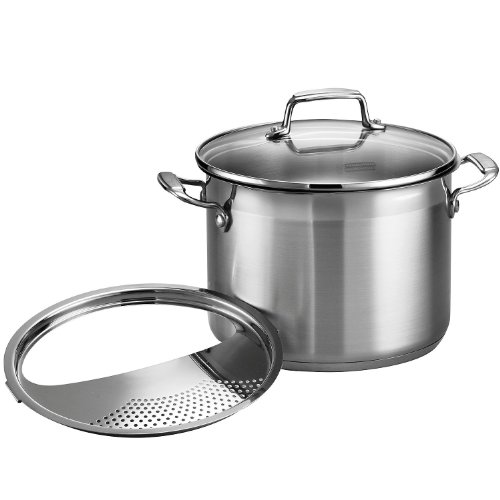
Tramontina Gourmet Stainless Steel 6 Quart Covered Pasta Pot
A tri-ply base combining aluminum between two layers of stainless steel spreads heat evenly, reducing the risk of scorched starch at the bottom. The included straining insert lifts out cleanly once pasta finishes cooking. A domed lid helps trap heat for a faster return to boiling after adding pasta.
Pros
- Tri-ply base reduces scorching risk during boiling
- Domed lid speeds up the return to a boil
- Straining insert lifts out cleanly after cooking
Cons
- 6 quart capacity limits batch size for large families
- Costs more than single-layer insert pots like T-fal’s
What to look for
What to look for in a pasta pot Capacity decides how much pasta cooks at once without overcrowding the water, with 6 quarts suiting smaller households and 8 quarts fitting larger families. A built-in straining insert saves a step by lifting pasta directly from the boiling water, though it reduces usable volume slightly. Material affects heat distribution, where tri-ply or clad bases spread heat more evenly than single-layer steel.
Pots with a straining insert versus a separate colander An insert, found in the Cuisinart, T-fal, and Tramontina pots, lifts pasta out in one motion and drains it over the sink without handling a full pot of boiling water. A plain stockpot, like Calphalon’s or Farberware’s, needs a separate colander but offers slightly more interior volume for the same stated capacity. Cooks who also make soups or stocks regularly may prefer a plain pot that serves double duty.
Material and heat distribution Multi-ply or tri-ply construction, used in All-Clad’s and Tramontina’s pots, sandwiches aluminum between stainless layers to spread heat evenly across the base. Single-layer stainless with just an aluminum-clad bottom, as in T-fal’s design, costs less but can develop slight hot spots during prolonged boiling. Porcelain-coated steel, like Granite Ware’s pot, resists sauce staining but conducts heat less consistently than full stainless construction.
Matching pot size to household needs Smaller households cooking for one to three people generally do fine with a 6 quart pot like Farberware’s or Cuisinart’s. Larger families or anyone who cooks in bulk for meal prep should look toward 8 quart options like Calphalon’s or All-Clad’s stockpots. Cooks who also steam vegetables or seafood regularly benefit from a multi-purpose design like Granite Ware’s or All-Clad’s that includes a steamer basket.
The lineup, side by side
| # | Model | Capacity | Best for | Score | Price |
|---|---|---|---|---|---|
| 1 | Cuisinart Chef’s Classic Stainless 6 Quart Pasta Pot | 6 quarts | Best Overall | 8.9 | Check price |
| 2 | Calphalon Classic Stainless Steel 8 Quart Stockpot | 8 quarts | Best for Larger Batches | 8.6 | Check price |
| 3 | T-fal Specialty Stainless Steel 8 Quart Pasta Pot with Insert | 8 quarts | Best for Budget Straining | 8.3 | Check price |
| 4 | Granite Ware Steamer and Pasta Pot | 8 quarts | Best for Multi-Purpose Use | 8.0 | Check price |
| 5 | Farberware Classic Stainless Steel 6 Quart Covered Stockpot | 6 quarts | Best for Simplicity | 8.1 | Check price |
| 6 | All-Clad Stainless Steel 8 Quart Multi-Cooker with Insert | 8 quarts | Best for Premium Build | 9.0 | Check price |
| 7 | Tramontina Gourmet Stainless Steel 6 Quart Covered Pasta Pot | 6 quarts | Best for Even Heat | 8.5 | Check price |
Good to know
Does a pasta pot need a straining insert?
No, a straining insert saves a step by draining pasta without a separate colander, but a plain stockpot works fine if a colander is already on hand.
What size pot is best for a family of four?
An 8 quart pot, like Calphalon’s or T-fal’s, generally gives enough room for a family-size batch of pasta without overcrowding the water.
Does pot material affect how fast water boils?
Thicker, multi-ply bases like All-Clad’s distribute heat more evenly, which can help maintain a more consistent boil once reached.
Can a pasta pot double as a stockpot for soup?
Yes, plain stockpots without an insert, like Farberware’s or Calphalon’s, work well for soups, stocks, and other large-batch cooking beyond pasta.
Is porcelain-coated steel as durable as stainless steel?
Porcelain coating resists sauce staining well but can chip if dropped or scraped with metal utensils, unlike bare stainless steel surfaces.
What is the benefit of a tri-ply base?
A tri-ply base sandwiches aluminum between stainless steel layers, spreading heat more evenly and reducing the chance of scorched starch at the bottom.
Do straining inserts fit all pasta shapes?
Most perforated inserts, including those from Cuisinart and Tramontina, handle common shapes like spaghetti, penne, and fusilli, though very small shapes like orzo may slip through larger holes.
Is a steamer basket useful beyond pasta cooking?
Yes, steamer baskets included with pots like Granite Ware’s and All-Clad’s work well for vegetables and seafood in addition to pasta.
Our pick
Cuisinart’s Chef’s Classic pasta pot offers the most practical everyday setup, combining a built-in straining insert with reliable heat distribution for most households. Families cooking larger batches or doubling as a stockpot should choose Calphalon’s 8 quart option instead, since its extra capacity and tri-ply base handle bigger jobs. Anyone who wants the most even heat and added durability is better served by All-Clad’s multi-cooker, even with its higher cost and heavier weight.
Dana Whitfield
Dana spent eight years buying and merchandising for a regional kitchenware retailer before moving into editorial work. She has handled thousands of SKUs across cookware, small appliances and kitchen organization, and focuses on the practical differences that matter once a product is actually in daily use.