How to Pick an Oxygen Sensor That Won’t Trip a Code
The Denso 234-4209 leads this list because Denso builds original equipment sensors for many manufacturers, and its connector plugs in without splicing. The NTK 24301 is the value pick with the same OE-grade heritage. The Denso 234-9005 is the right family for wideband air fuel ratio applications.
Most vehicles need a direct fit sensor from whichever company supplied the original part, usually the Denso 234-4209 or the NTK 24301 depending on the engine. Cars running a wideband air fuel ratio sensor instead of a conventional narrowband unit should look at the Denso 234-9005 family instead.
Buying an oxygen sensor on price alone tends to backfire. Universal sensors require cutting and splicing the harness, and a weak splice creates a high-resistance joint that mimics sensor failure months later. Slow sensors can even pass a basic circuit test while still triggering fuel trim and catalyst codes. We compared OE heritage, connector design, heater circuit specification, and published application coverage, then weighed that against what owners report about the same fault code returning.
The shortlist, ranked

Denso 234-4209 Oxygen Sensor
Denso supplies original oxygen sensors to many major manufacturers, so this unit’s internal design already matches what the engine management expects. The connector plugs straight in, removing the splice joint that causes most repeat faults. Confirm the exact part number against your vehicle and engine before ordering.
Pros
- Plug and play with no harness cutting
- Original equipment level internal design
- Wide application coverage across the range
Cons
- Application specific, so the part number must match
- Not available for every older vehicle
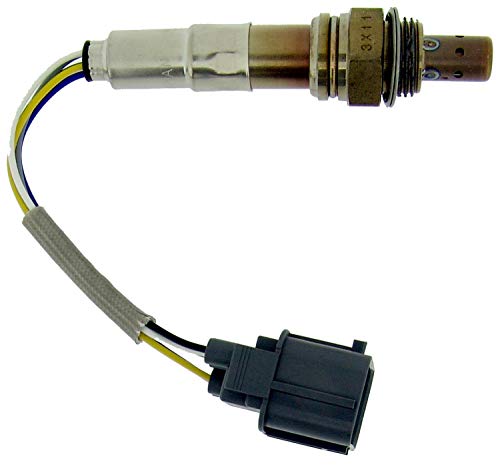
NTK 24301 Oxygen Sensor
NTK is NGK’s aftermarket line, and NGK is itself an original equipment sensor supplier. This direct fit unit uses the same zirconia ceramic element as factory parts, and response time follows the original spec rather than approximating it. It is the natural alternative when Denso does not list your application.
Pros
- Original equipment supplier engineering
- Direct fit connector with correct wire length
- Strong coverage where Denso does not list
Cons
- Part numbering is easy to confuse across similar units
- Packaging does not always list every application

Denso 234-9005 Air Fuel Ratio Sensor
Many modern engines run a wideband air fuel ratio sensor upstream instead of a conventional narrowband unit, and fitting the wrong type causes drivability problems even when it threads in fine. This is the correct family for those applications. Owners report cold start behavior improves noticeably once the right sensor type goes in.
Pros
- Correct sensor type for wideband systems
- Linear signal supports accurate fuel trim
- Direct fit with no wiring modification
Cons
- Not interchangeable with narrowband sensors
- Narrower application list than general sensors

Bosch 15717 Premium Oxygen Sensor
Bosch supplies original sensors across much of the European market, and its premium line uses the same platinum electrode and laser-welded housing as factory parts. The direct fit connector avoids splicing on applications where the harness sits somewhere hard to reach. Check whether a listing is the direct fit or universal version before ordering.
Pros
- Deep coverage of European applications
- Robust housing construction
- Original equipment level design
Cons
- Universal versions of similar numbers require splicing
- Application lists can be confusing between lines

Bosch 13478 Premium Oxygen Sensor
This direct fit sensor is commonly specified for the downstream position after the catalytic converter, where its job is monitoring converter efficiency rather than controlling fuel. Downstream sensors fail less often than upstream ones, but they still trigger codes with age. Based on specifications, the heater circuit design matches the original.
Pros
- Correct specification for post catalyst positions
- Direct fit connector
- Reliable heater circuit behaviour
Cons
- Wrong choice for upstream fuel control
- Coverage varies by model year

Walker Products 250-24435 Oxygen Sensor
This aftermarket sensor suits buyers who want to skip splicing without paying for an OE supplier brand. A sealed connector and pre-applied anti-seize on the threads speed up installation. Service life typically runs shorter than OE parts, so it suits an older vehicle better than one you plan to keep for a decade.
Pros
- Direct fit without splicing
- Anti seize already applied to the threads
- Wide listing coverage for older vehicles
Cons
- Typically shorter service life than OE brands
- Response time not always matched to original

Delphi ES20003 Oxygen Sensor
Delphi has a long history supplying sensors to domestic manufacturers, and this direct fit unit targets that range. Connector and lead length follow the original routing, which matters wherever a lead clips along a hot exhaust. Confirm upstream or downstream position before ordering.
Pros
- Correct lead length and routing
- Long history with domestic applications
- Shielded lead resists heat damage
Cons
- Narrower coverage outside domestic vehicles
- Position specific, easy to order the wrong one
Compared at a glance
| # | Model | Type | Best for | Score | Price |
|---|---|---|---|---|---|
| 1 | Denso 234-4209 Oxygen Sensor | Direct fit narrowband | Best overall | 9.4 | Check price |
| 2 | NTK 24301 Oxygen Sensor | Direct fit narrowband | Best value | 9.2 | Check price |
| 3 | Denso 234-9005 Air Fuel Ratio Sensor | Wideband air fuel ratio, upstream | Best for wideband applications | 9.0 | Check price |
| 4 | Bosch 15717 Premium Oxygen Sensor | Direct fit narrowband | Best for European vehicles | 8.8 | Check price |
| 5 | Bosch 13478 Premium Oxygen Sensor | Direct fit narrowband, downstream | Best for downstream monitoring | 8.6 | Check price |
| 6 | Walker Products 250-24435 Oxygen Sensor | Direct fit narrowband | Best budget direct fit | 8.3 | Check price |
| 7 | Delphi ES20003 Oxygen Sensor | Direct fit narrowband | Best for GM applications | 8.0 | Check price |
How to pick the right one
What to check before buying any oxygen sensor Vehicles carry at least two oxygen sensors, and often four. Upstream sensors sit before the catalytic converter and control fuel delivery. Downstream sensors sit after it and monitor converter efficiency, and the two are not interchangeable even when they thread into the same bung. Many modern engines use a wideband air fuel ratio sensor upstream, which behaves nothing like a narrowband unit. Read the fault code carefully, note the bank and sensor number, and match the part to that exact position.
Direct fit versus universal: which one to buy Universal sensors save money upfront and cost more later. Splicing four wires into a harness that sits near a hot exhaust creates joints exposed to heat, vibration, and moisture, and a joint with slightly elevated resistance produces intermittent codes that are miserable to trace. Buy the direct fit part whenever one exists for your application. Save universal sensors for vehicles where no direct fit listing is available at all.
Is the sensor really the problem, or something else? A P0420 catalyst efficiency code is frequently blamed on the sensor when the converter itself has failed. Lean or rich codes often trace back to a vacuum leak, a dirty mass airflow sensor, or a failing injector instead. Check live data before replacing anything. A healthy upstream sensor switches rapidly between rich and lean, while a downstream sensor should stay relatively steady. Slow switching points at the sensor; steady voltage everywhere else points elsewhere.
How to replace a seized sensor without breaking it Oxygen sensors thread into hot exhaust and often seize, especially on vehicles from areas that salt roads. Work on a warm engine rather than a hot one, soak the threads with penetrating oil first, and use a slotted oxygen sensor socket instead of an open-ended spanner. Apply anti-seize to the new sensor’s threads only, keeping it away from the sensing tip, and torque to spec instead of pulling as hard as possible.
Frequently asked questions
How do I know which oxygen sensor to replace?
The fault code identifies bank and sensor number. Bank one contains cylinder one, and sensor one sits upstream of the catalytic converter. Confirm your engine’s layout first, since misreading bank identification is a common reason for ordering the wrong part.
How long do oxygen sensors last?
Modern heated sensors commonly reach 60,000 to 100,000 miles. Oil burning, coolant leaks, or silicone sealant contamination can end one much sooner. Downstream sensors typically outlast upstream ones because they run in cleaner, cooler exhaust gas.
Can I still drive with a failing oxygen sensor?
Short term, usually yes, but fuel consumption rises and unburnt fuel can damage the catalytic converter, a far more expensive part to replace. Stop driving immediately if the check engine light flashes, since that signals active misfire rather than a slow sensor.
Are universal oxygen sensors worth buying?
Only when no direct fit part exists for your vehicle. The splice is the weak point, and a poorly crimped joint under the car causes intermittent faults that mimic a bad sensor. Use proper heat-shrink butt connectors and support the harness if you must splice.
Do I need to clear the code after replacing a sensor?
Yes, then drive through a full range of conditions so the monitors complete. Some codes clear on their own after several successful drive cycles, but clearing manually with a scan tool gives faster confirmation.
Should upstream and downstream sensors be replaced together?
Not automatically. They age at different rates, so only the failed sensor needs replacing. Doing both together can make sense on a high-mileage vehicle where you are already under the car and want to avoid repeating the job.
Can cleaning an oxygen sensor fix it?
Rarely, and it is not recommended. The ceramic element is fragile, and solvents contaminate it further. By the time symptoms appear, coolant or oil contamination has usually poisoned the sensing element beyond recovery.
Will a new sensor fix a P0420 code?
Sometimes, if the downstream sensor is genuinely slow. Often it will not, since P0420 most commonly points to a degraded catalytic converter. Check live data from both sensors first; similar switching patterns on a healthy pair point at the converter instead.
Denso versus NTK: which oxygen sensor brand is better?
Both are original equipment suppliers, so the better choice usually comes down to which one lists your exact application. Denso covers more Japanese and domestic platforms, while NTK often fills gaps where Denso has no listing.
What happens if I install a narrowband sensor where a wideband belongs?
It will not read fuel trim correctly even if it physically fits, since the two sensor types produce different signal outputs. Expect rough idle, poor fuel economy, or a stored code shortly after installation.
Our pick
Most repairs call for a direct fit sensor from an original equipment supplier, usually the Denso 234-4209 or the NTK 24301 depending on what is listed for your vehicle. Wideband applications need the correct air fuel ratio sensor, such as the Denso 234-9005, rather than a narrowband substitute. Whatever you buy, verify the part number against your exact engine and position, and diagnose the code before ordering.
Tony Russo
Tony trained as an automotive technician and spent years in service and parts retail before moving into writing. He focuses on garage tools, car care products and accessories from a hands-on maintenance perspective.


