Outdoor Lanterns That Last From Dusk to Sunrise
BioLite AlpenGlow 500 suits most buyers, pairing 500 lumens with colour tuning and USB C charging. Goal Zero Lighthouse 600 adds a hand crank plus a USB output for trips away from power. Coleman Northstar throws far more light than any LED here, burning propane instead.
BioLite AlpenGlow 500 is the lantern most campers and patio users should buy. Full output lights a picnic table, and the lowest setting stretches toward 60 hours on one charge. Warm amber modes keep insects calmer than cold white LEDs do. Its sealed battery cannot be swapped mid trip, which is where the Streamlight Siege AA and its three alkaline cells step in.
Lantern listings shout about peak lumens and whisper about runtime at that setting. We compared published output in each mode, cell capacity, IP ratings and the hanging hardware that decides where a lantern can go. Owner reports on cold weather performance and fuel availability shaped the ranking. Decorative garden lights with no stated output figure were skipped.
What to look for
What to look for in an outdoor lantern Start with where the light needs to land. Table lanterns want a frosted globe throwing 360 degrees, while a tarp mounted light should push most output downward. Weather ratings come next, and the gap between them is wide. IPX4 covers rain from any angle, IPX7 covers a drop into a creek. Hanging hardware is the detail buyers forget. One fabric loop ties you to a hook, whereas the Black Diamond Apollo offers legs and a double hook for either situation.
Lumens against runtime, the tradeoff that decides your night Peak lumens alone tell you almost nothing. BioLite AlpenGlow 500 gives about five hours at full output and roughly 60 hours on its lowest step. Most camp jobs sit between 100 and 200 lumens, with cooking wanting a little more. Running a large lantern at half power usually beats running a small one flat out, because the bigger cell holds voltage longer. Below freezing, lithium capacity drops noticeably, so shorten every runtime estimate you read.
Rechargeable, AA cells, propane or solar Rechargeable lanterns are easiest to keep topped up near a car or a wall outlet. Alkaline models like the Streamlight Siege AA win on storage, since cells keep for years and any fuel station sells more. Propane, as on the Coleman Northstar, produces output no LED matches, in exchange for an open flame and spare mantles. Solar fits multi day hikes where no charging exists, though the LuminAID PackLite Max needs genuine sun to fill up. Mixed kits are common, and sensible.
Best lanterns for patios, group campsites and power cuts Patios reward warm colour temperature and a long low setting, which is AlpenGlow territory. Group sites need the raw output of the Northstar, backed by a smaller lantern per tent for reading. Outages favour the Siege AA and the Lighthouse 600, one storing indefinitely and the other cranking light out of nothing. Paddlers should insist on IPX7, and the LuminAID has the extra benefit of floating if it goes over the side. Backpackers counting grams can skip everything heavier than that inflatable cube.
The top picks, ranked

BioLite AlpenGlow 500
Five hundred lumens covers a six person table, and a 6400 mAh cell drops to roughly 60 hours on low. Shake the body to cycle modes, including candle flicker and a slow colour wash. Warm settings pull fewer insects than a cold white panel. USB C means one cable for the lantern and the phone beside it.
Pros
- Twelvefold runtime span between modes
- Amber light keeps bugs at a distance
- Recharges from any USB C brick
Cons
- Sealed cell cannot be swapped on a trip
- Shake gesture takes a few tries to learn
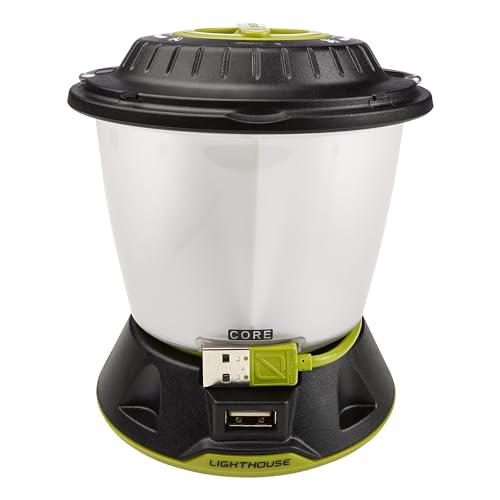
Goal Zero Lighthouse 600 Lantern
Two light panels run independently, so lighting one side doubles usable hours at a table edge. Its 5200 mAh cell also feeds a USB port for headlamps and phones. Fold out the crank when nothing is charged, or plug in a Goal Zero solar panel during the day.
Pros
- Single panel mode stretches the charge
- Doubles as a small power bank
- Crank produces light with no power source
Cons
- Cranking returns very little runtime per minute
- Heavier than most LED lanterns

Coleman Northstar Propane Lantern
Roughly 1500 lumens from a single mantle puts every LED here in shade. One 16.4 ounce propane cylinder feeds it for about seven hours on high, and InstaStart lights it without matches. Heat comes with the light, welcome in autumn and unwanted under a tent porch. Burn it outdoors only.
Pros
- Lights a group site from one post
- Adds warmth on cold evenings
- Cylinders stock almost every hardware store
Cons
- Open flame rules out enclosed spaces
- Mantles tear easily, so carry spares

Black Diamond Apollo Lantern
Collapsible tripod legs raise the globe above plates and stoves. Fold them away and a double hook appears for a tent ceiling or tarp ridgeline. Output tops out at 250 lumens, fine for cooking and poor for a clearing. Power comes from the rechargeable NRG2 pack or four AA cells, so a flat battery never ends the evening.
Pros
- Legs lift light above table clutter
- AA cells work as a backup supply
- Frosted globe spreads light evenly
Cons
- 250 lumens is modest for big groups
- Legs wobble on soft ground

Streamlight 44931 Siege AA Lantern
Three AA alkaline cells sit for years without a charger, which makes this the one to leave in a car or basement. Streamlight seals the housing to IPX7, one metre of submersion for 30 minutes. High gives 200 lumens, low gives 50, and a red mode preserves night vision. A D ring on the base hangs it upside down.
Pros
- Stores for years between uses
- Survives a drop into water
- Red mode protects dark adaptation
Cons
- No built in rechargeable option
- 200 lumens trails the bigger lanterns
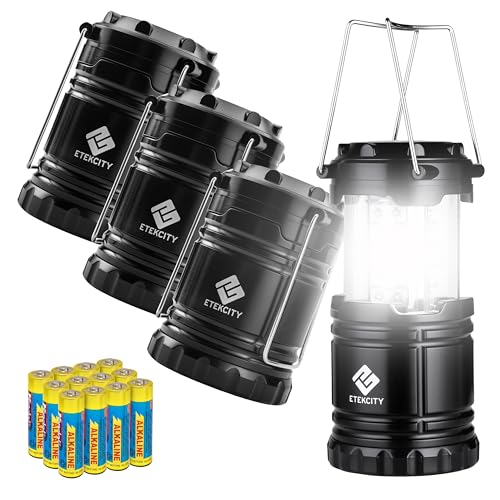
Etekcity Portable LED Camping Lantern
Pulling the body apart switches the light on, leaving no button to fail or bump in a pack. Three AA cells power each one, and multipacks put a lantern in every tent. Water resistant ABS handles dew and light rain. Light quality stays flat cool white with no dimming step.
Pros
- Nothing to switch off by accident
- Enough units for a whole group
- Collapses flat in a storage bin
Cons
- One brightness level only
- Cool white light reads harsh at a table

LuminAID PackLite Max 2-in-1 Phone Charger Lantern
Deflated it is barely thicker than a paperback, then it inflates into a diffused cube. Strap it to a pack lid and the solar panel refills it while you walk. Evening use adds a USB port for a phone top up. Peak output reaches 150 lumens, which is tent light rather than camp light. It floats too.
Pros
- Packs flat and weighs very little
- Refills with no power source nearby
- Floats and ignores rain
Cons
- Solar charging wants a full sunny day
- 150 lumens is too dim for a group table
How they compare
| # | Model | Brightness | Best for | Score | Price |
|---|---|---|---|---|---|
| 1 | BioLite AlpenGlow 500 | 500 lumens maximum | Best overall | 9.4 | Check price |
| 2 | Goal Zero Lighthouse 600 Lantern | 600 lumens maximum | Best for long trips off grid | 9.2 | Check price |
| 3 | Coleman Northstar Propane Lantern | 16.4 ounce propane cylinder | Best for lighting a whole campsite | 9.0 | Check price |
| 4 | Black Diamond Apollo Lantern | 250 lumens maximum | Best for hanging over a table | 8.8 | Check price |
| 5 | Streamlight 44931 Siege AA Lantern | 200 lumens high, 50 lumens low | Best for emergency kits | 8.6 | Check price |
| 6 | Etekcity Portable LED Camping Lantern | Collapsible body, light turns on when extended | Best budget | 8.3 | Check price |
| 7 | LuminAID PackLite Max 2-in-1 Phone Charger Lantern | 150 lumens maximum | Best for backpacking and solar charging | 8.0 | Check price |
Common questions
How many lumens does an outdoor lantern need?
About 200 lumens lights a four person table comfortably. Cooking and washing up want 300 or more. Reading in a tent works at 50 to 100 lumens, which also protects night vision.
Are rechargeable lanterns better than AA lanterns?
Rechargeables usually push more light and cost nothing to refill. Alkaline models win for emergency storage, because cells hold charge for years in a drawer. Many campers keep one of each.
Can outdoor lanterns be left out in the rain?
Check the IP rating before you decide. IPX4 handles rain from any direction. Streamlight Siege AA is rated IPX7 for submersion, and LuminAID PackLite Max floats, so both survive a real soaking.
Is a propane lantern safe inside a tent?
No. Coleman Northstar burns an open flame and produces carbon monoxide, so it stays outdoors. Use an LED lantern under any fabric, including an awning.
Which lantern is best for a power outage at home?
Streamlight Siege AA sits on a shelf for years and survives a drop. Goal Zero Lighthouse 600 adds a crank and a USB port for phones. Long outages justify keeping both.
BioLite AlpenGlow 500 vs Goal Zero Lighthouse 600: which for camping?
AlpenGlow gives warmer light and a longer low setting for table use. Lighthouse 600 wins when you also need to charge headlamps or crank power out of nothing. Weight favours the BioLite.
Do warm coloured lanterns attract fewer bugs?
Warm light sits further from the blue and ultraviolet wavelengths many insects track. Amber modes on the AlpenGlow stay noticeably calmer than cold white panels. No lantern repels insects completely.
How should you hang a lantern over a camp table?
Put it above head height so the globe leaves your eye line, then dim it. A tarp ridgeline gives the cleanest anchor. Black Diamond Apollo stands on its legs when nothing overhead exists.
How long does a solar lantern take to charge?
Budget a full sunny day for an inflatable panel like the LuminAID. Overcast skies stretch that well past one day. USB charging finishes in a few hours and is worth doing before you leave.
What is the best lantern for backpacking by weight?
LuminAID PackLite Max packs flat and adds almost nothing to a load. Black Diamond Apollo is heavier but brighter and takes AA cells. Anything with a 5000 mAh cell belongs in a car, not a pack.
Our take
BioLite AlpenGlow 500 is the buy for most back gardens and campsites, since its runtime span and warm modes cover far more evenings than one bright setting ever will. Cold weather group camps do better with the Coleman Northstar, which lights the whole site and adds heat. Backpackers counting grams should take the LuminAID PackLite Max instead. Keep a Streamlight Siege AA in the car either way, because alkaline cells outlast any rechargeable forgotten in a drawer.
Sierra Daniels
Sierra's background is in landscape design and nursery retail. She focuses on lawn and garden equipment, outdoor furniture and gear durability, weighing published specs against how materials actually hold up outside.