Choosing a Neutral Density Filter for Stills and Video
K&F Concept Nano-X Variable ND2 to ND32 fits hybrid shooters, covering 1 to 5 stops in a single ring. Hoya PROND1000 handles fixed 10 stop daylight exposures with dye bonded glass. B+W Master ND 3.0 MRC Nano pairs Schott glass with a brass frame for coastal work.
K&F Concept Nano-X Variable ND2 to ND32 is the first filter most hybrid shooters should own. One ring replaces a stack of fixed glass, and mechanical limits keep you out of the cross pattern zone. Its ceiling sits at 5 stops, short of what midday waterfall work asks for. Hoya PROND1000 fills exactly that gap.
ND filters fail in ways a spec sheet hides. Cheap variable designs throw a dark X across wide focal lengths, and thin coatings drag skin tones green. We compared published stop ranges, coating counts, frame materials and thread availability. Owner reports on color shift, corner vignetting and stiff rotation decided the order.
Before you buy
What to look for in an ND filter Density comes written three ways: as stops, as an ND number such as ND1000, or as an optical value like 3.0. Coating layers govern flare control and how fast rain beads off the front element. Frame thickness decides whether a 16mm lens sees dark corners. Check the thread size stamped on your lens cap before ordering anything.
Variable ND vs fixed ND Variable filters stack two polarizers and darken as one rotates against the other. Cross them too far and a dark X spreads over the frame, worst at wide focal lengths. Fixed NDs use a single density, avoid that pattern outright and usually shift color less. Shooters chasing changing light lean variable; landscape work leans fixed.
ND filters for long exposure landscapes Ten stops turns moving water to mist and thins a crowded plaza into blur. Frame and focus first, then mount the glass, since autofocus rarely locks through ND1000. Expect a faint cast from any 10 stop filter and shoot raw so white balance stays editable. A rigid tripod and a remote release matter more here than the brand on the ring.
Using ND filters for video and gimbal work Holding shutter at double the frame rate means dumping light outdoors, which is the job a variable ND does. Hard stops let you adjust by feel without pulling your eye off the monitor. Slim frames help on a gimbal where balance is already tight. Matte box users can skip threaded filters entirely and drop 4×5.65 glass into a tray.
The shortlist, ranked
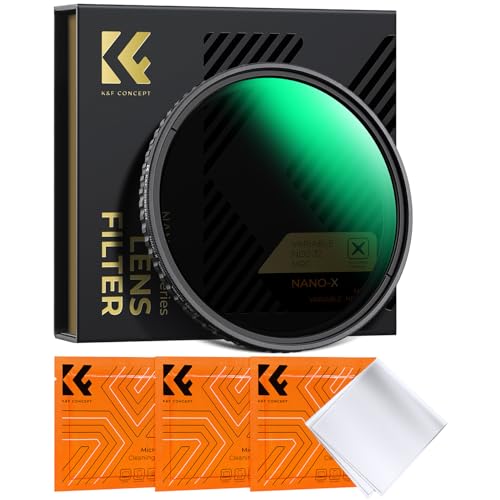
K&F Concept Nano-X Variable ND2-ND32 Filter
Rotation runs 1 to 5 stops with mechanical stops at each end, so the ring cannot twist into the cross pattern range. Japanese optical glass sits under a 28 layer nano coating that sheds water and fingerprints. Owners report a mild warm shift near maximum density, correctable in raw with one slider.
Pros
- Hard stops block the X pattern at both limits
- Slim frame clears the corners on a 24mm lens
- Front thread still accepts a cap or step ring
Cons
- Five stops is too little for midday long exposures
- Warm shift creeps in near full density

Hoya PROND1000 10-Stop ND Filter
Fixed 3.0 density buys roughly 10 stops, stretching a 1/60 second frame to about 15 seconds. ACCU-ND bonds the density inside the glass rather than onto the surface, which holds the cast closer to neutral than most budget 10 stops. Compose and focus before mounting, because live view goes almost black.
Pros
- Neutrality holds from center to corner
- Thin ring avoids clipped corners on wide zooms
- Threaded front takes a standard lens cap
Cons
- Autofocus and live view struggle once fitted
- One fixed density means packing a second filter

B+W Master ND 3.0 MRC Nano 110M Filter
German Schott glass sits inside a brass ring that resists cross threading and cold weather seizing. MRC Nano coating spans 16 layers and wipes clean of salt spray, which counts on a rocky shoreline. Density matches the Hoya at 10 stops, so the decision comes down to frame material and how rough your locations get.
Pros
- Brass ring unscrews cleanly after temperature swings
- Nano coating sheds sea spray with one wipe
- Residual color cast is the lowest in this group
Cons
- Heaviest ring of the seven
- Single density, like any fixed ND

Tiffen Variable Neutral Density Filter
Rotation spans roughly 2 to 8 stops, a wider swing than the K&F manages. ColorCore glass is laminated between polished optical flats at the Tiffen plant in New York. Past six stops on a wide lens the cross pattern appears, so treat the upper third as telephoto territory.
Pros
- Widest stop swing of any filter here
- Damped rotation with markings you can actually read
- Thread sizes run from 52mm up to 82mm
Cons
- Cross pattern shows past six stops on wide lenses
- No hard stops to fence off the unusable range

PolarPro Peter McKinnon Variable ND Edition II 6/9
Shutter angle discipline drives this design. Density swings between 6 and 9 stops inside DeadStop limits, letting you rotate blind while recording. Cinema Series glass keeps skin tones steady through the whole range. Stills shooters wanting light density should look at the NiSi instead, since 6 stops is the floor here.
Pros
- Hard stops allow blind adjustment mid take
- Color stays consistent from 6 through 9 stops
- Ships in a rigid protective case
Cons
- Six stop minimum is too dark for overcast stills
- Thicker ring than the slim photo filters here

Urth ND1000 Plus+ Lens Filter
Japanese AGC glass carries a 20 layer nano coating on both faces. Magnalium keeps the frame well under the weight of brass, which helps when a gimbal is already balanced. Density matches the Hoya and B+W at 10 stops, making this the lighter route into daylight long exposures.
Pros
- Light frame suits travel kits and gimbals
- Ultra slim profile clears the corners at 16mm
- Arrives in a recycled hard case
Cons
- Faint cool cast next to Schott glass
- Soft alloy threads need careful mounting

NiSi True Color ND-Vario 1 to 5 Stops
True Color coating holds white balance across the full rotation, which saves grading time when clips cut together. Range matches the K&F at 1 to 5 stops. Dual rings separate density from the front element, so a cap or matte box adapter stays put while you adjust.
Pros
- White balance holds through the entire range
- Non rotating front thread keeps caps seated
- Stop markings stay readable in dim light
Cons
- Only three thread sizes offered
- Two ring design takes up more pouch space
Side by side
| # | Model | Density range | Best for | Score | Price |
|---|---|---|---|---|---|
| 1 | K&F Concept Nano-X Variable ND2-ND32 Filter | ND2 to ND32, 1 to 5 stops | Best overall | 9.4 | Check price |
| 2 | Hoya PROND1000 10-Stop ND Filter | ND1000, 3.0, 10 stops | Best for daytime long exposure | 9.2 | Check price |
| 3 | B+W Master ND 3.0 MRC Nano 110M Filter | 3.0, 10 stops | Best premium build | 9.0 | Check price |
| 4 | Tiffen Variable Neutral Density Filter | ND2 to ND400, about 2 to 8 stops | Best budget variable | 8.7 | Check price |
| 5 | PolarPro Peter McKinnon Variable ND Edition II 6/9 | 6 to 9 stops | Best for video | 8.5 | Check price |
| 6 | Urth ND1000 Plus+ Lens Filter | ND1000, 3.0, 10 stops | Best value fixed ND | 8.3 | Check price |
| 7 | NiSi True Color ND-Vario 1 to 5 Stops | 1 to 5 stops | Best for color critical work | 8.0 | Check price |
Frequently asked questions
What does a neutral density filter actually do?
It cuts the light reaching the sensor without shifting color. That buys slow shutter speeds in daylight, or a wide aperture outdoors at base ISO.
Which ND strength is best for video?
Outdoor shooting usually sits between 3 and 6 stops at 1/50 second. A variable covering 1 to 5 stops handles shade through bright sun without swapping glass.
Can you stack ND filters?
Yes, and densities add, so two 3 stop filters give 6. Stacked rings push the front element forward, which can vignette on a wide lens.
Why does a variable ND show a dark X?
Crossed polarizers block light unevenly across a wide field once rotation passes a point. Hard stop designs such as the K&F Nano-X fence that range off mechanically.
Is a 10 stop ND filter worth buying?
Yes, if you want multi second daylight exposures of water, cloud or crowds. For video and general daylight use, a variable filter earns far more screen time.
Do ND filters reduce sharpness?
Quality glass such as Schott or AGC shows no visible softening. Cheap resin squares and stacked step rings are what usually blur the edges.
What size ND filter should I buy?
Buy for your largest lens thread, then let step up rings cover the smaller ones. Many kits settle on 82mm for exactly that reason.
ND1000 vs variable ND for landscapes?
ND1000 wins for still water and streaked cloud, because no polarizer artifacts appear. Variable filters earn their place when light shifts fast between frames.
How do you focus with a 10 stop filter on?
Autofocus in daylight, flick the lens to manual, then thread the filter on without touching the focus ring. Some mirrorless bodies still focus through ND1000 in bright sun, slowly.
What is the difference between an ND filter and a polarizer?
An ND cuts all wavelengths evenly to slow the shutter. A polarizer kills reflections and deepens sky at one angle, costing roughly 1 to 2 stops as a side effect.
Final word
K&F Concept Nano-X Variable ND2 to ND32 is the filter to buy first, since one ring covers shade through bright sun with hard stops guarding the range that ruins frames. Landscape shooters chasing multi second daylight exposures should skip it for the Hoya PROND1000 and its dye bonded density. Gimbal video work justifies the PolarPro Edition II, which can be rotated blind mid take.
Marcus Chen
Marcus covered consumer electronics for enthusiast tech publications for six years before joining ChoiceCrest. He specializes in translating manufacturer spec sheets into plain-language buying advice, with a focus on audio, computing accessories and smart-home gear.

