Finding a Neck Pillow That Helps You Sleep on Planes
Cabeau’s Evolution S3 leads with raised side walls and a flattened back that sits properly against a headrest. Side sleepers get more support from the Trtl Pillow Plus and its internal brace. The BCOZZY Neck Pillow gives the most chin support without spending much.
Cabeau’s Evolution S3 leads this comparison because its tall side walls and flattened back stop the head rolling forward without pushing the neck away from the headrest. Side sleepers get a better result from the Trtl Pillow Plus and its rigid internal brace. Budget conscious travellers still get real chin support from the BCOZZY Neck Pillow.
Neck pillows fail in predictable ways. The classic U shape pushes the head forward, memory foam turns rigid in a cold cabin, and anything bulky ends up strapped to the outside of a bag. What actually matters is whether a pillow blocks lateral head movement, how it interacts with a seat back, and how small it packs. We compared fill materials, dimensions, packed volume, closure designs and cover construction, then weighed that against what owners report after long haul flights and overnight bus rides.
What matters most
Why the flat back design matters more than the shape Traditional U shaped pillows put a thick foam section directly behind the neck, pushing the head forward and away from a seat headrest. Sitting slightly hunched follows, and the head still tips. A flattened or thinned rear panel lets a traveller rest against the seat properly. Anyone who has tried a neck pillow before and felt pushed forward has run into exactly this problem.
Ring, wrap or brace: matching support to how you sleep Ring pillows surround the neck and suit people who doze upright. Wrap designs like the Trtl brace the head at an angle, suiting natural side sleepers. Overlapping arm designs stop the chin from dropping without adding rigidity. No single geometry wins outright, only the one that matches how a head actually falls during sleep, so settle that question before comparing materials.
Packed size and how it travels with you A pillow clipped to the outside of a bag collects dirt and snags on doorways. Memory foam models usually include a compression sack that roughly halves their volume. Inflatable and shapeable designs pack smallest, giving up some support for size. Travellers carrying only a personal item may reasonably rank packed size above comfort.
Fabric, heat and how to keep it clean Fleece and plush covers feel pleasant but trap heat, which matters on a long flight in a warm cabin. Knit and mesh backed covers breathe better through the night. Removable washable covers are the minimum standard, and a fully washable pillow goes further still, since these pillows collect hair product, sunscreen and airport dust faster than almost anything else a traveller owns.
Our top picks

Cabeau Evolution S3 Travel Pillow
A flattened rear panel fixes the biggest flaw in traditional U pillows: the bulge that pushes the head away from a headrest. Raised side walls catch the head before it tips sideways. Memory foam holds its shape through a long flight, and the cover unzips for washing between trips.
Pros
- Flat back keeps the head against a seat headrest
- Tall side walls limit lateral head roll
- Removable cover washes between trips
Cons
- Bulkier than inflatable pillows even compressed
- Memory foam feels firm in a cold cabin

Trtl Pillow Plus
A fleece scarf wraps around an internal support that props the head at an angle, rather than circling the neck like a ring. That geometry suits anyone who naturally leans to one side when dozing. It packs flatter than foam pillows, and the Plus version adjusts in height to match different shoulder widths.
Pros
- Genuinely supports a leaning head position
- Packs flatter than foam ring pillows
- Height adjustment fits different shoulder widths
Cons
- Fleece wrap runs warm on a hot flight
- Takes practice to position correctly

BCOZZY Neck Pillow
Long overlapping arms tuck across the front of the neck, stopping the chin from dropping without any rigid frame. Soft rather than structured, it suits travellers who find memory foam too firm. The whole pillow machine washes, which matters more than expected on repeat trips.
Pros
- Overlapping ends give real chin support
- Soft build suits travellers who dislike foam
- Entire pillow is machine washable, not just the cover
Cons
- Bulky to pack without a compression bag
- Less structured than foam pillows

Ostrichpillow Go
Dense viscoelastic foam and a soft outer shell feel noticeably nicer than a typical travel pillow. A 360 degree design spreads support evenly around the neck, suiting anyone who shifts position often. Comfort drives this design more than packed size.
Pros
- Noticeably higher quality materials than rivals
- Even support regardless of head position
- Included carry case keeps it tidy in luggage
Cons
- Costs more than most travel accessories
- Does not compress as small as inflatables
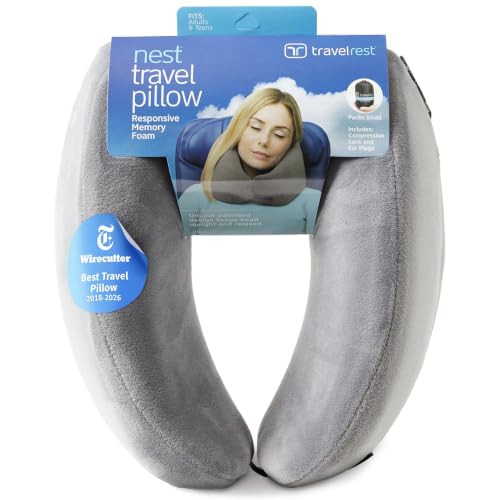
Travelrest Nest Ultimate Memory Foam Travel Pillow
A hook and loop closure lets a traveller set collar tightness precisely, which helps longer necks and broader shoulders. Firmer foam resists collapsing forward better than softer designs. An included stuff sack compresses it down for luggage.
Pros
- Adjustable collar fits a wide range of necks
- Supportive foam holds its position
- Compresses well into the included sack
Cons
- Closure strap can press if over tightened
- Less side wall height than the Cabeau
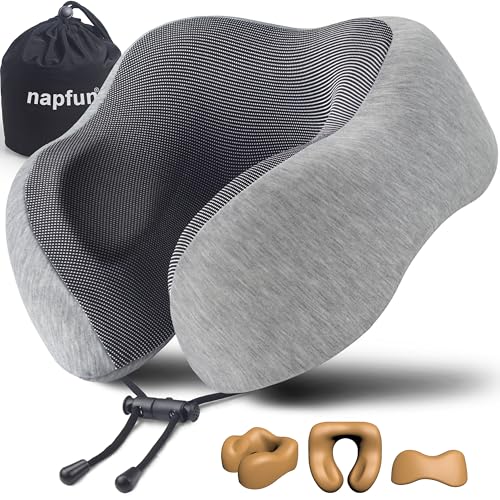
MLVOC Travel Pillow
A memory foam pillow bundles with an eye mask, earplugs and a carry bag, covering an entire sleep kit in one purchase. The pillow itself is a competent U shape with a slightly raised back. Owners report the accessories are decent rather than premium, though the bundle value stands out.
Pros
- Complete sleep kit in a single box
- Solid memory foam core does the main job well
- Strong value for occasional travellers
Cons
- Accessories are basic in quality
- Back sits thicker than dedicated flat back designs
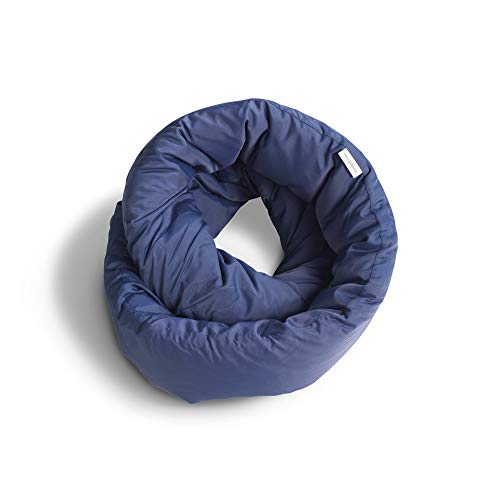
Huzi Infinity Pillow
A soft continuous loop twists into a neck support, an eye cover or a lumbar roll, depending on what a trip needs. That flexibility suits travellers who dislike being locked into one shape. Support stays softer than structured pillows, trading rigidity for comfort.
Pros
- Adapts to several positions and uses
- Very soft and quiet against skin
- Packs down easily into a bag
Cons
- Least structural support in this group
- Needs reshaping after moving around
The lineup, side by side
| # | Model | Fill | Best for | Score | Price |
|---|---|---|---|---|---|
| 1 | Cabeau Evolution S3 Travel Pillow | Memory foam | Best overall | 9.4 | Check price |
| 2 | Trtl Pillow Plus | Wrap scarf with internal support | Best for side sleepers | 9.2 | Check price |
| 3 | BCOZZY Neck Pillow | Overlapping adjustable arms | Best value | 9.0 | Check price |
| 4 | Ostrichpillow Go | Viscoelastic memory foam | Best for comfort | 8.8 | Check price |
| 5 | Travelrest Nest Ultimate Memory Foam Travel Pillow | Memory foam | Best for tall travellers | 8.6 | Check price |
| 6 | MLVOC Travel Pillow | Memory foam | Best travel kit | 8.3 | Check price |
| 7 | Huzi Infinity Pillow | Continuous loop, shapeable | Best for flexibility | 8.0 | Check price |
Good to know
Do travel neck pillows actually work?
They work when the geometry matches how the head falls during sleep. A pillow that only fills the gap behind the neck does little against lateral tipping. Raised side walls, overlapping arms or an internal brace prevent the head movement that wakes a sleeper, which is the real problem to solve.
Memory foam or inflatable neck pillow: which is better?
Memory foam gives consistent support with no setup, though it takes more space even compressed. Inflatable pillows pack tiny and let a traveller tune firmness, but some find them slippery against the skin. Foam suits long haul flights better, inflatables suit carry on only trips.
Can I use a travel pillow in the car?
Yes, and passengers on long drives use them often. Avoid a thick pillow while actually driving, since it can restrict how far the head turns. Flat back designs work particularly well against car headrests, which typically sit further forward than aircraft seats.
How do I attach a neck pillow to my bag?
Most include a clip, loop or compression sack with a strap. Attaching it to the outside is convenient but exposes the pillow to dirt. A compressed foam pillow stored inside a bag stays cleaner and is less likely to get pulled off in a crowded terminal.
Are neck pillows good for side sleepers?
Wrap style pillows with an internal brace work best for side sleepers, since they hold the head at an angle instead of upright. Standard ring pillows offer some lateral support through their side walls, but rarely enough on their own for someone who leans.
How do you clean a travel pillow?
Check first whether the cover removes on its own. Most memory foam models have zip off covers that machine wash cold. A few plush pillows wash whole. Memory foam inserts should never go in a washing machine, since they tear and take days to dry.
Will a neck pillow help with neck pain after flying?
Owners commonly report less stiffness after flights, since the pillow limits the repeated head drop that strains the neck. It remains a comfort accessory rather than a medical device, so anyone with an existing neck condition should follow a clinician’s advice instead.
What size neck pillow should I buy?
Fit depends more on neck circumference and shoulder width than height. Adjustable closures and height adjustable braces suit people at either end of that range. Children’s sizes exist and are worth choosing for younger travellers, since an adult pillow pushes a small head too far forward.
Best neck pillow for long haul flights vs short hops?
Long haul flights reward more structured support, like the Cabeau’s flat back and tall walls or the Trtl’s internal brace, since hours of sleep are at stake. Short hops favor something that packs small and sets up fast, which points toward a lighter, less structured option like the Huzi Infinity.
Do neck pillows come in adult and child sizes?
Several do, including the BCOZZY line, which offers both. A child fitted with an adult sized pillow ends up pushed too far forward, since the geometry assumes a larger neck and shoulder width. Check sizing before buying for a younger traveller.
Our take
Cabeau’s Evolution S3 remains the pillow worth packing for most flights, since its flat back and tall side walls fix the two failures that make ordinary neck pillows useless. Side sleepers get more from the Trtl Pillow Plus and its angled brace. Travellers chasing the most support for the least outlay will find the BCOZZY Neck Pillow hard to beat.
Sierra Daniels
Sierra's background is in landscape design and nursery retail. She focuses on lawn and garden equipment, outdoor furniture and gear durability, weighing published specs against how materials actually hold up outside.