Choosing a Digital Multimeter for Home and Jobsite Work
The Fluke 117 is the best overall multimeter for most users, pairing True RMS accuracy with non-contact voltage detection that professional electricians trust. Budget buyers do well with the INNOVA 3340, while anyone focused on automotive diagnostics should consider the AstroAI WH5000A instead.
The Fluke 117 covers the widest range of electrical work well, combining True RMS accuracy with a CAT III 600V safety rating that satisfies most residential and light commercial jobs. Its non-contact voltage detector speeds up troubleshooting, though its price sits above casual hobbyist budgets. Anyone doing occasional car or appliance checks will get more value from the AstroAI WH5000A instead.
Multimeters differ most in accuracy class, input protection, and whether they auto range or require manual range selection, which matters because a wrong range can blow a fuse or give a false reading. We compared published accuracy specs, safety certifications, and owner feedback on durability to match each meter to the work it actually suits.
Our top picks

Fluke 117 Electrician’s True RMS Multimeter
Fluke built this meter specifically for electricians who need fast, trustworthy readings on live circuits. True RMS measurement keeps accuracy intact even on the distorted waveforms common near variable speed drives and dimmers. A built in non-contact voltage detector flags live wires before you even touch a probe to them.
Pros
- Non-contact voltage detection speeds up safety checks
- CAT III 600V rating covers most residential panels
- Auto ranging removes guesswork on unfamiliar circuits
Cons
- Costs more than most hobbyist meters
- No Bluetooth or smartphone logging
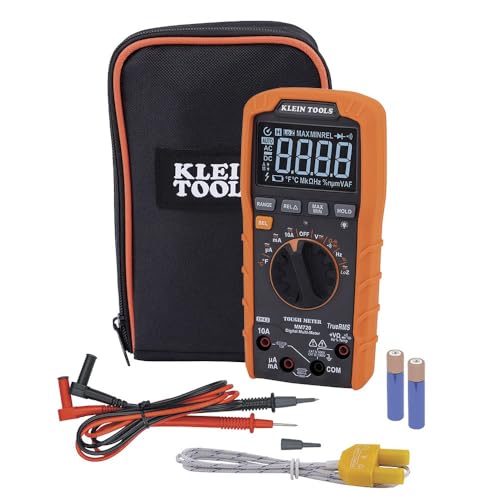
Klein Tools MM700 Digital Multimeter
Klein built this meter with HVAC and electrical technicians in mind, adding temperature and capacitance measurement most basic meters skip. A low input impedance mode helps rule out ghost voltage on circuits with capacitive coupling. The rugged rubber overmold survives the drops that happen on an active jobsite.
Pros
- Temperature probe support helps HVAC diagnostics
- Low impedance mode filters out false ghost voltage
- CAT IV rating covers service entrance work
Cons
- Bulkier than pocket-style meters
- Learning the extra modes takes some practice
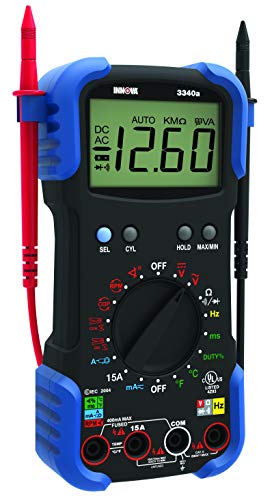
INNOVA 3340 Digital Multimeter
This meter targets drivers and homeowners who need basic checks without professional grade features. Auto ranging covers common AC and DC voltage tasks without manually dialing a range first. A built in audible continuity tester makes tracing a blown fuse or broken wire quick.
Pros
- Low cost compared to professional meter brands
- Auto ranging simplifies basic voltage checks
- Built in battery test settings add convenience
Cons
- Not True RMS, less accurate on distorted signals
- Safety rating falls short of CAT III jobs

AstroAI WH5000A Digital Multimeter
AstroAI aimed this meter at car owners checking batteries, fuses, and basic wiring rather than licensed electrical work. A dedicated diode test and continuity buzzer cover the checks most DIY automotive troubleshooting needs. A backlit display helps readings stay visible under a dim hood or dashboard panel.
Pros
- Backlit screen helps in low light under a hood
- Simple layout suits first time meter owners
- Diode test covers common automotive checks
Cons
- Not rated for higher voltage commercial panels
- Probes feel less durable than premium brands

Fluke 115 Compact True RMS Digital Multimeter
Fluke trimmed this model down for technicians who want pro grade accuracy in a smaller, pocket friendly body. True RMS measurement still holds up on variable frequency drive circuits despite the compact size. A min, max, average recording mode captures brief voltage spikes a quick glance would miss.
Pros
- Pro grade accuracy in a smaller form factor
- Min/max/average mode catches brief voltage dips
- Still carries a CAT III 600V safety rating
Cons
- Smaller buttons are harder to use with gloves
- Fewer extra functions than the full-size MM700

Klein Tools MM400 Auto-Ranging Digital Multimeter
This meter balances a lower price against features usually reserved for pricier models, including a True RMS reading and a CAT III 600V rating. Auto ranging switches between voltage ranges automatically, cutting down setup time on repeat checks. A sturdy rubber holster adds drop protection without inflating the cost much.
Pros
- True RMS accuracy at a mid-range price point
- CAT III rating suits most home electrical panels
- Protective holster reduces drop damage risk
Cons
- No non-contact voltage detection like the Fluke 117
- Display refresh feels slower on fast changing signals

Extech EX330 Autoranging Mini MultiMeter
Extech shrank this meter down for anyone who just needs a fast voltage or continuity check without carrying a full toolbox. A built in non-contact voltage detector on the tip flags live wires before probing. The compact body clips onto a belt or fits in a small bag easily.
Pros
- Small size makes it easy to carry everywhere
- Non-contact tip adds a quick safety check
- Simple one-dial operation suits fast jobs
Cons
- Smaller display is harder to read at a glance
- Fewer advanced functions than full-size meters
Before you buy
What to look for in a multimeter True RMS measurement matters most if you work near dimmers, variable speed drives, or anything with a distorted waveform, since average responding meters misread those signals. Safety rating, listed as a CAT class and voltage number, tells you which panels and circuits a meter can safely handle. Auto ranging saves time by picking the right voltage range automatically instead of making you guess. Extra functions like temperature or capacitance only matter if your work actually calls for them.
Best multimeters for electricians and HVAC technicians Professionals need a CAT III or CAT IV safety rating before working inside a breaker panel or service entrance, which rules out most budget meters. The Fluke 117 and Klein MM700 both add non-contact voltage detection, a feature that flags a live wire before a probe ever touches it. HVAC work benefits specifically from the MM700’s temperature probe support, since diagnosing a bad sensor often starts there.
Multimeters for car owners and home DIY Automotive checks rarely need a CAT III rating, since battery and fuse testing happens at low voltage away from a breaker panel. The AstroAI WH5000A and INNOVA 3340 both skip pricier safety certifications in favor of a lower cost, which fits occasional home use. A diode test setting, present on the AstroAI model, is specifically useful for checking alternator diodes and LED circuits.
When a compact meter makes more sense than a full-size one Carrying a full toolbox is not always practical, especially for a quick belt check or a single troubleshooting call. The Extech EX330 and Fluke 115 both trade some bulk for pocketability without dropping core accuracy. A smaller meter does mean a smaller display, so expect to squint slightly more on detailed readings.
Compared at a glance
| # | Model | Measurement Type | Best for | Score | Price |
|---|---|---|---|---|---|
| 1 | Fluke 117 Electrician’s True RMS Multimeter | True RMS | Best Overall | 9.5 | Check price |
| 2 | Klein Tools MM700 Digital Multimeter | Temperature and capacitance | Best for HVAC and Electrical Pros | 9.2 | Check price |
| 3 | INNOVA 3340 Digital Multimeter | Average responding, not True RMS | Best Budget | 8.3 | Check price |
| 4 | AstroAI WH5000A Digital Multimeter | Automotive and basic household | Best for Automotive and Beginners | 8.5 | Check price |
| 5 | Fluke 115 Compact True RMS Digital Multimeter | True RMS | Best Compact and Portable | 9.0 | Check price |
| 6 | Klein Tools MM400 Auto-Ranging Digital Multimeter | True RMS | Best Value | 8.8 | Check price |
| 7 | Extech EX330 Autoranging Mini MultiMeter | Mini, belt-clippable body | Best for Quick Checks | 8.4 | Check price |
Good to know
What does True RMS mean on a multimeter?
True RMS measures the actual effective value of an AC signal, including distorted waveforms from dimmers or variable speed drives, while cheaper average responding meters can misread those same signals.
Do I need a CAT III rated multimeter for home use?
Yes, if you plan to test inside a breaker panel or service entrance, a CAT III 600V rating like the Fluke 117 or Klein MM400 carry gives a real safety margin.
Is auto ranging better than manual ranging?
Auto ranging is faster and safer for most users since the meter selects the correct voltage range automatically, though some professionals prefer manual ranging for very specific repeat tests.
Can a basic multimeter test a car battery?
Yes, a basic meter like the AstroAI WH5000A handles battery voltage, continuity, and diode checks that cover most automotive troubleshooting without needing a CAT III rating.
What is non-contact voltage detection on a multimeter?
It is a built in sensor, found on the Fluke 117 and Extech EX330, that flags a live wire through its insulation before a probe ever makes contact.
How accurate do budget multimeters stay compared to Fluke?
Budget meters like the INNOVA 3340 handle basic voltage and continuity checks fine, but they typically skip True RMS measurement, which affects accuracy on distorted AC signals.
What does CAT IV mean on a multimeter rating?
CAT IV covers the highest risk category, including utility service entrances and outdoor overhead lines, a rating the Klein MM700 carries alongside CAT III.
Do multimeters need a specific battery?
Most handheld multimeters, including several models here, run on a standard 9V battery, though some compact models use AA or AAA cells instead.
Can a multimeter measure temperature?
Only models with a dedicated temperature function, like the Klein MM700, measure temperature directly using a compatible thermocouple probe.
Is a compact multimeter accurate enough for professional work?
The Fluke 115 keeps True RMS accuracy and a CAT III rating despite its smaller size, making it suitable for professional spot checks.
Our pick
The Fluke 117 remains the strongest overall pick for anyone doing regular electrical troubleshooting, combining True RMS accuracy with a safety rating that covers real jobsite work. Car owners and casual DIYers get better value from the AstroAI WH5000A, since they rarely need CAT III protection. Technicians who specifically work HVAC systems should look at the Klein MM700 instead, for its temperature probe support.
Jake Monroe
Jake worked as a residential contractor for over a decade before shifting to full-time writing. He evaluates power tools, hand tools and workshop gear through the lens of someone who has actually used them on job sites, not just read the box.


