Tail Bags Sized for Weekend Rides and Daily Commutes
Nelson-Rigg’s CL-1060-S ranks first for an expandable shell that grows for weekend trips without adding bulk on short rides. Kriega’s US-20 Drypack suits riders who want a fully waterproof roll-top seal. Viking Bags’ tail bag fits anyone who wants solid capacity without premium-brand pricing.
Nelson-Rigg’s CL-1060-S Sport Tail Bag leads this comparison because its expandable side panels let the bag grow from a compact daily size to a larger weekend-trip capacity without buying a second bag. A quick-release strap system mounts to the passenger seat or luggage rack without tools. The rigid base keeps the bag from sagging onto the taillight, though the expandable sides are not fully waterproof when unzipped to their largest setting.
Tail bag shopping gets tricky because capacity numbers alone do not capture how a bag mounts or how it holds its shape at highway speed, a bag that looks roomy on a shelf can list sideways if its strap system is not built for sustained wind pressure. We compared mounting hardware, expansion method, and owner reports on stability during longer highway stretches.
How to pick the right one
What separates a tail bag from a tank bag or saddlebag A tail bag mounts behind the rider on the passenger seat or a rear rack, keeping weight low and centered rather than on the fuel tank or hanging off the sides. Nelson-Rigg’s CL-1060-S and similar designs take advantage of that rear mounting position to offer larger capacity than most tank bags.
Expandable capacity versus a fixed, simpler shape A bag that expands, like Nelson-Rigg’s or Cortech’s, adapts from daily commuting size to weekend-trip capacity without buying a second bag. A fixed-size bag like Kriega’s US-20 trades that flexibility for a simpler, more weatherproof seal.
Waterproofing approaches differ more than they first appear A roll-top seal, as Kriega and Biltwell both use, keeps water out without extra parts, while bags like Nelson-Rigg’s and Cortech’s rely on a separate included rain cover for the same protection during expanded use.
Matching the bag to street touring versus off-road riding Street and highway touring favor a structured bag like Chase Harper’s TailTrunk or an expandable design like Nelson-Rigg’s. Off-road and dual-sport riders need the abrasion resistance Biltwell’s EXFIL-80 builds in for rough terrain and ADV rack mounting.
The best picks, ranked

Nelson-Rigg CL-1060-S Sport Tail Bag
Nelson-Rigg builds expandable side panels into this bag that unzip to add capacity for a weekend trip, then zip back down for a smaller daily commuting profile. A reflective trim panel improves visibility in low light. The included rain cover handles unexpected weather without needing a separate purchase.
Pros
- Expandable panels adjust capacity for trip length
- Quick-release straps mount without tools
- Included rain cover adds weather backup
Cons
- Expanded setting is not fully waterproof without the rain cover
- Rigid base adds some bulk versus soft-sided bags

Kriega US-20 Drypack
Kriega seals this bag with a roll-top closure that keeps contents dry through sustained rain without relying on a separate rain cover. The minimalist strap system mounts directly to the seat or rack without a rigid internal frame. Its tapered shape sits low and close to the bike, reducing wind drag at highway speed.
Pros
- Roll-top seal keeps contents dry without a rain cover
- Low, tapered shape reduces wind drag at speed
- Strap mounting works without a dedicated rack
Cons
- Fixed capacity cannot expand for larger loads
- No rigid structure, so shape depends on how it is packed

Dowco Fastrax Backpack Tail Bag
Dowco adds backpack straps to this bag that tuck away during mounted use but pull out for carrying it off the bike into a store or office. The convertible design suits commuters who need the bag both on and off the motorcycle during a single trip. A padded base protects the contents from vibration while mounted.
Pros
- Stowable backpack straps allow off-bike carrying
- Padded base reduces vibration transfer to contents
- Suits commuters needing the bag on and off the bike
Cons
- Less expandable capacity than dedicated touring bags
- Backpack straps add weight when not in use

Biltwell EXFIL-80
Biltwell reinforces this bag’s base and side panels for off-road and dual-sport use, where a soft touring bag might abrade against luggage racks over rough terrain. A roll-top closure adds water resistance without a separate rain cover. The straps route around common ADV luggage rack shapes rather than passenger seats alone.
Pros
- Reinforced panels resist abrasion on rough terrain
- Roll-top closure adds water resistance
- Strap routing fits common ADV rack shapes
Cons
- Smaller capacity than expandable touring bags
- Fixed size does not grow for longer trips

Cortech Super 2.0 Tail Bag
Cortech expands this bag’s main compartment further than most competitors, giving it one of the larger maximum capacities in this category for longer trips. A removable rain cover ships with the bag for unexpected weather. The strap system includes buckle-adjustable mounting points that fit a range of seat and rack shapes.
Pros
- Larger maximum expanded capacity than most competitors
- Buckle-adjustable straps fit a range of mounting shapes
- Included rain cover handles unexpected weather
Cons
- Bulkier at full expansion than non-expandable bags
- Heavier empty weight than minimalist waterproof bags
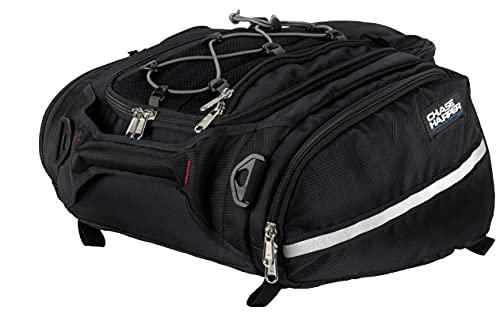
Chase Harper 1200 TailTrunk
Chase Harper builds a rigid internal frame into this bag that holds its boxy shape whether full or nearly empty, unlike soft-sided bags that sag when lightly packed. The rigid structure also protects contents like a helmet or tools from crushing under straps. A wide top opening simplifies loading bulkier items.
Pros
- Rigid frame holds shape regardless of how full the bag is
- Protects bulkier contents like a helmet from crushing
- Wide top opening simplifies loading
Cons
- Heavier than soft-sided bags of similar capacity
- Rigid shape takes up fixed storage space when empty

Viking Bags Tail Bag
Viking Bags prices this tail bag below most of the touring brands on this list while still including a basic expandable panel and mounting straps. It suits riders who want solid daily capacity without paying premium-brand pricing. The simpler strap system takes a bit more adjustment to seat securely than quick-release designs.
Pros
- Lower cost than premium touring-brand tail bags
- Expandable panel adds useful extra capacity
- Rain cover included at this price point
Cons
- Strap system needs more adjustment than quick-release designs
- Less reinforced construction than rugged ADV-focused bags
How they stack up
| # | Model | Capacity | Best for | Score | Price |
|---|---|---|---|---|---|
| 1 | Nelson-Rigg CL-1060-S Sport Tail Bag | 12 to 22 liters, expandable | Best Overall | 9.2 | Check price |
| 2 | Kriega US-20 Drypack | 20 liters, fixed | Best Waterproof and Minimalist | 9.0 | Check price |
| 3 | Dowco Fastrax Backpack Tail Bag | 15 liters | Best Convertible Backpack | 8.7 | Check price |
| 4 | Biltwell EXFIL-80 | 80 cubic inches, fixed | Best Rugged and Off-Road | 8.4 | Check price |
| 5 | Cortech Super 2.0 Tail Bag | 13 to 24 liters, expandable | Best Expandable Capacity | 8.2 | Check price |
| 6 | Chase Harper 1200 TailTrunk | 18 liters | Best Rigid Structure | 7.9 | Check price |
| 7 | Viking Bags Tail Bag | 14 to 20 liters, expandable | Best Budget | 7.7 | Check price |
Good to know
How much weight can a motorcycle tail bag safely carry?
Most tail bags are rated for a modest load in the range of a few kilograms, with capacity numbers reflecting volume rather than a strict weight limit, so overloading can still stress the mounting straps.
Can a tail bag be used as a backpack off the bike?
Only convertible designs like Dowco’s Fastrax include stowable backpack straps for that purpose, standard tail bags are built for mounted use only.
Are tail bags waterproof in heavy rain?
It depends on the design, roll-top sealed bags like Kriega’s US-20 handle sustained rain directly, while bags relying on a separate rain cover need that cover attached before the rain starts.
Do expandable tail bags lose stability when fully expanded?
Some do shift slightly at highway speed when expanded to maximum capacity, which is why checking strap tension after expanding a bag like Nelson-Rigg’s or Cortech’s matters before a long ride.
What is the difference between a tail bag and a saddlebag?
A tail bag mounts on top of the rear seat or rack, while saddlebags hang on either side of the rear wheel, and many riders use both together for more total capacity.
Can a rigid tail bag protect a helmet during transport?
A structured design like Chase Harper’s TailTrunk resists crushing better than a soft-sided bag, making it a more reliable choice for carrying a helmet.
Do tail bags fit on motorcycles without a passenger seat?
Most strap-mount tail bags need either a passenger seat or a rear luggage rack to anchor to, so a solo seat without a rack may limit mounting options.
Is a tail bag better than a backpack for motorcycle touring?
A tail bag keeps weight off the rider’s back and centered on the bike, which many riders find more comfortable than a loaded backpack over long distances.
Our pick
Nelson-Rigg’s CL-1060-S Sport Tail Bag remains the strongest overall pick for its expandable capacity and quick-release mounting across daily and weekend use. Riders prioritizing full waterproofing over expandability should choose Kriega’s US-20 Drypack instead for its sealed roll-top design. Off-road and dual-sport riders get better durability from Biltwell’s EXFIL-80 than a touring-focused bag not built for rough terrain.
Tony Russo
Tony trained as an automotive technician and spent years in service and parts retail before moving into writing. He focuses on garage tools, car care products and accessories from a hands-on maintenance perspective.

