Stainless Steel vs Glass Mixing Bowl Sets Compared
Pyrex Smart Essentials handles the microwave, oven and fridge equally, which makes it our top overall pick. OXO Good Grips’ stainless trio offers the best value for daily mixing, while the Cuisinart CTG-00-SMB set adds lids that double as storage containers.
Most kitchens do well with the Pyrex Smart Essentials set, the OXO Good Grips stainless trio for daily mixing, and the Cuisinart CTG-00-SMB set when lids matter. Between them they cover what bowls actually do: preparing food, then keeping it somewhere.
Mixing bowls seem hard to get wrong until you own the wrong ones. Glass is heavy and can shatter. Steel reacts with nothing but slides across a counter. Plastic stains and holds odors, and a set that will not nest steals a whole cupboard shelf. We compared materials and heat tolerance, capacity spreads, nesting depth, lid quality, and what owners report about slipping bases and chipped rims after years of use.
What matters most
Which material should you choose for mixing bowls? Glass and porcelain go in the oven and microwave, so one bowl can mix, prove and reheat. Stainless steel does none of that but resists breaking, stays light, and never reacts with food. That makes it the better choice for whisking egg whites or working with acidic ingredients. Plastic is the lightest and most comfortable to hold, though it stains and holds odors over time. Most well-equipped kitchens end up with a set of steel plus a couple of glass bowls.
How much capacity do you actually need? A three-bowl set that runs small to medium leaves you mixing cake batter in something too shallow. Look for a spread that includes something around one quart for eggs and dressings, and something at five quarts or more for dough and large batters. Six-piece sets sound generous, but the extra bowls are often tiny. Read the actual capacities rather than counting pieces.
Does a non-slip base actually matter? Whisking in a bowl that skates across the counter turns into a two-handed job, and one of those hands should be pouring. Silicone rings, like the one on the OXO Good Grips set, hold the bowl still. Without one, a damp folded towel under the base achieves the same thing, a useful trick with lightweight steel bowls.
How do mixing bowl sets store in a small kitchen? Bowls that nest deeply take one shelf, and bowls that nest poorly take three. Lids complicate this, since most sets only nest properly with the lids off, and the lids then need their own home. Tight cupboard space favors a nesting steel set without lids, paired with separate storage containers, over one large lidded set.
The best picks, ranked

Pyrex Smart Essentials 8-Piece Mixing Bowl Set
Tempered glass moves between fridge, microwave and oven, which no other material here does, so one set covers mixing, proving, reheating and storage. Seeing through the sides helps track how far a batter has come together while folding. Weight is the honest trade for that versatility, and glass will break if knocked onto a tile floor.
Pros
- Works in the oven, microwave and fridge
- See-through sides show mixing progress
- Does not stain or hold odors
Cons
- Heavy to lift when full
- Will break if dropped on a hard floor

OXO Good Grips 3-Piece Stainless Steel Mixing Bowl Set
A non-slip silicone base sets this set apart from cheaper steel, letting you whisk with one hand and pour with the other. Wide rims pour cleanly rather than dribbling down the side. Steel rules out microwave use entirely, the trade-off for bowls that will never chip or crack.
Pros
- Non-slip base stays put while whisking
- Rims pour cleanly without dribbling
- Effectively unbreakable
Cons
- Cannot go in the microwave
- Silicone base ring traps water in the dishwasher

Cuisinart CTG-00-SMB Stainless Steel Mixing Bowls with Lids
Lids turn mixing bowls into storage containers, halving the washing up when prepping ahead or resting dough in the fridge. Light steel handles easily, and the set nests tightly once lids come off. Snap-fit lids are not airtight, so treat them as fridge covers rather than something to carry in a bag.
Pros
- Lids remove the need to transfer food
- Light and easy to handle
- Nests tightly for storage
Cons
- Lids are not airtight
- Thin steel dents if treated roughly
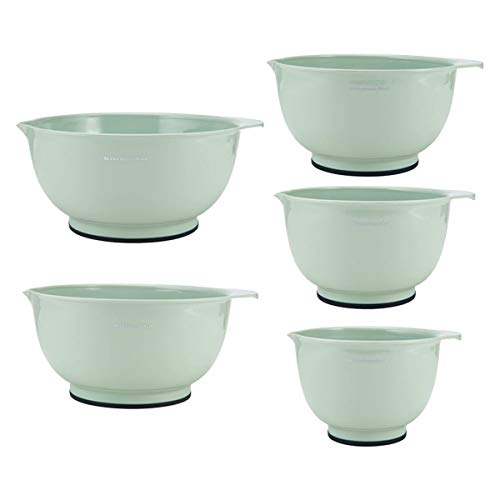
KitchenAid Classic Mixing Bowls, Set of 3
A handle and pour spout on these plastic bowls make moving batter into a tin noticeably cleaner. They stay put on the counter and skip the chill steel brings, which suits butter-based mixtures. Strongly colored ingredients like turmeric or tomato will stain them over time, and neither belongs near heat.
Pros
- Handle and spout make pouring clean
- Light enough for children to help
- Comfortable for hand mixing
Cons
- Stains from strongly colored ingredients
- Not suitable for heat of any kind

Anchor Hocking 3-Piece Glass Mixing Bowl Set
Three tempered glass bowls cover the sizes most recipes actually call for, with no lids and no extras. Keeping it simple lowers the cost while retaining glass advantages: heat tolerance, no staining, no reaction with acidic ingredients. Rims run chunkier than Pyrex’s, easier to grip though slightly less precise for pouring.
Pros
- Glass versatility at a lower cost
- Chunky rims are easy to grip
- No staining or flavor transfer
Cons
- No lids included
- Heavier than steel at the same capacity

FineDine Stainless Steel Mixing Bowls with Lids
Six bowls with lids cover everything from a single beaten egg to a full batch of bread dough, suiting anyone cooking several components at once. Capacity markings printed inside each bowl help when a recipe calls for volume rather than weight. Thinner steel than premium sets means these dent more easily, better suited to workhorse duty than heirloom status.
Pros
- Widest size range in this roundup
- Interior capacity markings
- Lids on every bowl
Cons
- Thinner steel dents more easily
- Six bowls plus lids take real cupboard space

Sweese 3-Piece Porcelain Mixing Bowl Set
Porcelain looks presentable enough to carry straight from counter to table, so a salad mixed here skips the transfer step. It holds temperature well, useful for proving dough in a warm kitchen, and stays entirely non-reactive. Weight runs heaviest in this roundup, and rims chip if knocked against a tap.
Pros
- Attractive enough to serve from
- Holds temperature well for proving
- Completely non-reactive
Cons
- Heaviest set in this roundup
- Rims chip if knocked
How they compare
| # | Model | Material | Best for | Score | Price |
|---|---|---|---|---|---|
| 1 | Pyrex Smart Essentials 8-Piece Mixing Bowl Set | Tempered glass | Best overall | 9.4 | Check price |
| 2 | OXO Good Grips 3-Piece Stainless Steel Mixing Bowl Set | Stainless steel | Best value | 9.2 | Check price |
| 3 | Cuisinart CTG-00-SMB Stainless Steel Mixing Bowls with Lids | Stainless steel | Best with lids | 9.0 | Check price |
| 4 | KitchenAid Classic Mixing Bowls, Set of 3 | Plastic with handle and spout | Best for everyday baking | 8.8 | Check price |
| 5 | Anchor Hocking 3-Piece Glass Mixing Bowl Set | Tempered glass | Best budget glass | 8.6 | Check price |
| 6 | FineDine Stainless Steel Mixing Bowls with Lids | Stainless steel | Best large set | 8.3 | Check price |
| 7 | Sweese 3-Piece Porcelain Mixing Bowl Set | Porcelain | Best for serving | 8.0 | Check price |
Common questions
Should I choose glass or stainless steel mixing bowls?
Choose glass for bowls that go in the oven and microwave and double as storage. Choose stainless steel for light, unbreakable bowls suited to daily mixing. Many kitchens use both, since each covers the other’s weakness.
Can I whip egg whites in a plastic bowl?
It gets harder, because plastic holds a fine film of fat that resists washing, and any fat keeps whites from reaching full volume. Stainless steel, glass or copper give more reliable results.
Are mixing bowls with lids worth buying?
Yes, if you prep ahead or rest dough in the fridge, since lids save transferring food to another container. Most lids are covers rather than airtight seals, so they do not replace proper storage containers.
What sizes of mixing bowl do you actually need?
A small bowl around one quart handles eggs and dressings, a medium around three quarts covers most batters, and a large five-quart-or-bigger bowl suits dough and multi-ingredient mixes. Anything beyond those three counts as convenience, not necessity.
Do stainless steel bowls affect the taste of food?
No. Stainless stays non-reactive, unlike aluminum or unlined copper, which can give acidic mixtures a metallic taste. Steel ranks among the safest materials for tomatoes, citrus and vinegar-based mixtures.
Can glass mixing bowls go straight from fridge to oven?
Not safely. Tempered glass tolerates heat but not sudden temperature change, and moving a cold bowl into a hot oven risks thermal shock. Let the bowl warm toward room temperature first.
How do you get stains out of plastic mixing bowls?
A paste of baking soda and water left on the stain often lifts it, and sunlight helps fade turmeric and tomato marks. Deep stains usually become permanent, which is why plastic bowls work best for dry ingredients.
Are silicone base rings dishwasher safe?
Generally yes, though water pools in the ring and needs tipping out afterward. Some owners remove the rings occasionally to clean underneath, where residue can collect over time.
Our pick
The Pyrex Smart Essentials set remains the most useful single purchase, since tempered glass mixes, bakes, reheats and stores without a second container. Add the OXO Good Grips stainless trio for light bowls with a base that stays still while whisking. Choose the Cuisinart CTG-00-SMB set when lids and make-ahead prep matter most.
Dana Whitfield
Dana spent eight years buying and merchandising for a regional kitchenware retailer before moving into editorial work. She has handled thousands of SKUs across cookware, small appliances and kitchen organization, and focuses on the practical differences that matter once a product is actually in daily use.


