Milk Pitchers Baristas Reach for When Latte Art Matters
Rattleware’s milk pitcher pours a controlled stream that suits learning basic latte art patterns. Motta’s version sharpens that spout further for intricate rosetta and tulip designs. Update International’s bell creamer covers basic frothing at a lower cost for anyone not yet pouring art.
Rattleware’s milk pitcher leads this list because its spout balances control and flow well enough for a beginner to practice basic latte art patterns without fighting the pour itself. Motta’s pitcher matters for anyone progressing past basic patterns, since its sharper, more tapered spout gives finer control over thin milk streams needed for detailed rosettas and tulips. Update International’s bell creamer solves a simpler need, covering reliable steaming and pouring for anyone not yet focused on decorative art at all.
A frothing pitcher needs to steam milk evenly and then pour it in a controlled stream thin enough to create latte art patterns on top of an espresso shot. We compared spout shape, capacity and handle grip across seven pitchers built for that two-part job.
Our top picks

Rattleware Stainless Steel Milk Pitcher
Rattleware shapes this pitcher’s spout to balance flow control with a forgiving margin of error, which suits someone still learning to pour basic hearts and simple rosettas. The 20 ounce capacity handles a standard latte’s worth of milk without needing a refill mid-steam. Its handle stays cool enough to hold throughout the steaming process on most home machines.
Pros
- Spout shape forgives minor pouring mistakes while learning
- 20oz capacity covers a standard latte without refilling
- Handle stays manageable during steaming
Cons
- Less precise than sharper-spouted pitchers for advanced patterns
- Capacity is more than needed for a single small cup

Motta Milk Pitcher
Motta tapers this pitcher’s spout more sharply than Rattleware’s, giving finer control over a thin milk stream once a barista has moved past basic hearts into more detailed patterns. That same sharp taper makes the pitcher slightly less forgiving for a true beginner still learning pour speed and angle. Capacity and handle design are otherwise comparable to other mid-size pitchers on this list.
Pros
- Sharp spout allows finer control for detailed patterns
- Well regarded among baristas practicing advanced pours
- Standard capacity suits most home latte sizes
Cons
- Less forgiving for a true beginner to latte art
- Requires practice to use the sharper spout effectively

Giannina Milk Pitcher
Giannina widens this pitcher’s base relative to its spout opening, giving it more stability on a steam wand during the vigorous whirlpool motion needed to texture milk evenly. The wider base also helps dissipate heat slightly more evenly during longer steaming sessions. Its spout performs adequately for latte art without matching Motta’s sharper precision.
Pros
- Wide base adds stability during steaming
- Handles longer steaming sessions evenly
- Reasonable pour control for most latte art
Cons
- Spout precision does not match sharper competitors
- Wider base takes up slightly more space near the steam wand
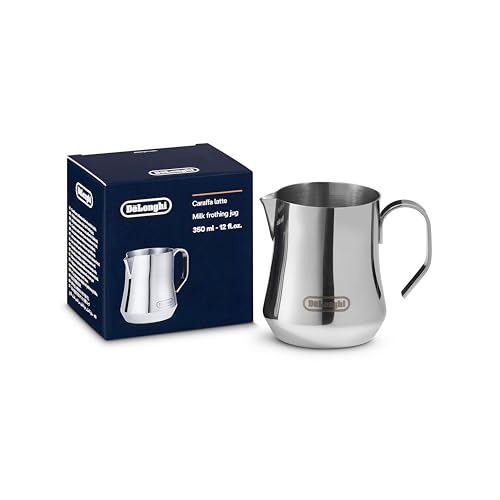
Barista Space Milk Pitcher
Barista Space sizes this pitcher smaller than most others on this list, suited to steaming just enough milk for a single cappuccino rather than a larger latte. The smaller volume also heats slightly faster during steaming, useful for a quick single drink. Its spout control is adequate for basic patterns but not matched to Motta’s precision for detailed work.
Pros
- Smaller size suits single-cup cappuccino portions
- Heats slightly faster due to lower milk volume
- Compact size stores easily near a machine
Cons
- Too small for a full latte without refilling
- Spout control is basic rather than precision-tuned

Breville Milk Jug
Breville includes measurement markings on this jug’s interior, helping a user pour a consistent milk volume before steaming each time rather than eyeballing the amount. Its size and spout are matched to fit comfortably under the brand’s own machines’ steam wands. It performs reasonably for basic latte art without the sharper precision of dedicated barista-brand pitchers.
Pros
- Interior markings help measure consistent milk volume
- Sized to fit comfortably under Breville steam wands
- Reliable for everyday basic latte art
Cons
- Spout precision falls short of dedicated barista brands
- Markings add little value for users who already measure by weight

Update International Bell Creamer Frothing Pitcher
Update International’s bell-shaped pitcher covers the basic steaming and pouring function at a price well below dedicated barista-brand options. It suits someone focused on texturing milk well rather than pouring decorative art on top. The bell shape handles the whirlpool motion during steaming reasonably, though less precisely than a tapered barista pitcher.
Pros
- Lower cost than dedicated barista-brand pitchers
- Bell shape handles steaming’s whirlpool motion adequately
- Suits anyone not yet focused on pouring decorative art
Cons
- Spout control is less precise than barista-focused pitchers
- Less refined finish than premium alternatives
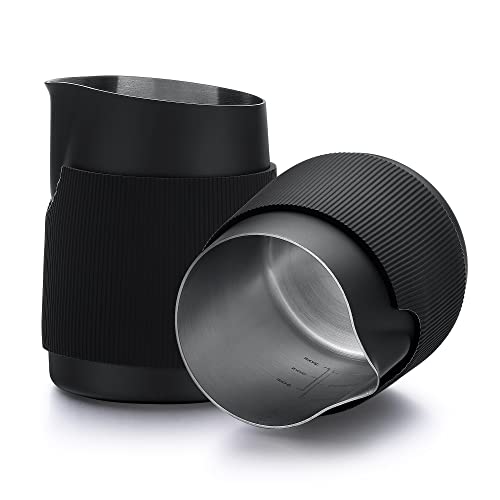
Normcore Precision Milk Pitcher
Normcore narrows this pitcher’s spout opening more than most competitors, giving a very controlled, thin stream suited to small, repeatable latte art pours. It comes in both 12oz and 20oz sizes, covering single cups and larger lattes with the same spout design. The narrow opening does slow down pouring speed compared to a wider spout.
Pros
- Narrow spout gives very controlled pour precision
- Available in two sizes with matching spout design
- Suits repeatable, consistent latte art practice
Cons
- Slower pour speed than wider-spouted pitchers
- Takes adjustment for users accustomed to a faster pour
The lineup, side by side
| # | Model | Material | Best for | Score | Price |
|---|---|---|---|---|---|
| 1 | Rattleware Stainless Steel Milk Pitcher | Stainless steel | Best overall for learning latte art | 9.0 | Check price |
| 2 | Motta Milk Pitcher | Stainless steel | Best for detailed rosetta and tulip patterns | 8.9 | Check price |
| 3 | Giannina Milk Pitcher | Stainless steel | Best for a wider base and steady steaming | 8.6 | Check price |
| 4 | Barista Space Milk Pitcher | Stainless steel | Best for a smaller single-cup capacity | 8.4 | Check price |
| 5 | Breville Milk Jug | Stainless steel | Best for pairing with Breville machines | 8.3 | Check price |
| 6 | Update International Bell Creamer Frothing Pitcher | Stainless steel | Best budget option for basic steaming | 8.0 | Check price |
| 7 | Normcore Precision Milk Pitcher | Stainless steel | Best for precise, repeatable small pours | 8.5 | Check price |
How to pick the right one
What a frothing pitcher’s spout actually controls A pitcher’s spout shape determines how thin and controlled the milk stream is during the pour, which directly affects whether a latte art pattern forms cleanly or spreads into a shapeless blob. Rattleware’s balanced spout gives a beginner enough control without being unforgiving, while Motta’s sharper taper rewards practiced technique with finer pattern detail. Spout shape matters more for the pour than it does for the steaming step itself, which depends more on technique and steam wand position.
Capacity and matching a pitcher to your typical drink A 12oz pitcher like Barista Space’s or the smaller Normcore option suits a single cappuccino, heating that smaller volume slightly faster than a larger pitcher would. A 20oz pitcher like Rattleware’s, Motta’s or Giannina’s handles a full latte’s milk volume without needing a refill partway through steaming. Buying a pitcher sized well below typical drink volume means refilling and re-steaming, which adds time and inconsistency to the process.
Base width and steaming stability A wider base, like Giannina’s, keeps a pitcher more stable on the steam wand during the vigorous whirlpool motion that textures milk into microfoam. A narrower base, common on more compact pitchers, can feel slightly less stable during aggressive steaming but takes up less space near the machine. Neither difference affects the final milk texture significantly, mainly the physical feel of holding the pitcher steady throughout steaming.
Measurement markings and consistent milk volume Breville’s jug prints measurement lines on the interior, helping a user pour the same milk volume before each steaming session rather than guessing by eye. Consistent starting volume matters because it affects how much the milk expands during steaming and how much is left to pour afterward. Pitchers without markings, like Motta’s or Rattleware’s, rely on a user’s own judgment or a kitchen scale for that same consistency.
Questions worth asking
What size milk pitcher is best for a single latte?
A 20 oz pitcher, like Rattleware’s or Motta’s, comfortably handles a single latte’s milk volume with enough room for steaming expansion.
Does spout shape really affect latte art?
Yes, a sharper, more tapered spout like Motta’s gives finer control over the milk stream, which matters for detailed patterns like rosettas.
Can a beginner use an advanced latte art pitcher?
Yes, though a more forgiving spout like Rattleware’s balanced design is generally easier to learn basic patterns with first.
Is stainless steel the best material for a frothing pitcher?
Yes, stainless steel conducts and retains heat evenly during steaming and resists dents and staining better than most alternatives.
What is the difference between a 12oz and 20oz pitcher?
A 12oz pitcher suits a single cappuccino’s smaller milk volume, while a 20oz pitcher handles a full latte without needing a refill.
Do measurement markings on a pitcher matter?
They help with consistent starting milk volume before steaming, though some users prefer weighing milk on a scale instead.
Can any milk pitcher be used for any espresso machine?
Yes, pitcher compatibility depends mainly on fitting comfortably under the steam wand, not on matching a specific machine brand.
Why does my milk pitcher’s handle get hot during steaming?
Handle heat buildup varies by design, with some pitchers insulating the handle better than others during longer steaming sessions.
How full should a milk pitcher be before steaming?
Filling to roughly a third of capacity leaves room for the milk to expand as it textures during steaming without overflowing.
Can a wide-based pitcher improve steaming consistency?
A wider base, like Giannina’s, adds stability during the whirlpool motion, though technique affects final texture more than base width.
The bottom line
Rattleware’s milk pitcher is the best overall starting point for learning latte art, since its balanced spout forgives early mistakes while still producing clean basic patterns. Baristas ready to move into detailed rosettas and tulips should upgrade to Motta’s sharper-spouted pitcher instead, which rewards practiced pour control with finer pattern detail. Anyone steaming just enough milk for a single cappuccino is better served by a smaller 12oz pitcher like Barista Space’s than by a 20oz pitcher sized for a larger drink.
Dana Whitfield
Dana spent eight years buying and merchandising for a regional kitchenware retailer before moving into editorial work. She has handled thousands of SKUs across cookware, small appliances and kitchen organization, and focuses on the practical differences that matter once a product is actually in daily use.


