Microfiber Towels That Won’t Scratch a Fresh Car Wax
The Rag Company Eagle Edgeless 500 suits buffing and general paint work best thanks to its edgeless construction. Adam’s Polishes Great White Drying Towel dries a whole car fastest. Zwipes Auto multipacks cover wheels and interiors cheaply, keeping grit away from towels that touch paint.
The Rag Company Eagle Edgeless 500 is the towel to buy for paint-safe buffing and general detailing work. Adam’s Polishes Great White Drying Towel dries a whole car faster than the rest. Zwipes Auto multipacks handle wheels, door jambs and interior surfaces sensibly.
Every microfiber pack claims to be scratch-free, yet a stitched polyester edge or a low-quality blend is exactly what puts fine marks into clear coat. GSM, weave and edge construction separate the towels that protect paint from the ones that mark it. We compared those factors along with owner reports after dozens of wash cycles to rank the seven below.
How to pick the right one
Does GSM weight tell you whether a towel is safe? GSM stands for grams per square meter and describes how dense and plush a towel feels. Higher GSM towels hold more water and product, and their longer pile carries missed grit away from the paint surface. None of that makes a towel automatically safe, since a heavy towel with a hard stitched edge can still mark a panel. Treat GSM as a guide to purpose, roughly 300 to 500 for buffing and detailing, higher for drying, then check the edge separately.
Why does the towel edge matter more than the GSM? A stitched polyester border sits harder than the microfiber around it, and it causes most fine marks on an otherwise decent towel. Laser-cut edgeless towels remove that problem entirely. Silk-banded edges land as a good middle ground between the two. Rough stitched towels already in a garage still work fine for wheels and interiors, so reserve edgeless towels for anything touching paint.
Should you use separate towels for different jobs? Wiping a panel with a towel that previously cleaned a wheel is the fastest way to ruin good paint, since brake dust embeds in the fibers and rarely washes fully out. Color coding solves this: one color for paint and glass, one for wheels and arches, one for interiors and engine bay. Storing and washing each group separately prevents more damage than any single towel upgrade could.
How should you wash microfiber to keep it working? Contamination kills microfiber long before wear does. Fabric softener and dryer sheets coat the fibers and destroy absorbency permanently, so skip both. Warm water with a dedicated microfiber detergent, or a plain liquid without additives, works best, followed by a low tumble dry or air drying. Washing microfiber only with other microfiber prevents cotton lint from clinging to it and later transferring onto paint.
The best picks, ranked

The Rag Company Eagle Edgeless 500 Microfiber Towel
Laser-cut borders remove the stitched polyester band that drags across paint on cheaper towels. Medium pile at 500 GSM suits wax removal, quick detailer work and general buffing without feeling too plush to control on a panel. Owners report this towel holds its loft through many wash cycles, where cheaper towels give out first.
Pros
- No stitched edge to mark clear coat
- Versatile weight for buffing and detailing
- Holds pile through repeated laundering
Cons
- Too small to dry a whole car efficiently
- Costs more per towel than bulk packs

Adam’s Polishes Great White Microfiber Drying Towel
A twisted loop weave holds a lot of water per square inch, covering a roof or bonnet in a single pass. That size difference separates drying a car in minutes from chasing water for half an hour. Owners report wringing it out just once partway through a full-size vehicle.
Pros
- Covers large panels in a single pass
- Very high water capacity per towel
- Cuts drying time on full size vehicles
Cons
- Bulky to wring out when saturated
- Too large for detail work and tight areas
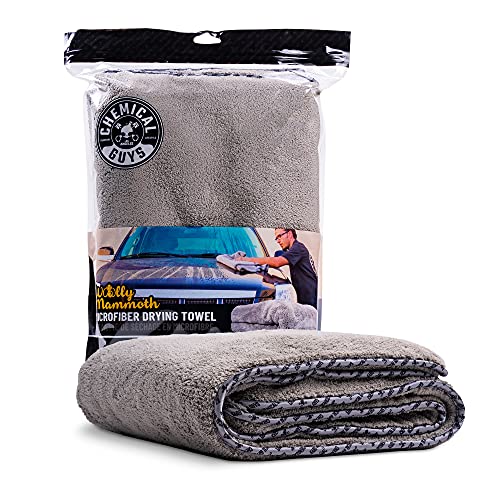
Chemical Guys Woolly Mammoth Microfiber Dryer Towel
A very deep pile lets the towel’s own weight do the work, so you glide rather than press. A silk-banded edge replaces the usual stitched border. Dark paint, where drying marks show up most, benefits most from this towel according to owner reports.
Pros
- Deep pile is very forgiving on dark paint
- Silk band is softer than stitched polyester
- Absorbs heavily without needing pressure
Cons
- Takes longer to dry between uses
- Sheds a little on the first few washes
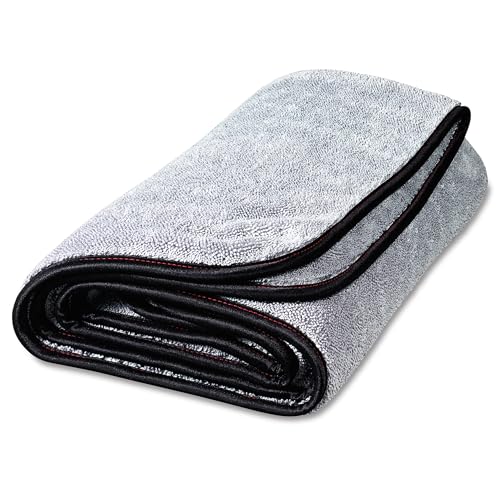
Griot’s Garage PFM Terry Weave Drying Towel
A dense terry weave holds enough water for trucks, vans and large SUVs before a standard towel would already be saturated. Wringing releases water readily, so the towel returns to service fast. Owners report it turned drying a full-size pickup into a one-towel job.
Pros
- Enough capacity for trucks and large SUVs
- Wrings out and returns to service quickly
- Dense weave resists matting
Cons
- Heavy when fully saturated
- Overkill for a small hatchback

Meguiar’s Supreme Shine Microfiber Towel
A plush pile lifts dried wax and sealant residue without smearing it back onto paint. Multipacks matter here since wax removal burns through towels quickly. Owners describe this towel as a reliable, easy-to-restock default rather than the best in any single category.
Pros
- Easy to restock from almost anywhere
- Plush enough for residue removal
- Good value in multipack form
Cons
- Stitched edge on some versions
- Pile flattens sooner than premium options
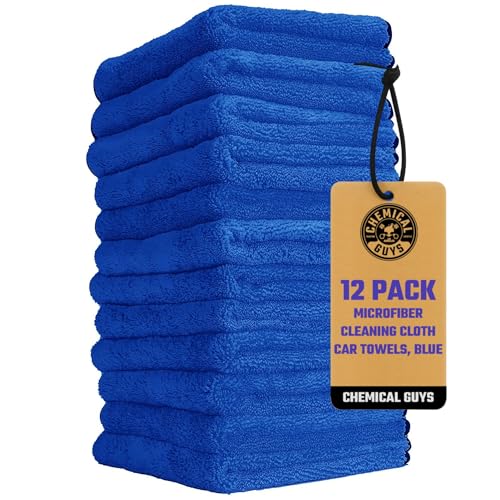
Chemical Guys Professional Grade Premium Microfiber Towels
Medium-weight towels in a large multipack are meant to be used freely and retired without regret. Color-coded packs keep wheel towels separate from paint towels at a glance. Owners treat these as the workhorse layer rather than the towel touching a freshly polished panel.
Pros
- Enough towels to separate tasks by colour
- Low cost per towel
- Good for jobs that ruin towels
Cons
- Stitched edges require care near paint
- Quality varies more than premium lines

Zwipes Auto Professional Microfiber Towels
A large budget multipack handles the jobs no one wants a premium towel for: wheels, arches, door shuts, engine bays and interior spills. Treating these as consumable keeps grit away from towels that touch paint. Owners report they hold up fine for dirty work once kept off clear coat.
Pros
- Cheap enough to treat as consumable
- Plenty of towels for dirty jobs
- Keeps grit away from paint towels
Cons
- Not paint safe once used on wheels
- Thinner pile absorbs less per towel
The lineup, side by side
| # | Model | Weight | Best for | Score | Price |
|---|---|---|---|---|---|
| 1 | The Rag Company Eagle Edgeless 500 Microfiber Towel | 500 GSM | Best overall | 9.4 | Check price |
| 2 | Adam’s Polishes Great White Microfiber Drying Towel | Twisted loop microfiber | Best for drying | 9.2 | Check price |
| 3 | Chemical Guys Woolly Mammoth Microfiber Dryer Towel | Deep pile microfiber | Best plush drying | 9.0 | Check price |
| 4 | Griot’s Garage PFM Terry Weave Drying Towel | Dense terry weave microfiber | Best for large vehicles | 8.8 | Check price |
| 5 | Meguiar’s Supreme Shine Microfiber Towel | Wax and sealant removal, general buffing | Best for wax removal | 8.6 | Check price |
| 6 | Chemical Guys Professional Grade Premium Microfiber Towels | Medium GSM general purpose | Best multipack value | 8.3 | Check price |
| 7 | Zwipes Auto Professional Microfiber Towels | Large bulk pack | Best budget | 8.0 | Check price |
Frequently asked questions
What GSM should I choose for drying a car?
Twisted loop or deep pile towels matter more than a specific GSM number for dedicated drying, since drying towels get measured differently. Total water capacity and size decide how fast a towel dries a car. A large twisted loop towel dries a saloon in one or two passes, while a 350 GSM general purpose towel saturates on a single panel.
Are edgeless towels really worth the extra cost?
Yes, for anything touching paint. A stitched border sits harder than the pile and causes most fine marks on a panel. Edgeless construction removes that risk entirely. Wheels, jambs and interiors do fine with standard stitched towels that cost far less.
Can I use the same towel for glass and paint?
You can, though a dedicated glass towel with a tighter waffle or low pile weave leaves fewer streaks. Product transfer is the bigger issue, since a towel that removed wax will smear residue onto glass. Setting aside one towel for glass only improves results immediately.
How do I wash microfiber towels correctly?
Wash them separately from cotton, in warm water, with a microfiber-specific detergent or a plain liquid free of softeners, brighteners or bleach. Fabric softener and dryer sheets ruin absorbency permanently, so skip both. Tumble dry on low heat, or hang them to dry instead.
How long should a microfiber towel last?
A good quality towel used on paint and washed correctly stays serviceable for well over a hundred cycles. Towels used on wheels and engine bays wear out much faster from embedded contamination. A towel that feels slick rather than grabby has coated or matted fibers and should get retired.
Why is my towel leaving lint on the paint?
Washing it with cotton items is the likely cause, since cotton sheds lint that clings to microfiber fibers. A brand new towel that has not been through its first wash can do the same thing. Washing new towels before first use, and keeping microfiber loads separate afterward, solves the problem.
Should I dry a car with a towel or a blower?
A blower removes any risk of touching the paint and works well on mirrors, grilles, badges and trim where water hides and drips later. Most people combine both: a blower for crevices, a large drying towel for flat panels. Gliding with the weight of the towel, rather than pressing down, matters if drying by hand alone.
Does a drying aid reduce the risk of marks?
Yes, meaningfully. A quick detailer or drying aid misted on a wet panel adds lubrication so the towel slides instead of dragging, cutting down on marring and water spots. Drying also goes faster since the water sheets off more easily. Sparing use, on a clean towel, gets the best result.
The Rag Company Eagle Edgeless 500 vs Adam’s Great White: which towel should I buy first?
Eagle Edgeless 500 suits buffing, wax removal and general paint contact best, since its laser-cut edge avoids marks. Great White suits whole-vehicle drying best, since its twisted loop holds far more water per pass. Most detailers eventually own both for different stages of the wash.
The verdict
The Rag Company Eagle Edgeless 500 is the towel to buy for anything touching paint, since its laser-cut edge removes the most common cause of fine marks. Adam’s Polishes Great White speeds up whole-vehicle drying. A bulk pack of Zwipes Auto keeps grit away from good towels by handling wheels and interiors instead.
Tony Russo
Tony trained as an automotive technician and spent years in service and parts retail before moving into writing. He focuses on garage tools, car care products and accessories from a hands-on maintenance perspective.
You might also need
How to Pick a Microfiber Towel That Won’t Scratch Paint
