Medicine Balls Built for Rotational Power Training
The Dynamax Medicine Ball leads this comparison for its soft shell that absorbs impact during slams and catches. Buyers wanting a bouncier ball for partner throws should consider the SPRI Dual Grip Medicine Ball instead, while the Yes4All Medicine Ball fits anyone training on a tighter budget.
The Dynamax Medicine Ball stands out because its soft, no-bounce shell absorbs rather than rebounds on impact, reducing the chance of an unpredictable bounce back toward the thrower. Its main limitation is price, since the specialized shell material costs more than basic rubber medicine balls.
We compared published shell material, bounce behavior, grip texture and weight range across each listing based on manufacturer specifications.
Before you buy
What to look for in a medicine ball Bounce behavior decides whether a ball suits slamming, wall throws or catch drills, since no-bounce, moderate and high-bounce shells behave very differently. Shell material and texture affect grip security during sweaty training sessions. Weight range and size determine how a ball feels during overhead throws versus seated core work.
Slamming versus throwing and catching No-bounce balls like the Dynamax Medicine Ball suit floor slams without an unpredictable rebound back at the thrower. Moderate-bounce balls like the SPRI Dual Grip or GoFit Pro work better for wall ball throws and partner catches. Higher-bounce balls like the ProsourceFit fit core twist and balance work more than aggressive slamming.
Choosing weight for your training level Beginners and rehabilitation work generally start lighter, within ranges covered by the ProsourceFit or Yes4All. Advanced athletes building rotational power need the wider weight range the Dynamax and Titan Fitness offer. Partner drills with a training buddy often use a moderate weight that both people can control safely.
Grip and durability for frequent use Textured shells, used on the SPRI, GoFit Pro and ProsourceFit, hold grip better than smooth shells when hands sweat during longer sessions. Reinforced rubber on the Titan Fitness resists cracking under frequent commercial gym use. Entry-level balls like the Amazon Basics option work for occasional use but may show wear sooner under daily heavy training.
The shortlist, ranked

Dynamax Medicine Ball
A dense foam core wrapped in a durable shell absorbs impact on slams rather than bouncing unpredictably, a safety advantage during fast partner drills. The larger diameter compared to rubber medicine balls makes it easier to catch during overhead throws. Weight is built into the shell, so the size stays large even at lighter weights.
Pros
- No-bounce shell improves safety during fast slam drills
- Larger diameter makes catching easier during throws
- Durable shell withstands repeated high-impact use
Cons
- Higher price than standard rubber medicine balls
- Larger size needs more storage space
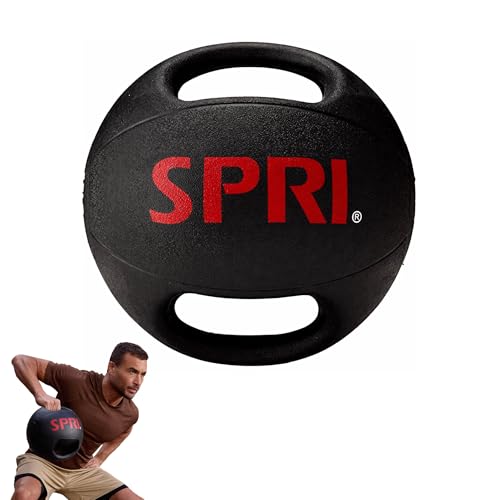
SPRI Dual Grip Medicine Ball
Molded handles on opposite sides aid two-handed throws and twisting movements that a smooth ball makes harder to control. A textured rubber shell keeps grip secure even with sweaty hands. It bounces more than a dedicated slam ball, which suits controlled catch drills but not aggressive slamming.
Pros
- Dual handles aid two-handed and rotational throws
- Textured shell maintains grip when hands sweat
- Moderate bounce suits controlled catch and throw drills
Cons
- Not designed for aggressive floor slamming like a dedicated slam ball
- Handles add bulk compared to a smooth round ball

GoFit Pro Medicine Ball
A grippy textured rubber shell holds up to repeated wall ball throws without slipping from sweaty palms. The moderate bounce returns the ball predictably off a wall, useful for solo training without a partner. Weight distribution stays even, avoiding the lopsided feel some budget balls develop over time.
Pros
- Textured shell maintains grip during repeated wall throws
- Even weight distribution avoids a lopsided feel
- Predictable bounce suits solo training without a partner
Cons
- Less suited to aggressive slamming than a no-bounce ball
- Standard weight range may not satisfy advanced athletes needing heavier options

Yes4All Medicine Ball
A basic rubber shell keeps the price accessible while covering a reasonable weight range for general conditioning. It bounces moderately, similar to mid-tier competitors, suiting catch and throw drills over slamming. Surface texture is lighter than premium textured shells, which can affect grip during sweaty sessions.
Pros
- Lower price than premium textured medicine balls
- Reasonable weight range for general conditioning
- Suitable for catch and throw style drills
Cons
- Lighter surface texture than premium grip-focused shells
- Not built for aggressive floor slamming

Titan Fitness Rubber Medicine Ball
Reinforced rubber construction holds up to repeated use in a commercial or home gym setting without cracking. A moderate bounce behaves predictably for wall throws and partner catches. The heavier-duty build adds slightly more cost than basic budget balls.
Pros
- Reinforced construction resists cracking under repeated use
- Predictable moderate bounce suits wall ball training
- Holds up well in shared gym environments
Cons
- Costs more than basic entry-level rubber balls
- Not designed specifically for no-bounce slam training

ProsourceFit Medicine Ball
A textured surface aids grip during seated core twists and balance exercises more than smooth-shell balls. Lighter weight options in the range suit rehabilitation or beginner conditioning work. The shell bounces more readily than a slam-focused ball, limiting use for aggressive floor drills.
Pros
- Textured grip aids core twist and balance exercises
- Lighter weight options suit beginners and rehabilitation
- Reasonable price for general conditioning use
Cons
- Noticeable bounce limits use for aggressive slam drills
- Heavier weight options are less available than lighter ones

Amazon Basics Medicine Ball
A no-frills rubber shell covers the basics for buyers just starting conditioning work without extra features. Weight range stays standard without the extended options some specialty brands offer. Grip texture is lighter than dedicated textured-shell competitors.
Pros
- Lowest price point among the medicine balls compared here
- Suitable for general beginner conditioning work
- Simple, no-frills design with no extra features to maintain
Cons
- Grip texture is lighter than dedicated textured-shell balls
- Limited weight range compared to specialty brands
Side by side
| # | Model | Shell material | Best for | Score | Price |
|---|---|---|---|---|---|
| 1 | Dynamax Medicine Ball | Reinforced foam and rubber blend | Best Overall for Slams and Catches | 9.1 | Check price |
| 2 | SPRI Dual Grip Medicine Ball | Textured rubber | Best for Partner Throws | 8.8 | Check price |
| 3 | GoFit Pro Medicine Ball | Textured rubber | Best for Wall Ball Exercises | 8.6 | Check price |
| 4 | Yes4All Medicine Ball | Rubber | Best Budget | 8.3 | Check price |
| 5 | Titan Fitness Rubber Medicine Ball | Reinforced rubber | Best for Gym Durability | 8.2 | Check price |
| 6 | ProsourceFit Medicine Ball | Textured rubber | Best for Core and Balance Work | 8.1 | Check price |
| 7 | Amazon Basics Medicine Ball | Rubber | Best Entry-Level Pick | 8.0 | Check price |
Good to know
What is the difference between a medicine ball and a slam ball?
A medicine ball like the Dynamax or SPRI often bounces at least somewhat and suits catches, while a dedicated slam ball absorbs impact with no bounce at all.
What weight medicine ball should a beginner use?
Beginners typically start in a lighter range, often under 10 pounds, before progressing to heavier balls as strength and control improve.
Can medicine balls be used for wall throws?
Yes, moderate-bounce balls like the GoFit Pro or SPRI Dual Grip are well suited to wall ball exercises that rely on a predictable rebound.
Is a no-bounce medicine ball safer than a bouncing one?
For floor slams, yes; a no-bounce ball like the Dynamax avoids the unpredictable rebound that a bouncing ball can send back toward the thrower.
Do medicine balls come in different sizes for the same weight?
Yes, shell material affects diameter, so a no-bounce ball like the Dynamax is often larger at the same weight than a dense rubber ball.
Can medicine balls be used for core exercises?
Yes, textured-grip balls like the ProsourceFit work well for seated twists, Russian twists and other rotational core movements.
How do you clean a medicine ball?
Wiping the shell with a damp cloth after sweaty sessions helps maintain grip texture and prevents buildup on rubber or textured surfaces.
What is a dual grip medicine ball used for?
Molded handles, like those on the SPRI Dual Grip, aid two-handed throws and rotational movements that a smooth round ball makes harder to control.
The bottom line
The Dynamax Medicine Ball is the best choice for athletes focused on floor slams and controlled catches. Buyers running partner throw drills should choose the SPRI Dual Grip Medicine Ball instead for its molded handles. Anyone training on a tighter budget still gets solid general use from the Yes4All Medicine Ball.
Derek Holt
Derek has a background coaching recreational and amateur athletes and has worked the sales floor at specialty fitness retailers. He focuses on equipment durability, ergonomics and realistic use cases rather than marketing claims.


