Magnifying lamps for soldering, sewing and reading
Brightech LightView Pro leads for general use, pairing a 5 inch glass lens with a weighted floor base that needs no clamp. Neatfi XL Bifocals pushes 1200 lumens for solder joints and component markings. LANCOSC covers a craft desk with three colour modes and USB power.
Brightech LightView Pro fits most homes. Its 3 diopter glass lens rides a weighted floor stand, so reading beside an armchair needs no table edge to grip. Light output stays modest next to bench lamps, which is the tradeoff. Anyone soldering or working fine needlework should take the Neatfi XL Bifocals and its 1200 lumens instead.
Magnification and lighting pull against each other, since a stronger lens shortens working distance and casts more shadow over the work. We compared diopter ratings, lens material and diameter, stated lumens, colour temperature settings and how each lamp mounts. Owner reports on gooseneck droop and edge distortion settled the close calls.
Before you buy
How diopter and magnification actually work Listings mix two numbers, and confusing them leads to buying the wrong lens. Diopter describes curvature, not power. To convert, divide the diopter by four and add one, so 3 diopter lands near 1.75x and 5 diopter reaches 2.25x. Stronger lenses shorten the working distance, which is why a 10 diopter lens hovers a few inches above the bench with no room for hands or an iron. Between 3 and 5 diopter covers almost every task at home.
Glass or acrylic, and why lens diameter matters Acrylic keeps a lamp light and cheap, which is why budget models use it. It also scratches from ordinary wiping and yellows after years under LEDs. Glass keeps its clarity and its optical shape, which is what you are paying for on the Brightech and Neatfi lamps. Diameter deserves a look as well: a 5 inch lens shows a useful field, while a 3 inch lens has you shuffling the work underneath every few seconds.
Best magnifying lamps for soldering and electronics Bench work needs light more than it needs power. Shadows thrown by your own hands cause most of the trouble, so a ring of LEDs beats a single sided shade. Neatfi XL Bifocals is the strongest here at 1200 lumens, with a bifocal insert for component markings. Clearance counts too, since a 3 diopter lens leaves roughly seven inches for an iron to move underneath. Save the very high diopter lenses for inspection you do with your hands out of the way.
Crafts, beauty work and reading Each of these pulls the choice in a different direction. Quilting, painting and beading live on colour accuracy, which favours the OttLite daylight spectrum and the three colour modes on the LANCOSC. Lash and brow technicians need an arm that will not drift during a two hour appointment, so the spring balanced Daylight Company Slimline earns its place. Reading asks the least of a lens, and a floor standing Brightech LightView Pro beside an armchair beats any clamp lamp for that.
The top picks, ranked
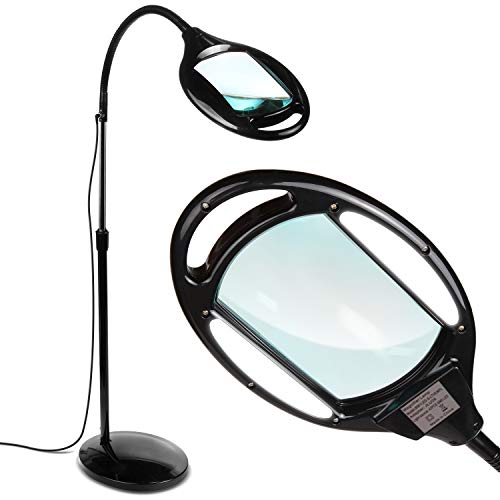
Brightech LightView Pro Magnifying Floor Lamp
A 5 inch glass lens at 3 diopter delivers roughly 1.75x, enough for reading, hemming and model work without the fishbowl edges stronger lenses produce. Glass shrugs off the scratching and yellowing that dull an acrylic lens inside a couple of years. Its weighted base and flexible gooseneck let the lamp stand beside a chair instead of clamping to furniture.
Pros
- Glass lens stays clear far longer than acrylic
- Free standing, so no table edge is required
- Gooseneck holds its position instead of sagging
Cons
- Output trails dedicated bench lamps
- Floor base eats space in a small room

Neatfi XL Bifocals 1,200 Lumens LED Magnifying Lamp
Sixty SMD LEDs ring the lens and produce 1200 lumens, which is the gap between seeing a solder joint and guessing at it. A bifocal insert sets a higher power window inside the main 1.75x field for reading component markings. Its clamp grips a bench a couple of inches thick, and the metal arm stays put rather than creeping downward.
Pros
- Brightest lamp here for soldering and inspection
- Bifocal window resolves the smallest detail
- Metal arm avoids the droop plastic arms develop
Cons
- Needs a bench edge to clamp onto
- Mains only, so it stays tethered to an outlet

LANCOSC Magnifying Glass with Light and Stand
Another 5 inch glass lens at 3 diopter, this time on a clamp arm with three colour modes and stepless dimming. Warm, neutral and cool settings matter more than buyers expect, because matching yarn or paint under a cold LED gives a misleading result. USB or mains power lets it sit mid table, away from any socket, running off a power bank.
Pros
- Three colour temperatures help with colour matching
- USB power frees it from outlet placement
- Clamp opens wide enough for a thick craft table
Cons
- Arm reach is shorter than bench specific models
- Clamp needs a flat edge, ruling out round tables

OttLite Dual Shade LED Magnifier Lamp
OttLite builds around a natural daylight spectrum, so thread, paint and fabric read closer to how they look outdoors. Its dual shade aims light down onto the work rather than back into your eyes, which cuts the glare that bounces off glossy surfaces. Magnification is moderate, making it a craft and reading lamp more than a component inspection tool.
Pros
- Colour rendering suits quilting, painting and beading
- Shade design tames reflected glare from glossy work
- Stands on a desk with no clamp needed
Cons
- Weaker magnification than bench inspection lamps
- Desk base occupies more surface than a clamp
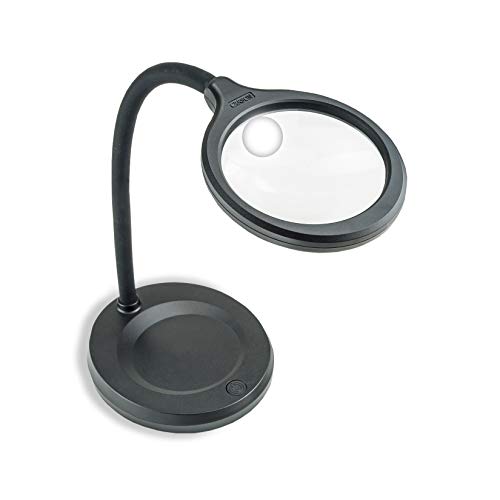
Carson DeskBrite200 LED Lighted 2x Magnifier
This one works as a desktop magnifier and lifts off as a handheld, carrying a 2x acrylic lens with a 4.5x spot inset for fine print. Batteries or the supplied adapter run it, making it the only genuinely portable pick in the group. Acrylic scratches far more easily than glass, so it belongs in a case rather than loose in a drawer.
Pros
- Only option here that runs without an outlet
- Folds flat for a bag or a drawer
- Inset spot lens reads tiny print and serial numbers
Cons
- Acrylic lens scratches and dulls over time
- Light output sits far below the bench lamps

Brightech LightView Pro 2 in 1 Magnifying Desk Lamp
Same 1.75x glass lens as the floor model, this time on an arm that either clamps to a desk edge or drops into a weighted base. That flexibility suits a shared workspace where the lamp migrates between a sewing table and a desk. Brightness and colour temperature both adjust, though peak output stays below the Neatfi.
Pros
- Converts between clamp and free standing use
- Glass lens matches the floor model for clarity
- Clamp mode frees up desk surface
Cons
- Arm reach falls short of the floor lamp
- Output lags behind dedicated inspection lamps

Daylight Company Slimline LED Magnifying Lamp
Spring balancing holds the lens exactly where you set it through a full shift, which is what separates salon and workshop lamps from home models. Optical quality shows at the edges, where distortion stays low across the viewing area. It clamps to a table or takes an optional floor stand, and the narrow head suits a crowded bench.
Pros
- Spring balanced arm holds position all day
- Low edge distortion across the lens
- Slim head fits between tools on a busy bench
Cons
- Floor stand is a separate purchase
- Fewer light settings than the consumer lamps
Side by side
| # | Model | Magnification | Best for | Score | Price |
|---|---|---|---|---|---|
| 1 | Brightech LightView Pro Magnifying Floor Lamp | 3 diopter, about 1.75x | Best overall | 9.4 | Check price |
| 2 | Neatfi XL Bifocals 1,200 Lumens LED Magnifying Lamp | 3 diopter main lens with bifocal insert | Best for detailed bench work | 9.2 | Check price |
| 3 | LANCOSC Magnifying Glass with Light and Stand | 3 diopter, about 1.75x | Best value | 9.0 | Check price |
| 4 | OttLite Dual Shade LED Magnifier Lamp | Integrated magnifier lens | Best for craft colour accuracy | 8.8 | Check price |
| 5 | Carson DeskBrite200 LED Lighted 2x Magnifier | 2x main lens, 4.5x inset spot | Best budget | 8.5 | Check price |
| 6 | Brightech LightView Pro 2 in 1 Magnifying Desk Lamp | 3 diopter, about 1.75x | Best for small desks | 8.2 | Check price |
| 7 | Daylight Company Slimline LED Magnifying Lamp | 3 diopter glass lens | Best for professional workstations | 8.0 | Check price |
Frequently asked questions
What magnification do you need in a magnifying lamp?
Three diopter, roughly 1.75x, handles reading, sewing and general crafts. Five diopter, near 2.25x, helps with small electronics and jewellery. Past eight diopter, the lens sits so close that hands and tools no longer fit underneath.
What does diopter mean on a magnifying lamp?
Diopter measures lens curvature rather than magnification itself. Divide by four and add one to convert, so 3 diopter works out near 1.75x. Listings that quote only a magnification figure are often describing a small acrylic lens with a narrow field.
Is a glass or acrylic magnifying lens better?
Glass, for anything used weekly. It resists scratching and holds its clarity under years of LED exposure. Acrylic, as used on the Carson DeskBrite200, keeps weight and cost down but goes hazy with handling.
Which magnifying lamp is best for soldering?
Neatfi XL Bifocals. Sixty LEDs arranged in a ring put 1200 lumens onto the joint and kill the hand shadow that makes a bad connection look fine. Its bifocal window also reads markings a single power lens blurs.
Can you use a magnifying lamp for eyelash extensions?
Yes, and technicians tend to prefer a spring balanced arm that holds still through a long appointment. Daylight Company Slimline fits that brief. A floor model works as well, so long as it reaches across the bed without constant nudging.
How many lumens should a magnifying lamp have?
Around 500 to 800 lumens keeps craft and reading work comfortable. Electronics and inspection want 1000 or more, which is why the Neatfi XL is rated at 1200. Dimming counts as much as peak output, since glare off glossy work tires the eyes fast.
Clamp or floor stand: which magnifying lamp mount is better?
Clamps save surface space and hold steadier, but they need a flat edge under about two inches thick. Floor stands work beside armchairs and round tables where nothing will grip. Brightech sells both patterns, and the 2 in 1 desk model switches between them.
How far above the work should a magnifying lamp sit?
Let the lens find its own focal distance, which runs near seven inches on a 3 diopter lens and shrinks as power rises. Move the work, not the lamp, once focus is sharp. Tilting the head slightly also pushes reflections off the lens surface.
Do magnifying lamps help with reading small print?
They do, especially with a wide lens that holds a full line of text in view. A 5 inch glass lens at 3 diopter suits books and paperwork without warping the edges. For a bottle label or a serial number, the Carson inset spot at 4.5x goes further.
The verdict
Brightech LightView Pro is the sensible default, since a 5 inch glass lens on a weighted floor base covers reading, sewing and model work without gripping any furniture. Anyone soldering, inspecting boards or doing fine needlework should buy the Neatfi XL Bifocals for its 1200 lumens and bifocal window. Colour critical crafters get more from the OttLite, whose daylight spectrum shows thread and paint much closer to how they look outside.
Dana Whitfield
Dana spent eight years buying and merchandising for a regional kitchenware retailer before moving into editorial work. She has handled thousands of SKUs across cookware, small appliances and kitchen organization, and focuses on the practical differences that matter once a product is actually in daily use.
You might also need

Vollum 8 Liter Insulated Beverage Dispenser Review: Does the Spigot Design Deliver?

JH JIEMEI HOME Ramen Bowl Set Review: Real Donburi Bowls or Just Pretty Glaze?

Breaking Bad Los Pollos Hermanos Apron Review: Fun Fan Gear, But How Functional?
