Best Macro Lens Picks for 1:1 and 2x Close-Ups
Canon RF 100mm f/2.8L Macro IS USM tops the list at 1.4x magnification, past the usual life size ceiling. Sony E mount owners get faster autofocus from the FE 90mm f/2.8 Macro G OSS. Nikon Z shooters gain working distance with the NIKKOR Z MC 105mm f/2.8 VR S.
Canon RF 100mm f/2.8L Macro IS USM suits RF shooters chasing frame filling detail, because 1.4x beats the 1:1 ceiling rivals stop at. Mount lock-in is the catch, since only Canon RF mirrorless bodies accept it. Sony, Nikon and multi mount alternatives follow below.
Two lenses can both wear the macro label and behave nothing alike. A 35mm design focuses 13 cm out; a 105mm lets you stand back and keep a dragonfly settled. We compared published magnification ratios, minimum focus distances, stabilisation ratings, weight and mount coverage. Owner reports on close range autofocus behaviour broke the ties.
How to choose
What to look for in a macro lens True macro means 1:1, where a 10 mm beetle projects 10 mm wide on the sensor. Labels reading 1:2 or 0.5x deliver half that. Working distance is a separate number, measured from the front element rather than the sensor plane. Subtract body and barrel from the Canon RF 100mm figure of 0.26 m and roughly 10 cm of air remains. Flat field correction is the third thing to check, since it keeps a stamp or circuit board sharp right into the corners.
Focal length decides how close you stand Short macro lenses focus within 16 cm of the sensor. Stamps, coins and circuit boards on a bench never object to that. What a 90mm or 105mm buys is the same 1:1 ratio from roughly three times further back. Extra room keeps your shadow off the subject and leaves space for a flash head and diffuser. Skip the 35mm and 50mm options if live insects are the plan.
Best macro lens for insects and garden flowers Skittish subjects reward reach, so start with the NIKKOR Z MC 105mm or the Sony FE 90mm. Stabilisation counts outdoors, where a tripod is rarely practical. Set a focus limiter when the lens has one, because a hunt through the full range loses the frame. Sigma 105mm owners usually pair it with an IBIS body for the same reason. Wind is the other enemy, and a diffused flash at 1/200 freezes petal movement that no stabiliser can touch.
Bench work: coins, product shots and flat copy Bench shooting flips the priorities. Tripods make stabilisation irrelevant, and a flat field matters more than autofocus speed. Laowa’s 2:1 design pays off on watch movements and solder joints, where 1:1 still frames too loose. For casual product listings, the Canon EF-S 35mm and its ring light stand in for a light tent. Focus stacking software then handles the millimetre depth of field that stopping down alone cannot fix.
The top picks, ranked

Canon RF 100mm f/2.8L Macro IS USM
Magnification runs to 1.4x, so a 10 mm beetle lands 14 mm wide on the sensor. A spherical aberration control ring shifts bokeh character in camera, which no rival macro lens offers. Stabilisation is rated at 5 stops alone, rising toward 8 stops on an EOS R body with IBIS.
Pros
- 1.4x reproduction exceeds the 1:1 standard
- SA ring reshapes background blur without filters
- Dual Nano USM focuses quietly enough for video
Cons
- Canon RF mirrorless bodies only, with no EF version
- At 730 g it tires the arms on long handheld sessions

Sony FE 90mm f/2.8 Macro G OSS
Sliding focus ring snaps between autofocus and manual, exposing a hard distance scale for repeatable focus racks. Internal focusing holds barrel length steady, so a flash bracket or diffuser stays aligned through the range. Optical SteadyShot earns its keep once you stop down to f/11 and the viewfinder dims.
Pros
- Corner sharpness holds up at life size
- Sliding ring gives instant manual override
- Barrel never extends toward the subject
Cons
- Autofocus hunts on low contrast subjects
- Focus motor predates Sony’s quicker G Master units
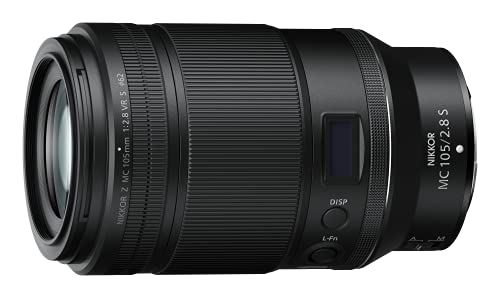
Nikon NIKKOR Z MC 105mm f/2.8 VR S
Fifteen extra millimetres over a 90mm buys visible breathing room in front of a nervous subject. An OLED panel on the barrel reads out live magnification and focus distance. VR is quoted at 4.5 stops, which counts most near the close focus limit where shake gets magnified too.
Pros
- 105 mm adds working distance for live subjects
- OLED readout confirms magnification at a glance
- Fluorine coating sheds water and fingerprints
Cons
- Z mount only, so F mount bodies miss out
- Front heavy balance on the compact Z models

Sigma 105mm f/2.8 DG DN Macro Art
One Art series design covers full frame on both Sony E and L mount. Controls beat most macro lenses: an aperture ring with a click switch, a three position focus limiter and an AF lock button. Nothing stabilises inside the barrel, so shake control falls entirely to the camera body.
Pros
- Declickable aperture ring suits video work
- Focus limiter cuts hunting at close range
- Dust and splash sealed at the mount
Cons
- No optical stabilisation inside the lens
- Stepping motor slows near minimum focus

Laowa 100mm f/2.8 2x Ultra Macro APO
Twice life size is territory other macro lenses reach only by stacking extension tubes. Apochromatic correction holds purple and green fringing down at 2:1, where simpler designs smear. Focusing is manual throughout, so budget for a tripod, a focus rail and slow deliberate framing.
Pros
- Reaches 2:1 without tubes or bellows
- APO glass controls longitudinal chromatic aberration
- Sold for Canon RF and EF, Sony E and Nikon Z
Cons
- Manual focus rules out moving subjects
- No stabilisation, so handheld hit rate drops

Nikon NIKKOR Z MC 50mm f/2.8
At 260 g this is the macro lens that actually leaves the house on a walk. Close focus of 0.16 m parks the front element near the subject, which makes lighting anything shiny awkward. Doubling as a normal prime on FX bodies makes it a reasonable single lens for a day out.
Pros
- 260 g carries all day on a small Z body
- Works as a standard 50 mm prime at normal distances
- On screen readout shows focus distance and magnification
Cons
- Short working distance spooks insects
- No vibration reduction built into the barrel

Canon EF-S 35mm f/2.8 Macro IS STM
An LED ring circles the front element and cancels the shadow short macro lenses cast on their own subject. Either half of the ring can fire alone for directional light across coins, stamps and solder joints. Coverage is APS-C, so it belongs on a Rebel, an 80D or a 90D.
Pros
- Built in LED ring lights subjects at 0.13 m
- 190 g balances on entry level DSLR bodies
- Hybrid IS corrects shift as well as angular shake
Cons
- APS-C image circle excludes full frame bodies
- 0.13 m focus distance leaves almost no working room
The lineup, side by side
| # | Model | Mount | Best for | Score | Price |
|---|---|---|---|---|---|
| 1 | Canon RF 100mm f/2.8L Macro IS USM | Canon RF, full frame | Best overall | 9.4 | Check price |
| 2 | Sony FE 90mm f/2.8 Macro G OSS | Sony E, full frame | Best for Sony E mount | 9.2 | Check price |
| 3 | Nikon NIKKOR Z MC 105mm f/2.8 VR S | Nikon Z, full frame | Best for Nikon Z bodies | 9.1 | Check price |
| 4 | Sigma 105mm f/2.8 DG DN Macro Art | Sony E and L mount | Best value | 8.9 | Check price |
| 5 | Laowa 100mm f/2.8 2x Ultra Macro APO | Canon RF and EF, Sony E, Nikon Z | Best for extreme magnification | 8.7 | Check price |
| 6 | Nikon NIKKOR Z MC 50mm f/2.8 | Nikon Z, FX and DX | Best lightweight option | 8.4 | Check price |
| 7 | Canon EF-S 35mm f/2.8 Macro IS STM | Canon EF-S, APS-C | Best budget pick | 8.0 | Check price |
Good to know
What is the best macro lens for beginners?
A native 90mm or 100mm is the safest first buy, since it hits 1:1 and still works as a portrait lens. Nikon Z owners can start lighter with the MC 50mm f/2.8 at 260 g.
Do you need 1:1 magnification for macro photography?
Flowers, food and jewellery usually fill the frame at 1:2. Insect eyes, fabric weave and electronics want full 1:1 or more, which is where the Laowa 2:1 design pulls ahead.
Which focal length is best, 50mm, 90mm or 105mm?
Choose 50mm for bench work and portability. Take 90mm for a balance of reach against weight. Go up to 105mm once subjects keep leaving before you finish framing.
Can extension tubes replace a macro lens?
Tubes push any lens closer for very little outlay. They also cost light, block infinity focus and soften corners on optics never designed for close range. Dedicated macro glass holds a flat field that no tube recreates.
Do macro lenses need image stabilisation?
Handheld field work benefits, and Canon quotes up to 8 stops for the RF 100mm on an IBIS body. Tripod shooting makes the feature redundant, which is why the Sigma 105mm leaves it out.
Sony FE 90mm vs Sigma 105mm, which is better?
Sony focuses faster and adds optical stabilisation. Sigma answers with an aperture ring, a focus limiter and 15 mm more reach. Video shooters lean Sigma, wildlife shooters lean Sony.
Are macro lenses good for portraits?
Yes, 90mm and 105mm macro lenses shoot sharp portraits at normal distances. Some photographers find the detail unflattering on skin, which a wider aperture or light retouching softens.
How much light do you need at 1:1?
Depth of field shrinks to millimetres, so most close-up work sits between f/8 and f/16. That demands flash, an LED panel, or the ring light built into the Canon EF-S 35mm.
Which macro lenses work on APS-C cameras?
Full frame designs mount on APS-C bodies and gain apparent reach from the crop. Going the other way fails: the EF-S 35mm projects too small an image circle for a full frame sensor.
The verdict
Canon RF 100mm f/2.8L Macro IS USM takes it on capability, since 1.4x and the SA control ring reach beyond anything else here, provided your camera wears an RF mount. Nikon Z owners should take the MC 105mm f/2.8 VR S for working distance, Sony owners the FE 90mm G OSS. Anyone photographing still subjects on a bench can drop to the MC 50mm or the ring lit EF-S 35mm and give up nothing that matters.
Marcus Chen
Marcus covered consumer electronics for enthusiast tech publications for six years before joining ChoiceCrest. He specializes in translating manufacturer spec sheets into plain-language buying advice, with a focus on audio, computing accessories and smart-home gear.


