How Light Can a Camping Lantern Get and Still Work?
Black Diamond Moji R+ gives the most usable light per ounce, at roughly 4 ounces and 100 lumens. Goal Zero Lighthouse Micro Flash weighs less and adds a flashlight beam. BioLite AlpenGlow 250 wins when a group needs one wide light over a table.
Black Diamond’s Moji R+ suits backpackers who want a single lantern for tent duty. It weighs about 4.1 ounces, pushes 100 lumens through a frosted globe, and hangs from a double hook. Output falls short across a full picnic table, so groups should size up.
Lumens mislead on their own. Headline output drains a battery in an hour, while a 20 lumen setting runs for days. We compared listed weights, maximum output, low-mode runtime, charging method and hang hardware. Owner feedback on cold-weather battery behaviour settled the close calls.
Before you buy
How to read lantern weight, lumens and runtime Divide listed lumens by listed ounces for a rough shortlist. Then set peak output aside, because tent lighting mostly happens between 10 and 30 lumens. Check whether a listing quotes runtime at maximum or minimum, since the gap often runs twenty to one. Hang hardware belongs in the same comparison. A lantern with no hook ends up propped on a boot, aimed at the tent wall.
Rechargeable, solar or AA: which power source? USB rechargeables stay lightest for weekend trips, and the Lighthouse Micro Flash folds its plug into the body. Solar hybrids such as the PackLite Max suit multi-day routes with open sky above. Sun alone needs most of a clear day for a full charge, so treat the panel as a top-up. AA lanterns like the Siege weigh more and never strand you, which keeps them in expedition and storm kits. Below freezing, lithium-ion capacity drops and disposable lithium AA cells gain ground.
Best lanterns for backpacking vs car camping Under 5 ounces marks the backpacking bracket, and both the Moji R+ and Lighthouse Micro Flash clear it. Car campers should buy spread instead of grams. AlpenGlow 250 lights faces around a table where a compact globe leaves them dark. Two mid-output lanterns beat one bright one for families, since a single source throws hard shadows across a cooking area. Paddlers have a different priority: the IPX7 rating on the Siege survives a capsized dry bag.
Details that matter once the sun goes down Warm colour temperature reads easier at low output and pulls in fewer insects than cold white. Diffusion beats raw lumens inside a tent, where a bare emitter sits at eye level. Red modes on the LR40 and the Siege let you find gear without resetting dark adaptation. Check hang geometry before you leave. Lanterns that tilt light the wall instead of the floor where your boots and stove sit.
Our top picks
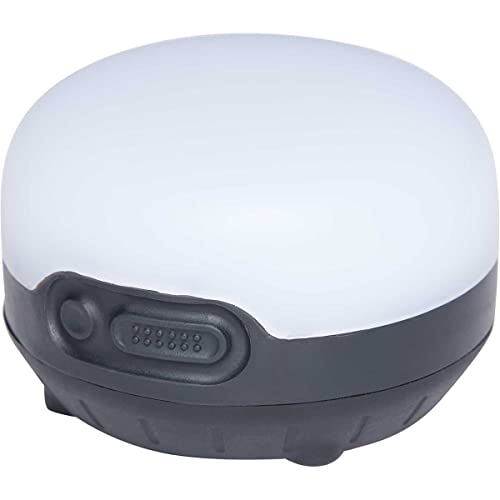
Black Diamond Moji R+ Lantern
Frosted globe spreads 100 lumens evenly, so nothing inside a two-person tent throws a hard shadow. Weight lands near 4.1 ounces with the cell installed. Its dimmer returns to the last level used, and a double hook loop takes either a tent ceiling loop or a pack strap.
Pros
- Frosted globe avoids glare at eye level
- Dimmer remembers the last setting
- Double hook fits tent loops and pack straps
Cons
- 100 lumens is thin for a group table
- Colour modes need the phone app

Goal Zero Lighthouse Micro Flash
Slim cylinder switches between a 150 lumen lantern glow and a directional beam from the end cap. At roughly 3.6 ounces it is the lightest pick in this group. A fold-out USB plug charges straight from a power bank, so no cable rides along.
Pros
- Fold-out plug removes the charging cable
- Beam mode replaces a backup flashlight
- Narrow body slides into a pack side pocket
Cons
- Tall shape tips over on uneven ground
- Plastic hang hook feels fragile under load

BioLite AlpenGlow 250
Fabric diffuser turns 250 lumens into a soft pool wide enough for a picnic table. Shake the body and colour modes cycle with no app involved. Its internal cell also feeds a phone over USB, though that pulls hours off lantern runtime.
Pros
- Diffused spread covers a full table
- Colour modes work without a phone
- USB output tops up a phone at camp
Cons
- Heavier than every backpacking pick here
- Charging a phone drains lantern runtime fast

LuminAID PackLite Max 2-in-1 Lantern
Inflatable cube collapses to about an inch thick and lies flat against a pack panel. Light leaves through the whole shell at 150 lumens, which reads softer than a single globe. Solar input is slow, so charge over USB before a trip and let sun handle top-ups.
Pros
- Packs flatter than any rigid lantern here
- Solar panel stretches trips past battery life
- Whole-shell glow removes a bright hotspot
Cons
- Full solar charge needs a day of direct sun
- Inflated shell punctures against sharp gear

Nitecore LR40 Camping Lantern
Puck-shaped body near 100 grams carries a 100 lumen white ring plus a separate red bank. Red mode keeps dark adaptation intact for stargazing or a late walk to the treeline. Charging runs over USB-C, and a magnetic base sticks to a vehicle panel or steel post.
Pros
- Red bank protects night vision
- USB-C matches other camp electronics
- Magnet holds it to steel without a hook
Cons
- Flat profile throws light down, not outward
- White output is modest for cooking tasks

Streamlight The Siege AA Lantern
Three AA cells run it, which matters on a week out with no charger in the pack. Peak output sits near 200 lumens, and a red night-vision mode comes built in. Pull the globe off and it works as a bare area light, while a base D-ring hangs it upside down in a tent.
Pros
- Spare cells work where no power exists
- IPX7 rating handles rain and brief submersion
- Base D-ring hangs it from a tent loop
Cons
- Loaded cells push weight above rechargeables
- Replacement batteries add cost over many trips

Vont LED Camping Lantern 2-Pack
Pull the body open and it lights; push it closed and it switches off. Each lantern runs on three AA cells inside impact-resistant plastic. Two per pack covers a tent and a table at once, though the light stays cold, flat and fixed at one brightness.
Pros
- Two lights cover tent and table together
- Pull-open action works wearing gloves
- Housing shrugs off drops onto rock
Cons
- No dimmer, so brightness is all or nothing
- Cold flat light feels harsh inside a tent
Side by side
| # | Model | Weight | Best for | Score | Price |
|---|---|---|---|---|---|
| 1 | Black Diamond Moji R+ Lantern | About 4.1 oz | Best overall | 9.4 | Check price |
| 2 | Goal Zero Lighthouse Micro Flash | Around 3.6 oz | Best ultralight | 9.2 | Check price |
| 3 | BioLite AlpenGlow 250 | 250 lumens max | Best for group camp tables | 9.0 | Check price |
| 4 | LuminAID PackLite Max 2-in-1 Lantern | 150 lumens max | Best solar and packable | 8.8 | Check price |
| 5 | Nitecore LR40 Camping Lantern | Around 100 g | Best for red-light and night use | 8.6 | Check price |
| 6 | Streamlight The Siege AA Lantern | 3 AA batteries | Best for long trips on AA batteries | 8.3 | Check price |
| 7 | Vont LED Camping Lantern 2-Pack | 3 AA batteries each | Best budget | 8.0 | Check price |
Questions worth asking
How many lumens do you need for a camping lantern?
Between 100 and 150 lumens covers a two-person tent and close-up tasks. Group cooking and picnic tables want 250 lumens or more behind a diffuser. Most of the night runs far below maximum, which is why low-mode runtime matters more than the headline figure.
What is the lightest camping lantern worth carrying?
Goal Zero Lighthouse Micro Flash at roughly 3.6 ounces is the lightest here, and it doubles as a flashlight. Moji R+ adds about half an ounce for a better hang loop and a smoother dimmer.
Rechargeable vs battery lanterns: which is better for camping?
Rechargeables save weight and running cost on weekend trips. AA lanterns such as the Streamlight Siege fit week-long routes, cold weather and emergency bins, where no outlet exists. Carry spare cells rather than a dead power bank.
Do solar camping lanterns actually work?
They top up rather than replace charging. PackLite Max needs many hours of direct sun to fill, so use the USB port before you leave. Overcast days give almost nothing back.
Can you use a camping lantern inside a tent?
Any LED lantern is safe inside a tent. Hang it from the ceiling loop and run it well below maximum, since a bright emitter at eye level is uncomfortable in a small space. Fuel-burning lanterns never belong inside.
Why do camping lanterns have a red light mode?
Red light preserves dark adaptation, so you can read a map or find a stove without losing night vision. Insects respond to it less than to cold white. Nitecore LR40 and the Siege both include one.
How long does a lightweight lantern last on one charge?
Expect a few hours at maximum output. Listed runtimes stretch into dozens of hours on the low settings people actually use in a tent. Confirm which figure a listing quotes before comparing two models.
Which camping lantern is best for backpacking under 5 ounces?
Moji R+ at about 4.1 ounces and Lighthouse Micro Flash at about 3.6 ounces both fit. Choose the Moji for even tent light, or the Goal Zero if a flashlight beam saves you carrying a second light.
Are camping lanterns waterproof enough for rain?
Most handle spray and light rain. IPX7 on the Streamlight Siege goes further and survives brief submersion. Inflatable and fabric-shaded models like PackLite Max and AlpenGlow 250 prefer a vestibule to open weather.
Is a headlamp enough, or do you need a lantern too?
A headlamp handles tasks but blinds whoever you look at. Lanterns give shared, diffuse light for cooking and cards. Many campers carry both, hanging the lantern and saving the headlamp for moving around.
Our take
Take the Black Diamond Moji R+ if one lantern has to cover tent duty on foot. Gram counters should choose the Goal Zero Lighthouse Micro Flash instead, since it drops half an ounce and replaces a backup flashlight. Groups eating outside want the BioLite AlpenGlow 250, where spread and diffusion beat four ounces of savings once several people share a table.
Derek Holt
Derek has a background coaching recreational and amateur athletes and has worked the sales floor at specialty fitness retailers. He focuses on equipment durability, ergonomics and realistic use cases rather than marketing claims.
You might also need
Lightweight Camping Mattresses That Pack Small and Sleep Big

Lightweight Football Gear That Still Protects Players

Lightweight Foldable Camping Mattresses for Comfortable Nights Outdoors