Lens Filter Kit Picks for UV, Polariser and ND
K&F Concept’s 67mm UV, CPL and ND4 kit fits most hybrid shooters, pairing multi coated glass with slim brass rings. Urth’s 67mm set swaps in a three stop ND8 for daylight portraits. Tiffen’s 58mm Photo Essentials kit covers protection and warming glass inside a hard wallet.
K&F Concept’s 67mm UV, CPL and ND4 kit suits photographers who want protection, glare control and a mild daylight light cut in one box. Coating on both glass faces holds ghosting down when you shoot into the sun. Its ND4 stops at two stops, so blurring a waterfall at noon still needs denser glass.
Kits hide their differences in small print. Thread diameter, coating count, ring depth and frame metal all change what reaches the sensor. We compared published optical specs, thread sizes and reported colour casts, then weighed owner feedback on binding rings, corner darkening and case durability.
How to pick the right one
What to look for in a lens filter kit Coating count sets flare resistance, and eight layers or more handles backlight without ghost blobs. Frame depth comes next, since a thick ring eats into corners on lenses wider than 24mm. Brass threads bind less often than aluminium once you start stacking. Match ND strength to the work you actually do. Two stops does nothing for daytime water blur, while ten stops is far too dense for casual shooting.
How to match filter thread size to your lenses Filter diameter is printed on the lens barrel after a circle with a line through it. Buy for your largest thread first, then add step up rings for the smaller lenses. A 67mm kit plus two rings usually covers 49mm through 62mm glass. Step down rings work the other way and pull corners dark, so leave them alone. Owners of kit zooms report that 58mm and 67mm cover most of the bag.
Best filters for landscape and long exposure Polarisers do work that no editing can copy. Reflections lift off wet rock, and sky deepens at 90 degrees from the sun. Pair one with six or ten stops of ND to smooth surf and cloud. Denser glass brings a colour cast, so shoot raw, correct one frame, then copy that profile across the set. Gobe’s three density kit fits this branch better than any UV and CPL bundle.
What video shooters need instead Fixed NDs force a stop and restart every time cloud cover moves. A variable ND with hard stops avoids that, which is why PolarPro’s ring suits run and gun filming despite its five stop ceiling. Drop the UV filter for video work. On a modern coated lens it adds one more reflective surface, and a hood already shields the front element. Indoor only shooters can skip ND entirely and buy a polariser alone.
The top picks, ranked

K&F Concept 67mm UV CPL ND4 Lens Filter Kit
Three filters handle the jobs that repeat on almost every shoot: front element protection, reflection control and a two stop light cut. Coating sits on both faces of each element, so backlit frames pick up less ghosting than single coated budget glass. Brass rings thread smoothly and resist galling after repeated stacking.
Pros
- Slim brass rings keep corners clean on 24mm zooms
- Coating on both faces holds ghosting down in backlight
- Threads release cleanly after long stacking sessions
Cons
- Two stops of ND will not blur moving water at midday
- Polariser ring turns stiffly until it breaks in
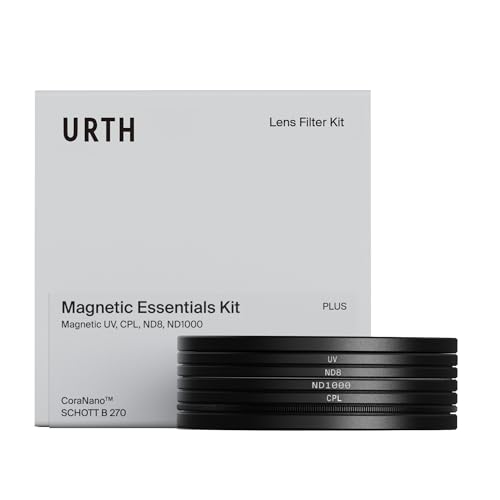
Urth 67mm UV, CPL and ND8 Lens Filter Kit
Urth replaces the usual weak ND with a three stop ND8, enough to hold f1.8 in open daylight. Japanese optical glass carries 20 coating layers, and owners report neutral rendering rather than a warm tint. A folding fabric wrap keeps all three filters flat in a jacket pocket.
Pros
- ND8 keeps fast primes wide open in bright sun
- Neutral colour leaves white balance largely alone
- Fold wrap packs flatter than a hard filter case
Cons
- Fabric wrap offers little crush protection in a bag
- Aluminium rings scuff sooner than brass

Tiffen 58mm Photo Essentials Filter Kit
Tiffen grinds its glass in the United States and pairs a UV protector with an 812 warming filter and a circular polariser. Warming glass lifts skin tones on grey days when faces look flat. Nothing in this box cuts enough light for long exposure work, so read it as a protection and colour set.
Pros
- Hard four pocket wallet guards glass better than a pouch
- 812 warming filter helps portraits under overcast skies
- Stocked widely in other thread sizes for a second lens
Cons
- No neutral density filter at any strength
- Standard depth rings can darken corners below 24mm

Hoya NXT Plus 67mm 3 Piece Filter Kit
Ten coating layers finish with a water repellent top coat, so rain and sea spray bead instead of smearing. Owners report very little warm cast across the set, which saves batch correction after a shoot. Aluminium frames keep weight low on compact mirrorless primes.
Pros
- Top coat sheds spray and wipes clean in one pass
- Colour shift stays minimal across UV, CPL and ND8
- Light frames suit small mirrorless lenses and gimbals
Cons
- Aluminium threads can seize when overtightened
- Supplied pouch holds the three filters loosely
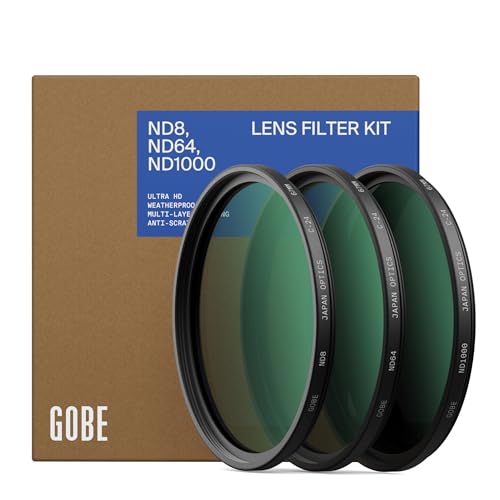
Gobe 3Peak 67mm ND Filter Kit
Gobe skips protection glass entirely and supplies three densities at three, six and ten stops. That spread covers dusk surf through to midday cloud movement without stacking two filters. Magnalium rings stay rigid yet weigh less than brass on a long telephoto barrel.
Pros
- Ten stop glass allows minute long exposures in daylight
- Stepped densities remove the need to stack filters
- Magnalium rings resist bending after a knock
Cons
- ND1000 leaves a cast that needs correcting in raw
- No UV or polariser, so it works poorly as a first kit

PolarPro Peter McKinnon Variable ND Edition II
One ring spans two to five stops and replaces a pouch of fixed densities. Physical hard stops at each end block the cross pattern that spoils footage past a variable filter’s limit. Fused quartz glass holds detail at wide apertures where cheaper VND glass smears.
Pros
- Hard stops keep the X pattern out of footage
- Step up rings fit 67mm and 77mm lenses as well
- Exposure changes take one hand mid take
Cons
- Deep 82mm frame needs a matching larger lens cap
- Single filter, so protection and polarising need separate glass
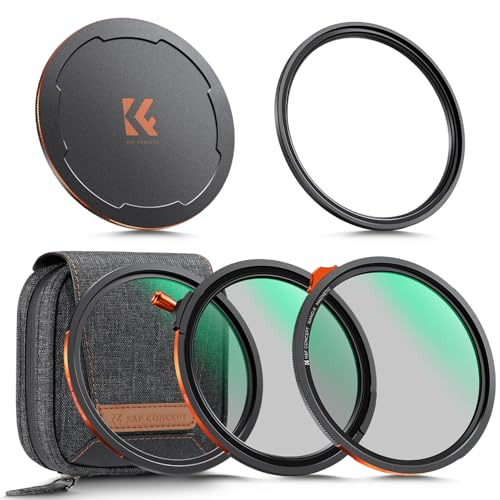
Neewer 67mm Magnetic Filter Kit
A threaded base ring stays on the lens and each filter snaps onto it magnetically. Going from polariser to ten stop ND takes about a second when the light shifts. Magnets grip firmly in still air, though a lanyard makes sense on a windy cliff edge.
Pros
- Swaps take roughly a second with gloves on
- Stacking pouch keeps the set together on a belt
- Base ring removes any cross threading risk
Cons
- Every lens needs its own matching base ring
- Taller magnetic stack can vignette on ultra wide glass
Side by side
| # | Model | Kit contents | Best for | Score | Price |
|---|---|---|---|---|---|
| 1 | K&F Concept 67mm UV CPL ND4 Lens Filter Kit | UV, CPL, ND4 | Best overall | 9.4 | Check price |
| 2 | Urth 67mm UV, CPL and ND8 Lens Filter Kit | UV, CPL, ND8 | Best value | 9.2 | Check price |
| 3 | Tiffen 58mm Photo Essentials Filter Kit | UV Protector, 812 Warming, Circular Polariser | Best budget | 9.0 | Check price |
| 4 | Hoya NXT Plus 67mm 3 Piece Filter Kit | UV, CPL, ND8 | Best for colour accuracy | 8.8 | Check price |
| 5 | Gobe 3Peak 67mm ND Filter Kit | ND8, ND64, ND1000 | Best for long exposure | 8.6 | Check price |
| 6 | PolarPro Peter McKinnon Variable ND Edition II | Variable ND, 2 to 5 stops | Best for video | 8.3 | Check price |
| 7 | Neewer 67mm Magnetic Filter Kit | Magnetic UV, CPL, ND1000 | Best for fast swaps | 8.0 | Check price |
Common questions
What filters come in a lens filter kit?
Most kits pair a UV or clear protector, a circular polariser and one neutral density filter. Cheaper sets swap the ND for a warming or fluorescent correction filter. Landscape specific kits drop the protection glass and supply three ND strengths instead.
Do UV filters reduce image quality?
On well coated glass the loss is hard to see in normal daylight. Point an uncoated filter at a streetlight or the sun and ghost blobs appear across the frame. Night photographers often pull protection glass off for exactly that reason.
Which filter thread size should I buy?
Read the number printed after the diameter symbol on your lens barrel or inside the cap. Buy the kit for your widest thread, then fit step up rings on the smaller lenses. One kit plus rings covers a whole bag without duplicate glass.
Is a circular polariser worth it for beginners?
Yes, because glare on water, foliage and shop windows cannot be removed later in editing. Rotate the ring while watching the viewfinder and stop at the strongest effect. Expect to lose roughly one and a half stops of light, so raise ISO indoors.
Can you stack two filters without vignetting?
Two slim filters normally stack safely from 35mm upward. At 16mm to 24mm even one thick ring darkens the corners. Magnetic sets swap faster but sit taller, so test at your widest focal length before a shoot.
ND8 vs ND1000: what is the difference?
ND8 cuts three stops and keeps a fast lens wide open in daylight. ND1000 cuts ten stops and turns a 1/30 second shutter into roughly 30 seconds. ND64 sits in between and suits moving water at golden hour.
Are magnetic filter kits better than screw in filters?
Magnets win on swap speed and rule out cross threading. Screw in glass sits flatter, fits any lens with the right thread and needs no adapter ring. Photographers changing filters every few minutes gain most from a magnetic set.
Which lens filter kit is best for landscape photography?
Look for a polariser plus at least six stops of ND, which the Gobe three density set covers on its own. Add a separate CPL if the kit includes none. Slim frames matter here because landscape work leans on wide focal lengths.
How should filters be cleaned and stored?
Blow grit off first, then work a microfibre cloth outward from the centre with a drop of lens fluid. Store glass in a hard wallet rather than loose in a bag pocket. Water repellent coatings such as Hoya’s shed spray and need less rubbing.
Final word
K&F Concept’s 67mm UV, CPL and ND4 kit answers the widest set of everyday needs, with coated brass framed glass that stays invisible in the picture. Landscape shooters chasing silky water should pass on it and take Gobe’s three density ND set. Anyone filming rather than shooting stills gets far more from PolarPro’s variable ND than from any three filter bundle.
Marcus Chen
Marcus covered consumer electronics for enthusiast tech publications for six years before joining ChoiceCrest. He specializes in translating manufacturer spec sheets into plain-language buying advice, with a focus on audio, computing accessories and smart-home gear.


