Large Capacity Compost Tumblers That Fit Small Gardens
The FCMP Outdoor IM4000 Tumbling Composter is our top pick for small gardens that need large capacity. It holds 37 gallons yet fits in tight spaces, and its dual-chamber design lets you compost continuously. Some owners note that assembly requires careful attention, but the sturdy build and easy turning make it worth the effort.
Composting in a small garden doesn’t mean you have to settle for a tiny bin. Large-capacity tumblers let you process more kitchen scraps and yard waste without taking up much room. The right model turns frequently to speed up decomposition and keeps pests out.
We evaluated popular tumblers with capacities from 30 to 50 gallons. We considered their footprint, ease of turning, material quality, and whether they can handle a steady stream of organic waste. Here are the top performers for compact spaces.
Our top picks

FCMP Outdoor IM4000 Tumbling Composter
This dual-chamber tumbler holds 37 gallons and rotates on a sturdy frame. Its two doors make loading and unloading easy, and the powder-coated steel resists rust. Owners report that it turns well even when full, though assembly can be tricky.
Pros
- Dual chambers allow continuous composting
- Steel frame is sturdy and weather-resistant
- Easy to turn with a crank handle
Cons
- Assembly can be challenging
- Sliding doors may jam if overfilled
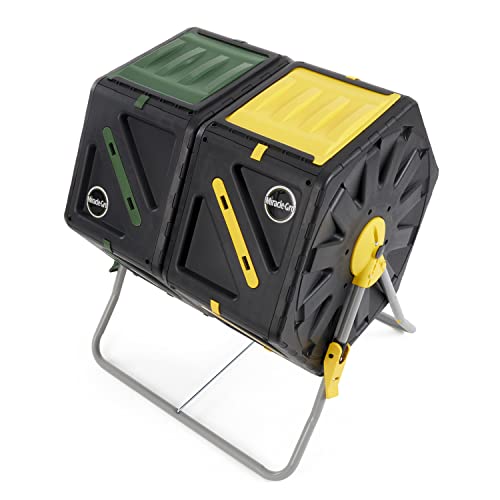
Miracle-Gro Small Composter Tumbler
Despite its name, this tumbler holds 35 gallons, making it a large-capacity option for compact spaces. It features a single chamber and a stable frame. Owners appreciate its lightweight design, but some note that the plastic may become brittle over time.
Pros
- Affordable price point
- Lightweight and easy to move
- Large opening for easy loading
Cons
- Plastic may crack in freezing temperatures
- Single chamber means you must wait for compost to finish

Lifetime 75 Gallon Dual Chamber Compost Tumbler
This tumbler offers a massive 75-gallon capacity split into two chambers, yet its vertical design occupies minimal ground space. It features a heavy-duty steel frame and UV-protected polyethylene drums. Users report smooth rotation and high-quality construction, but it requires a bit more effort to turn when full.
Pros
- Huge capacity yet compact footprint
- Durable materials resist UV and weather
- Dual chambers for continuous composting
Cons
- Heavy when full, harder to turn
- Taller design may be less stable on windy days
Yimby Tumbler Composter
The Yimby Tumbler features a unique dual-chamber design with a crank handle that makes turning effortless. It holds 37 gallons and sits on a sturdy frame with wheels for portability. Owners love how easy it is to use, though the plastic may not be as durable as steel.
Pros
- Crank handle reduces turning effort
- Two chambers speed up composting
- Wheels make it easy to reposition
Cons
- Plastic drum may fade over time
- Some plastic parts may feel less sturdy

Vivosun 43 Gallon Tumbling Composter
Vivosun offers a 43-gallon dual-chamber composter that balances capacity and price. It is made from galvanized steel with a rust-resistant finish. Users report that it performs well, but the turning mechanism may require occasional lubrication.
Pros
- Large capacity at a reasonable price
- Rust-resistant galvanized steel
- Dual chambers for continuous use
Cons
- Crank can be stiff at first
- Doors may warp if overfilled

Redmon 65 Gallon Compost Tumbler
The Redmon 65-gallon tumbler offers a single large chamber at a budget-friendly price. It features a powder-coated steel frame and a locking lid. Owners say it holds a lot, but its single chamber means you must compost in batches.
Pros
- Very large capacity for the price
- Simple, robust design
- Easy to load and unload
Cons
- Single chamber delays new additions
- Bulky footprint may not suit very tight spaces
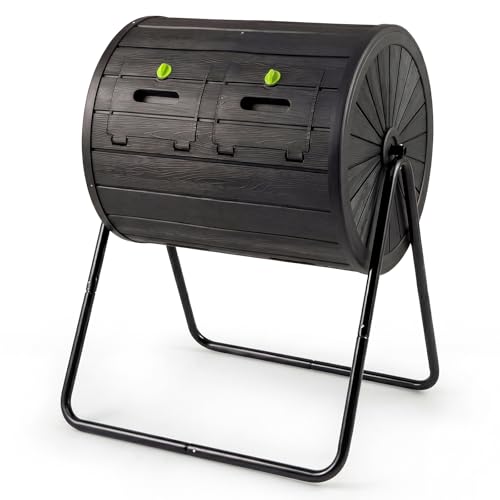
Goplus 37 Gallon Dual Chamber Compost Tumbler
The Goplus 37-gallon tumbler provides two chambers at an entry-level price. It is made of steel with a black powder coat finish. Users find it functional and cost-effective, though some report the frame could be sturdier.
Pros
- Dual chambers for continuous composting
- Low cost
- Easy to turn with crank
Cons
- Frame may flex under heavy loads
- Plastic drum can scratch easily
What to look for
Compared at a glance
| # | Model | Capacity | Best for | Score | Price |
|---|---|---|---|---|---|
| 1 | FCMP Outdoor IM4000 Tumbling Composter | 37 gallons (two chambers) | Best overall for small gardens | 9.4 | Check price |
| 2 | Miracle-Gro Small Composter Tumbler | 35 gallons | Best budget pick for small gardens | 8.2 | Check price |
| 3 | Lifetime 75 Gallon Dual Chamber Compost Tumbler | 75 gallons (two chambers) | Best for maximum capacity in a small footprint | 9.0 | Check price |
| 4 | Yimby Tumbler Composter | 37 gallons (two chambers) | Best for easy turning and minimal effort | 8.8 | Check price |
| 5 | Vivosun 43 Gallon Tumbling Composter | 43 gallons (two chambers) | Best for value with large capacity | 8.5 | Check price |
| 6 | Redmon 65 Gallon Compost Tumbler | 65 gallons | Best for budget-conscious with high capacity | 8.0 | Check price |
| 7 | Goplus 37 Gallon Dual Chamber Compost Tumbler | 37 gallons (two chambers) | Best for small budgets with dual chambers | 8.1 | Check price |
Questions worth asking
How much compost can a large tumbler produce?
A 37-gallon tumbler can produce about 5 to 10 gallons of finished compost every few weeks, depending on your mix and how often you turn it. Larger 75-gallon models yield more but take up similar space.
Is a large tumbler too heavy to turn when full?
It can be heavy, but most tumblers are designed to be rotated when full. Look for models with a crank handle or a balanced drum. Some owners add a brick or weight to help rotation, but that is not recommended.
Can I put weeds and diseased plants in a compost tumbler?
A tumbler that heats up can kill weed seeds and pathogens. However, if the compost does not reach high temperatures, they may survive. It is safer to avoid diseased plants and persistent weeds.
How often should I turn my compost tumbler?
You should turn it every 2 to 3 days to aerate the pile. Some gardeners turn daily for faster results. The more often you turn, the quicker the compost breaks down.
Do compost tumblers smell?
When balanced correctly with browns and greens, they should not smell. If it smells, add more dry materials like leaves or cardboard. Turn the tumbler to mix and aerate.
Can I use worms in a compost tumbler?
Tumblers are not ideal for worms because they get disturbed by tumbling. Worms prefer a static bin. If you want vermicomposting, use a separate worm bin.
How long does it take to make compost in a tumbler?
With regular turning, you can get compost in 3 to 6 months. Some models with dual chambers allow you to harvest one side while the other continues, speeding up the overall process.
Where should I place my compost tumbler?
Place it in a spot with partial sun to help heat the pile, but not too much direct sun that dries it out. Ensure you have easy access for loading and turning. Also, keep it away from wooden structures to avoid staining.
Are compost tumblers rodent-proof?
Most tumblers are elevated and sealed, which deters rodents. However, if you have a severe rodent problem, you may need additional precautions like a wire mesh base.
Can I compost in winter with a tumbler?
Yes, you can, but decomposition slows down in cold weather. Insulating the tumbler or moving it to a warmer spot can help. Keep adding materials and turn occasionally.
Our pick
For most small gardens, the FCMP Outdoor IM4000 is the best balance of capacity, durability, and ease of use. If you have a slightly larger budget and want the biggest capacity, choose the Lifetime 75 Gallon. For those on a tight budget, the Miracle-Gro or Goplus offer good value, but be prepared for a shorter lifespan.
Sierra Daniels
Sierra's background is in landscape design and nursery retail. She focuses on lawn and garden equipment, outdoor furniture and gear durability, weighing published specs against how materials actually hold up outside.